Home
» Today
»
Flash Flood Warning: What It Means and What to Do Immediately | Nov. 6, 2026
Flash Flood Warning: What It Means and What to Do Immediately | Nov. 6, 2026
Last checked: November 6, 2026, 1:08:44 p.m. UTC.
A Flash Flood Warning from the National Weather Service (NWS) means flash flooding is happening, is imminent, or is highly likely in the warned area. Treat it as an instruction to act now: move to higher ground, follow any evacuation directions, and stay out of floodwater. Do not wait until you see water rising, and never drive or walk through a flooded road.
Highlights
Warning means take action: dangerous, fast-developing flooding is occurring or expected soon.
Get to higher ground: leave low-lying places promptly when your route is safe, and follow local evacuation orders.
Keep out of floodwater: just 6 inches of fast-moving water can knock an adult off their feet.
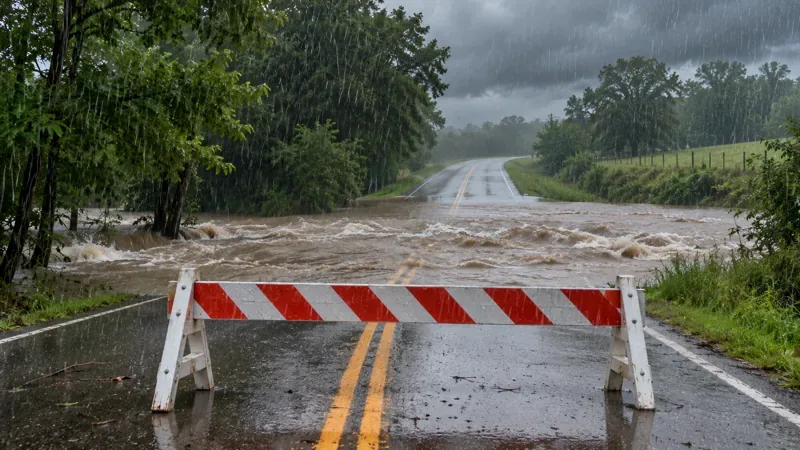
Turn around, don’t drown: water can hide a washed-out road and can sweep vehicles away.
Illustration: Floodwater covers a road behind a barricade. It does not depict a specific warning or location.
What does a Flash Flood Warning mean?
The NWS issues a Flash Flood Warning when flash flooding is in progress, imminent, or highly likely. A flash flood is a sudden rise of water that can develop in minutes to hours, often after intense rain, a dam or levee failure, or other rapid water release. It can occur even where rain is not falling at that moment, because water may rush downstream from heavy rain elsewhere.
A warning applies to a defined area and time period; it does not mean every home in that area will flood. Still, the message signals an urgent threat to life or property. Read the full alert for the named locations, timing, and instructions. If emergency managers tell your area to evacuate, leave immediately by a safe route. Do not wait for a second message or try to protect belongings first.
For an active alert, check the National Weather Service forecast and warning page for your location and follow directions from local emergency management. This article is general preparedness guidance, not a live report about a particular community.
How is a warning different from a watch or advisory?
The NWS uses different messages to show how urgent the flood threat is:
Flash Flood Watch — Be Prepared: conditions are favorable for flash flooding, but flooding is not certain. Review your plan, keep alerts on, and be ready to move.
Flash Flood Warning — Take Action: flash flooding is occurring, imminent, or highly likely. Move to safety and follow official instructions immediately.
Flood Advisory — Be Aware: flooding may cause inconvenience or create hazardous conditions. Use caution, avoid water-covered roads, and be ready to respond if conditions worsen.
These messages are not interchangeable. A watch is time to prepare; a warning is time to act. The NWS explains the distinctions in its flood watch, warning, and advisory guide.
What should you do when a Flash Flood Warning is issued?
Move to higher ground immediately if you are in a flood-prone or low-lying place. Choose a route away from creeks, drainage channels, riverbanks, underpasses, and dips in the road. Do not cross moving water on foot, even if it looks shallow. Water can hide holes, debris, open manholes, damaged pavement, or electrical hazards.
If you are indoors, go to a higher floor of a sturdy building when flooding threatens and evacuation is no longer safe. Do not enter a closed attic where rising water could trap you. If you become trapped, call 911 if you can and signal rescuers from the highest safe point. If authorities issue an evacuation order, use the designated route and do not return until officials say it is safe.
Keep receiving updates through Wireless Emergency Alerts on a compatible phone, NOAA Weather Radio, local radio or television, and official county or city emergency channels. The warning message may be updated or replaced as conditions change. Check its expiration time and later alerts, but do not treat an expired message as proof that roads or buildings are safe; rely on current official guidance.
Is it safe to drive or walk through floodwater?
No. Turn around and choose another route. Never drive around a barricade or enter a flooded roadway, even in a large vehicle. The road surface may have washed away, and darkness or muddy water can make depth impossible to judge. The NWS says 6 inches of fast-moving water can knock an adult down, 12 inches can carry away most cars, and 2 feet can sweep away SUVs and trucks.
If a vehicle is already trapped in rapidly moving water, do not step into the current. NWS safety guidance says to stay in the vehicle; if water begins rising inside, move to the roof if you can do so safely and call 911. If water has gathered around a stopped vehicle but is not moving, get to higher ground only if you can exit without entering dangerous water. For more detail, see the NWS Turn Around, Don’t Drown® guidance.
What should you do after floodwater recedes?
Wait for local officials to say an area is safe before returning or driving through it. Floodwater may leave unstable roads, contaminated debris, downed power lines, and damaged buildings behind. Do not touch electrical equipment or wires that are wet or submerged. Avoid entering a building if you smell gas, see structural damage, or hear electrical buzzing; report hazards to emergency services or the utility company. Follow public health advice about drinking water and cleanup, and keep children and pets away from standing water.
Does a Flash Flood Warning mean flooding is already at my home?
Not necessarily. It means flooding is occurring, imminent, or highly likely somewhere in the warned area. Check the alert’s location details and act promptly if you are in a vulnerable place.
Should I wait for water to reach the road before leaving?
No. If officials order an evacuation, leave immediately by a safe route. If you are in a flood-prone area, move to higher ground as soon as the warning makes that action necessary; do not wait for rising water.
Can I cross a flooded road if the water looks shallow?
No. Depth and road damage are hard to judge, and even shallow, fast-moving water can be dangerous. Turn around and find another route.