Home
» Today
»
GLP-1 Drugs: Side Effects, NHS Access, and Patient Guidance (November 2026)
GLP-1 Drugs: Side Effects, NHS Access, and Patient Guidance (November 2026)
Last checked: November 24, 2026, 12:07 a.m. Greenwich Mean Time (GMT, UTC+00:00).
GLP-1 medicines can help manage type 2 diabetes and, for certain patients, obesity or related health risks. Their practical trade-off is that nausea, vomiting, diarrhea, and constipation are common, while rare but serious problems require urgent attention. In England, NHS access to weight-management injections is determined by clinical criteria and a phased rollout; a medicine being licensed does not mean every eligible person can get it immediately.
No single new UK announcement was confirmed in the official material checked for this article. The guidance below reflects current NHS, NICE, and Medicines and Healthcare products Regulatory Agency (MHRA) information reviewed on November 24, 2026. The NHS access details describe England; arrangements can differ across the UK.
Highlights
Expect possible stomach and bowel symptoms, especially when treatment starts or the dose increases.
Persistent severe abdominal pain, sudden vision loss, or signs of a severe allergic reaction need urgent medical help.
NHS weight-management access is not automatic: eligibility, local service capacity, and the medicine’s specific indication matter.
Use only a prescription from a qualified clinician and a registered pharmacy; do not stop, switch, or change a dose without medical advice.
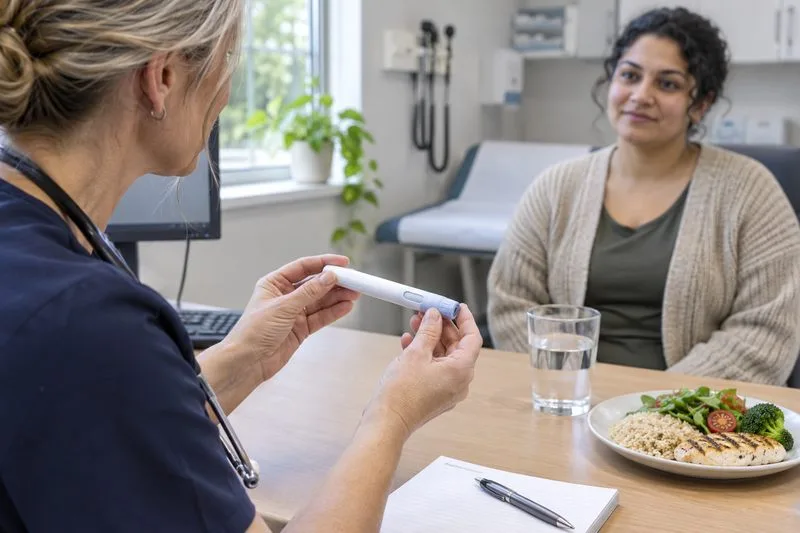
A patient reviewing medicine information at home; this illustrative image does not depict a specific product or treatment.
What side effects can GLP-1 medicines cause?
For semaglutide and tirzepatide, NHS medicine information lists nausea, vomiting, constipation, diarrhea, tiredness, and injection-site irritation among common effects. Tirzepatide information also lists stomach pain. Hair loss is reported as a possible side effect. These medicines slow stomach emptying and can reduce appetite, so meal size and pace may feel different. Symptoms can be more noticeable when treatment begins or a clinician increases the dose.
If symptoms are mild, keep track of when they happen and whether they follow meals or a dose change. Smaller meals and regular fluids may be easier to tolerate, but follow any fluid limits you have been given. Contact your prescriber or pharmacist if symptoms are troublesome, persist, or make it hard to eat or drink. Do not increase, reduce, or repeat a dose on your own. Dehydration from ongoing vomiting or diarrhea can become serious.
Which warning signs need urgent attention?
Severe, persistent pain in the abdomen, sometimes spreading to the back and accompanied by nausea or vomiting, can be a sign of pancreatitis. In January 2026, the MHRA strengthened warnings after rare reports of severe, including necrotizing and fatal, cases. Seek urgent medical attention for this symptom. NHS guidance also identifies gallstones or gallbladder inflammation as possible serious effects with tirzepatide, and low blood sugar as a concern, particularly when a GLP-1 medicine is combined with insulin or certain diabetes medicines.
Call 999 for a life-threatening emergency, such as breathing difficulty or swelling of the throat or tongue. For suspected serious side effects that are not immediately life-threatening, contact NHS 111 or your treating team. Semaglutide has also been very rarely associated with sudden loss of vision in one eye; sudden visual changes should be assessed urgently. Report suspected medicine reactions through the MHRA’s Yellow Card scheme.
Can you get GLP-1 medicines on the NHS in the UK?
Some GLP-1 medicines are available by prescription for type 2 diabetes, with the choice depending on a person’s clinical circumstances and current guidance. Brand and indication matter: Ozempic and Rybelsus contain semaglutide and are used for diabetes; Wegovy is the semaglutide brand licensed for weight management, and Mounjaro (tirzepatide) has uses for diabetes and weight management. A prescription for one purpose is not interchangeable with another brand or purpose.
For weight management in England, NICE recommends semaglutide (Wegovy) for eligible patients through specialist weight-management services, alongside a reduced-calorie diet and increased physical activity. NICE sets BMI and health criteria, including adjusted thresholds for some ethnic backgrounds, and treatment is time-limited under the guidance. Tirzepatide (Mounjaro) has a different NHS implementation route. NICE recommends it for certain adults with obesity and weight-related health conditions, but NHS England is introducing primary-care access in phases, prioritizing people with the highest clinical need. In the initial cohorts, eligibility considers BMI and a specified set of conditions such as hypertension, abnormal blood lipids, sleep apnea, cardiovascular disease, and type 2 diabetes. Local integrated care board arrangements and clinical assessment apply.
These are England-specific implementation details, not a guarantee of an individual prescription. NHS availability in Scotland, Wales, and Northern Ireland may follow different arrangements. Ask your GP or specialist service what applies where you live and whether you can be assessed. A treatment being licensed or recommended by NICE does not mean it is suitable for everyone or immediately available through every local service. For current England information, see NHS England’s weight-management injection guidance and NICE guidance on tirzepatide.
What should patients check before starting treatment?
Share your full medication list. Tell the prescriber about insulin, other diabetes medicines, blood thinners, supplements, and any previous pancreatitis or gallbladder problems.
Discuss pregnancy and contraception. These medicines should not be used during pregnancy or breastfeeding. The MHRA advises stopping semaglutide at least two months and tirzepatide at least one month before trying to become pregnant. Tirzepatide may reduce the reliability of oral contraception for four weeks after starting and after each dose increase; ask a clinician about additional protection.
Tell the surgical team. Before an operation, deep sedation, or a procedure requiring anesthesia, tell the clinician and anesthetist that you take a GLP-1 medicine. Do not stop it unless your care team tells you to.
Check the supply. Private prescriptions still require a proper clinical assessment. Buy only from a registered pharmacy and avoid social-media sellers, beauty salons, and unregulated products. The MHRA warns that counterfeit products can be dangerous.
For anyone considering treatment, the next practical step is a conversation with a GP, diabetes team, or specialist weight-management service. Bring your medication list, relevant medical history, and questions about follow-up, side effects, and what happens if treatment is paused or stopped. Do not abruptly stop a prescribed medicine: blood glucose may be affected, and a clinician can help plan a safe change.
Frequently asked questions
Are nausea and constipation normal with GLP-1 medicines?
They are common reported side effects. Contact a pharmacist or prescriber if they are severe, persistent, or prevent you from keeping fluids down.
Can I buy weight-loss injections online without a prescription?
No. UK GLP-1 medicines are prescription-only. Use a qualified prescriber and a registered pharmacy; avoid unregulated sellers.
Does NICE approval mean I can get a weight-loss injection on the NHS now?
No. Eligibility and access depend on the medicine, clinical criteria, local service, and phased rollout—especially for tirzepatide in England.