Home
» Today
»
Golden Retriever Dog Guide: Care, Training, Health, and Realistic Costs
Golden Retriever Dog Guide: Care, Training, Health, and Realistic Costs
A Golden Retriever can look wonderfully easy to live with: friendly face, soft coat, eager personality, and a reputation for being highly trainable. The real-world problem appears a few weeks after bringing one home. The puppy is chewing, shedding, jumping on guests, demanding exercise, and growing fast; the adult dog may become bored or overweight if daily routines slip. None of that means the breed is a poor choice. It means Golden Retrievers do best when their care is structured rather than improvised.
This guide starts with the simplest fixes that prevent most day-to-day problems, then moves into training, grooming, health planning, and costs. Breed averages are useful, but every dog is an individual. A veterinarian should guide medical decisions, nutrition for special conditions, vaccination timing, and any plan for a dog with pain, illness, or unusual behavior.
Start with the basics: what a Golden Retriever needs every day
Golden Retrievers are active sporting dogs, not decorative couch dogs. The American Kennel Club describes them as intelligent, social, trainable dogs that benefit from daily physical activity and mental engagement. Most adults fall roughly in the 55–75 pound range, and a typical lifespan is about 10–12 years. Those numbers are useful for planning food, equipment, transportation, and long-term care, but they are not targets every individual must match.
The easiest way to prevent many behavior problems is to make the day predictable. Build a routine around meals, bathroom breaks, exercise, short training sessions, rest, and social time. A fenced yard can be convenient, but the Golden Retriever Club of America notes that a yard does not replace active exercise with people. Goldens usually want interaction, retrieving games, walking, swimming, scent work, and other shared activities.
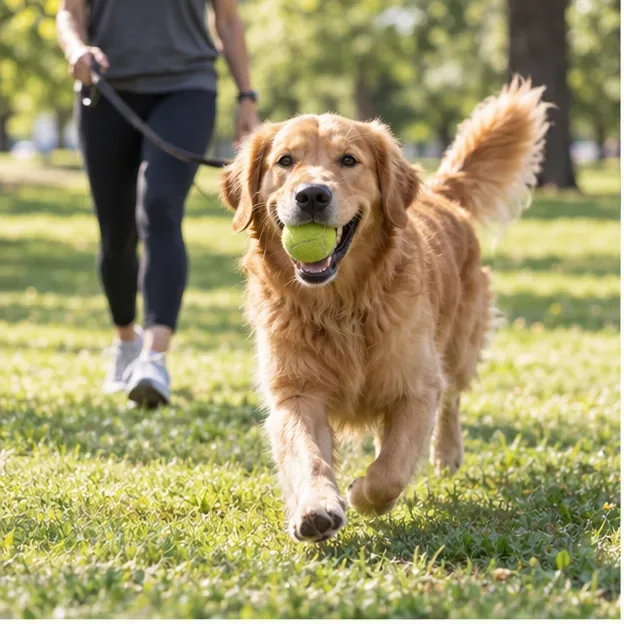
An adult Golden Retriever carrying a ball during outdoor exercise. Daily activity is easier to sustain when it includes games the dog genuinely enjoys.
How much exercise is enough?
There is no single correct number of minutes for every Golden Retriever. Age, joint health, temperature, conditioning, and personality matter. Puppies need frequent play and exploration, but high-impact repetitive exercise should be increased gradually as they grow. Healthy adults usually need meaningful activity every day, while seniors may benefit from shorter, more frequent outings.
Use walks for both movement and sniffing, not just distance.
Add retrieving, swimming, hiking, or structured play when appropriate.
Include mental work such as food puzzles, search games, and obedience practice.
Reduce intensity if your dog is limping, lagging, overheating, or taking unusually long to recover.
A good practical test is behavior after the activity. A well-exercised Golden should be able to settle at home. If the dog remains frantic, destructive, or constantly demands stimulation, consider whether exercise, enrichment, sleep, or training structure is missing.
Training: solve the easy problems before they become habits
Golden Retrievers are often described as easy to train because they tend to be people-oriented and food- or toy-motivated. That does not mean training happens automatically. A friendly, enthusiastic 65-pound adolescent can still pull hard, jump, steal food, or ignore recall if those behaviors have been rehearsed for months.
Begin with a small set of skills that make daily life safer: name response, sit, down, come, leave it, drop it, loose-leash walking, handling for grooming, and settling on a mat. Keep sessions short and reward the behavior you want. For puppies, early socialization should expose them gradually and positively to people, sounds, surfaces, vehicles, veterinary handling, and calm dogs rather than simply flooding them with stimulation.
A Golden Retriever puppy focuses on a food reward during a short home training session. Frequent, low-pressure practice is easier to repeat than occasional marathon sessions.
A simple training order
Reward attention. Teach the dog that checking in with you pays.
Build impulse control. Practice waiting briefly at doors, before meals, and before greeting people.
Train recall indoors first. Add distance and distractions gradually.
Teach loose-leash walking in easy environments. Busy streets and dog-filled parks are advanced settings.
Practice calm handling. Touch paws, ears, mouth, tail, and body so grooming and veterinary exams are less stressful.
If progress stalls, make the task easier before increasing rewards or corrections. Distance, distractions, duration, and excitement level are all variables. Professional group classes can also be useful because they let the dog practice around controlled distractions while the owner learns timing and technique.
Grooming and coat care: plan for shedding, not against it
The Golden Retriever's double coat sheds year-round and typically more heavily during seasonal coat changes. AKC grooming guidance recommends regular brushing, with more frequent brushing during heavy shedding. The coat is functional and should not be routinely shaved simply to reduce hair around the house.
Routine brushing removes loose coat and gives the owner a chance to notice skin changes, tangles, or new lumps early.
For many household Goldens, brushing once or twice a week is a workable baseline, increasing to daily during heavy shedding. Check feathering behind the ears, legs, chest, and tail for mats. Nails should be kept short enough that they do not alter footing or snag. Ears deserve special attention after swimming because moisture can contribute to irritation or infection.
Dental care is easy to postpone because the teeth may look fine for years. AKC grooming guidance recommends regular tooth brushing and notes that several sessions per week can help reduce buildup. Use dog-specific toothpaste, not human toothpaste. Ask your veterinarian whether professional dental cleaning is needed based on the dog's oral exam.
Feeding and body condition: keep a Golden lean
One of the most useful health habits is also one of the least glamorous: keep the dog at a healthy body condition. The Golden Retriever Club of America emphasizes slow, steady growth in puppies and avoiding excess weight. Extra weight increases mechanical stress on joints and can make exercise harder.
Choose a complete diet appropriate for the dog's life stage, measure portions rather than free-pouring food, and count training treats as part of the daily intake. The correct amount depends on the food's calorie density, age, activity, reproductive status, and individual metabolism. If your Golden gains or loses weight unexpectedly, do not simply make large food changes without considering health causes.
Use your hands as well as the scale: you should be able to feel the ribs without pressing through a thick layer of fat, and there should be a visible waist from above in a healthy dog. Your veterinarian can assign a formal body-condition score and help adjust intake.
Health: what Golden Retriever owners should watch and screen for
Golden Retrievers can live active, comfortable lives, but the breed has known inherited health concerns. For people buying a puppy, one of the most practical protections is verifying health testing in the parents rather than relying on statements such as “vet checked.” The Golden Retriever Club of America specifically highlights screening of hips, elbows, eyes, and heart in breeding dogs, with results ideally recorded in public databases such as the Orthopedic Foundation for Animals.
A routine veterinary visit for an adult Golden Retriever. Preventive care is most useful when weight, mobility, skin, ears, teeth, and behavior are reviewed over time rather than only when illness appears.
Preventive care checklist
Establish a veterinarian soon after adoption or purchase.
Follow an individualized vaccine plan. The AAHA canine vaccination guidelines, updated in 2024, identify core vaccines and recommend additional vaccines according to lifestyle and risk.
Discuss parasite prevention appropriate to your region and activities.
Track weight and body condition at home and during veterinary visits.
Watch for persistent limping, difficulty rising, reduced stamina, eye changes, recurrent ear problems, unexplained lumps, or a clear change in appetite or behavior.
For senior dogs, ask whether examination frequency or laboratory screening should change with age and medical history.
Do not wait for a scheduled wellness visit if a dog has severe pain, breathing difficulty, collapse, repeated vomiting, inability to urinate, major trauma, or another rapidly worsening problem. Those signs warrant prompt veterinary advice or emergency care.
How much does a Golden Retriever cost to own?
There is no honest single price for Golden Retriever ownership in the United States. Food prices vary by diet and dog size; veterinary fees vary by region; grooming may be done at home or professionally; and boarding, daycare, training, insurance, emergencies, and chronic disease can change the budget dramatically.
A useful current benchmark comes from Synchrony's 2025 Pet Lifetime of Care Study. It estimated that caring for a dog over a 15-year period can total roughly $22,125 to $60,602, while one-year dog-care costs were estimated at about $1,591 to $2,770. These are all-dog estimates, not Golden Retriever-specific prices, and they should not be treated as a quote for your household. A Golden's larger size may increase some costs such as food, medication doses, crates, and boarding.
Cost category
What to budget for
Food
A complete diet sized for a 55–75 pound adult, plus treats and possible prescription food if medically needed.
Routine veterinary care
Exams, vaccines, parasite prevention, dental care, and age-appropriate testing.
Training
Puppy class, basic obedience, private help if behavior problems become difficult.
Grooming
Brushes, nail tools, shampoo, ear care, or professional grooming visits.
Equipment
Crate, bed, leash, collar or harness, bowls, toys, travel restraints, and replacement items.
Unexpected care
Emergency treatment, injury, surgery, chronic medication, rehabilitation, or specialty care.
The underlying 2025 study is summarized by Synchrony's pet-care cost research. Because pet-care inflation and regional prices change, update your budget with local veterinary, food, grooming, and boarding quotes rather than relying on a national average alone.
Is a Golden Retriever the right fit for your household?
A Golden Retriever is usually a strong match for people who want an involved, social dog and can provide consistent exercise, training, grooming, and companionship. The breed is less convenient for someone seeking a low-shedding, low-activity dog that can routinely entertain itself for long periods.
Before adopting or buying, test your assumptions. Can your schedule support daily activity in bad weather? Are you comfortable with hair on floors and furniture? Can you manage a large adolescent dog that may remain exuberant well past puppyhood? Can your budget absorb both routine costs and a surprise veterinary bill? Those questions matter more than whether you love the breed's appearance.
Final self-check: is your care plan working?
Once a month, review your Golden's routine using a simple scorecard. A good plan is not one that looks perfect on paper; it is one that produces a dog who is healthy, manageable, and able to settle comfortably at home.
Body: weight is stable, ribs are easy to feel, nails are manageable, coat and skin look healthy.
Movement: no persistent limp, stiffness, or reluctance to exercise.
Behavior: the dog can relax after activity, responds to basic cues, and is not becoming increasingly destructive or anxious.
Grooming: brushing is routine, ears are checked, and mats are not building up.
Health: preventive veterinary care is current and new symptoms are addressed promptly.
Budget: routine expenses are covered and you have a realistic plan for unexpected care.
If one area keeps failing, change the system rather than blaming the dog. Shorten training sessions, schedule exercise, move grooming tools where they are easy to use, pre-measure food, or ask a veterinarian or qualified trainer for help. Golden Retrievers tend to thrive when the household turns good intentions into repeatable routines.