Home
» Today
»
IndiGo Boeing 787-9 Returns to London Heathrow: What We Know About Flight 6E04
IndiGo Boeing 787-9 Returns to London Heathrow: What We Know About Flight 6E04
IndiGo flight 6E04, a Boeing 787-9 operating from London Heathrow to New Delhi, returned to Heathrow on the evening of September 22, 2026 after what the airline described as a technical issue detected shortly after takeoff. The aircraft landed safely. IndiGo said the airplane was being inspected and would return to service only after the required maintenance clearances, while affected passengers were offered hotel accommodation and seats on later flights.
Those points are the core of what is confirmed. Several other details circulating online — including claims about smoke, the exact system that malfunctioned, and how serious the underlying defect was — have not been publicly confirmed by IndiGo as of September 23, 2026. That distinction matters because a return to the departure airport can look dramatic on a flight map without revealing the cause.
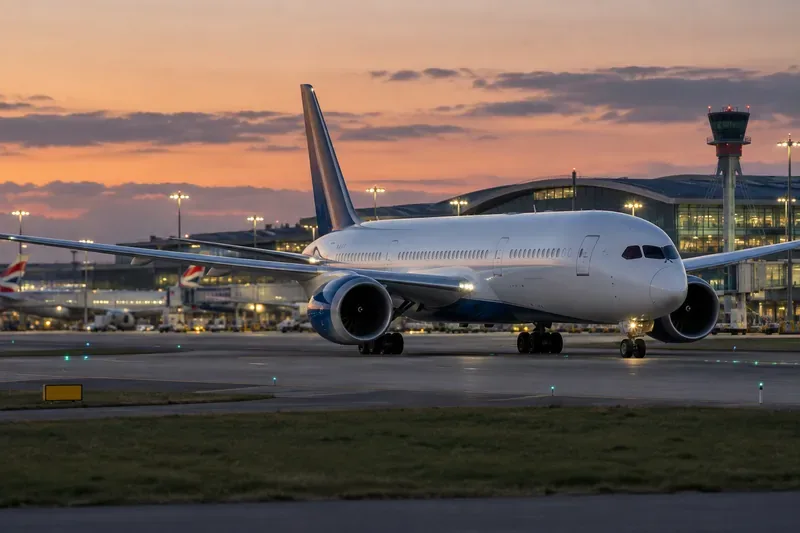
A modern twin-engine widebody aircraft at a London airport. This is a contextual image, not a photograph of IndiGo flight 6E04.
What is confirmed about the London return
According to an IndiGo statement reported on September 23, flight 6E04 was operating from London to New Delhi when a technical issue was detected shortly after departure. The pilots turned back under standard operating procedures and landed safely at London Heathrow.
Public flight-tracking reports place the departure at roughly 8:05 p.m. British Summer Time on September 22 and the return at about 9:23 p.m., meaning the aircraft was airborne for a little over an hour. Those times come from tracking data rather than from a detailed operational report released by the airline, so they are best treated as approximate.
IndiGo also said the aircraft was undergoing maintenance checks and would resume operations only after obtaining the necessary clearances. For travelers, that is the practical point: the airplane was not simply turned around and sent back out without inspection. Useful action: if you were booked on the flight or a later service using the same aircraft, rely on IndiGo's flight-status channels rather than assuming the aircraft's next rotation will operate as originally scheduled.
Was this an “emergency landing”?
Some reports described the event as an emergency and said the aircraft transmitted transponder code 7700. The UK Civil Aviation Authority describes 7700 as the general emergency transponder code, used when an aircraft is suffering an emergency. That code tells air traffic control that the flight needs priority handling; it does not identify the malfunction or establish how severe the technical problem ultimately proves to be.
This is an important source of confusion. A 7700 squawk is not evidence by itself of an engine failure, fire, depressurization, or any other specific fault. It is a communications and traffic-management signal. The CAA's explanation is available in its Skyway Code guidance on transponder use. Useful action: when you see “7700” in a flight-tracking post, separate the verified fact that priority assistance was requested from speculation about why it was requested.
What has not been confirmed
The exact technical fault
IndiGo has publicly used the broad phrase “technical issue.” It has not, in the material available at the time of this article, identified a failed component or system. That means claims that the event was caused by an engine problem, electrical fault, pressurization issue, or another specific system should not be stated as fact without a later airline, regulator, or investigation update.
Useful action: look for a subsequent statement from IndiGo, a regulator, or an accident-investigation authority before repeating a specific mechanical explanation.
Reports of smoke
Some news coverage cited reports that smoke was detected onboard. IndiGo's own statement, as reported by multiple outlets, did not specify smoke; it referred only to a technical issue. Because the underlying source for the smoke claim has not been publicly established in the materials reviewed here, it remains unconfirmed.
Useful action: treat “smoke onboard” as an allegation unless and until an official source confirms it.
Passenger count
Reports have not been consistent about the number of people aboard, and the airline statement available through news reports did not provide a confirmed passenger total. Useful action: avoid citing a precise passenger count unless IndiGo or another authoritative source publishes one.
Why a crew may return to the departure airport
A return to the departure airport does not automatically mean the aircraft was in immediate danger. Airlines and flight crews use established procedures to decide whether to continue, divert elsewhere, or return after an abnormal indication. Factors can include the type of alert, weather, airport facilities, maintenance support, fuel state, airspace conditions, and the crew's assessment of the safest operational choice.
In this case, the only confirmed reason provided by the airline is that a technical issue was detected and the pilots decided to return. Without a maintenance finding or official occurrence report, it is not possible to determine how close the situation was to a more serious outcome. Useful action: distinguish the operational decision — returning to Heathrow — from an engineering diagnosis, which has not been published.
Why the Boeing 787-9 detail matters — and what it does not prove
The aircraft type was a Boeing 787-9 Dreamliner, a long-range twin-engine widebody. Boeing lists the 787-9 as having a typical two-class capacity of 250 to 325 seats and a range of up to 8,300 nautical miles. Those are general model specifications, not details about the configuration or condition of this specific airplane. Boeing's current specifications are available on the official 787 Dreamliner page.
IndiGo's 2026 widebody program used Boeing 787-9 aircraft obtained from Norse Atlantic Airways under damp/wet lease arrangements. IndiGo's own network update says it began the project with six Norse 787-9s and later announced that the arrangement would conclude in late October 2026. The airline's official description is available in its widebody network update and its 2026 press release archive.
A common misunderstanding is to treat any incident involving a particular aircraft model as evidence of a fleet-wide design problem. One turnback does not establish that. A fleet-wide conclusion would require evidence such as repeated comparable failures, manufacturer findings, regulatory directives, or an investigation tying the event to a broader issue. Useful action: do not extrapolate from this single flight to every Boeing 787-9 unless later evidence supports that conclusion.
What happened to passengers
IndiGo said it offered affected customers hotel stays and accommodated them on the next available flights. That is consistent with the care obligations that apply to many flights departing from the United Kingdom. The UK Civil Aviation Authority says that when UK261 applies, airlines must provide care during qualifying delays, including food and drink and, where an overnight wait is necessary, accommodation and transport between the airport and lodging.
The CAA also explains that compensation is a separate question from care. Whether fixed-sum compensation is due depends on the length of the delay and whether the cause falls within the airline's responsibility or qualifies as an extraordinary circumstance. A generic “technical issue” is not enough information by itself to decide a compensation claim. See the CAA's official guidance on flight delays and UK261 rights.
Useful action: if you were affected, keep your booking confirmation, boarding pass, rebooking messages, and itemized receipts for reasonable meals, transport, or lodging that you had to arrange yourself. Those records matter if you later seek reimbursement or compensation.
Is there an official investigation?
As of the September 23 check for this article, the UK Air Accidents Investigation Branch public reports index did not show a published case entry for this flight. That does not prove that no occurrence report, regulatory review, or internal investigation exists; public investigation pages can appear later, and not every operational return results in a full published investigation.
The AAIB explains that it investigates civil aircraft accidents and serious incidents in the United Kingdom and publishes reports through its official database. Readers can check the AAIB reports index for any later case entry. Useful action: if the cause matters to you, revisit the airline and AAIB sources after maintenance findings or regulatory information become available.
What to watch for next
The most meaningful next update would be a specific maintenance finding: what system generated the problem, what corrective work was carried out, and whether regulators or the operator required additional inspections. Another useful signal would be confirmation that the aircraft received the required clearance and returned to service.
By contrast, social-media clips of the flight path, screenshots of altitude, or the fact that the aircraft returned to the same airport cannot determine the root cause. They can show what the airplane did, not why the fault occurred. Useful action: prioritize statements from IndiGo, the operator, Heathrow, the UK CAA, or the AAIB over unsourced technical theories.
Bottom line
The verified picture is straightforward: IndiGo flight 6E04, a Boeing 787-9 flying from London Heathrow to New Delhi, encountered a technical issue soon after takeoff on September 22, 2026, turned back, and landed safely at Heathrow. The aircraft was placed into maintenance checks, and IndiGo arranged accommodation and alternative flights for affected passengers.
The exact defect has not been publicly identified. Reports of smoke and other specific causes remain unconfirmed in the official information available at the time of writing. A reported 7700 emergency code would explain why the flight received priority handling, but not what malfunction occurred. Until a more detailed airline, maintenance, or regulatory update appears, the most accurate description is simply a precautionary return following a technical issue — with the cause still under review.