Would Europe Be Drawn into a Hypothetical U.S.-Israel-Iran Nuclear War? NATO Rules Explained

A guide to NATO Articles 4 and 5, UN self-defense rules, and why consultation does not mean automatic European entry into war.
With the unimpressive performance of recent CPU generations, Intel seems to be losing popularity in the Chinese market, where rival AMD is increasingly gaining popularity.
AMD dominates market once dominated by Intel
It’s been a while since Intel made a big splash in the desktop CPU space. Recent generations of the company’s products have been plagued by stability issues or disappointing performance. According to a report from Board Channels Forums (via HXL), Intel is losing ground in a key market—China—with its CPU adoption rates at record lows. Meanwhile, AMD is taking over the consumer market with more attractive and powerful products.
Speaking of Intel's latest generation of CPUs, the Arrow Lake "Core Ultra 200S" series, many post-launch reviews have shown that the performance of this product line is much lower than what Intel initially advertised, which has damaged the image of ARL-S in the eyes of consumers. "Team Blue" has tried to fix it by releasing many updates and new microcode, but it seems that these efforts are still not enough to convince users to choose the Core Ultra 200S series.
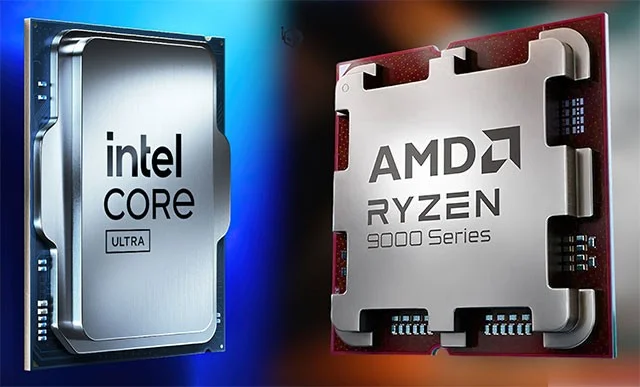
In addition, with the Raptor Lake Refresh series, Intel has faced widespread CPU instability, forcing the company to recall thousands of products for warranty. This has created panic among users, causing them to look for alternatives. In such a context, Intel's market share in China - a market they once dominated - has dropped dramatically, while its rival AMD is doing better and becoming more popular.
With AMD's latest Zen 5 CPUs, such as the Ryzen 9000 and X3D versions, Chinese consumers seem to be leaning towards "Team Red." AMD reportedly reached 50% market share in the first quarter of 2024. This trend is expected to continue, and it may not be long before AMD dominates the CPU market in China, which could have serious consequences for Intel's business.
Furthermore, with the percentage of users choosing Intel CPUs decreasing, motherboard sales have also dropped sharply, indicating that Intel is going through a difficult period. Meanwhile, AMD continues to consolidate its position with high-performance and stable products, attracting more and more users in the world's largest market.
A guide to NATO Articles 4 and 5, UN self-defense rules, and why consultation does not mean automatic European entry into war.
Assess claims about Iran in six steps, distinguishing uranium enrichment, weapons development and verified possession.
Understand nuclear decision authority in six steps, including US civilian control and the limits of public information about Israel.
A guide to official 2026 evidence on Hormuz shipping disruption, Iran-related claims, confirmed incidents, and what remains uncertain.
A source-based guide to nuclear escalation risks, UN Charter rules and NATO Article 5 in a strictly hypothetical Iran scenario.
Use five steps to prepare for an outage; nuclear and EMP scenarios are hypothetical, and official shelter instructions come first.
Use 5 defensive steps to verify a cyber disruption, protect household accounts, and avoid mistaking an outage for war.
Use these 5 steps to assess climate effects from a hypothetical Iran strike, compare model assumptions, and avoid unsupported predictions.
Explore six steps for reading research on climate, food and ecosystem recovery after a hypothetical nuclear conflict.
Build a practical fallout preparedness kit in six steps, with sealed food and water, a radio, medical supplies and shelter guidance.