XPeng L03: Features, Technology and What U.S. Buyers Should Know

Explore the XPeng L03’s announced range, charging, cabin tech, driver assistance, and what U.S. shoppers should verify about availability.
Meta Connect 2026 introduced a product that can easily be confused with the company’s existing smart-glasses lineup: Meta VR Glasses. Despite the name, this is not simply another pair of camera-and-audio glasses. Meta is positioning it as a full virtual-reality computing device in a glasses-like form factor, with immersive displays, hand and eye input, spatial media, gaming, work features, and a separate compute-and-battery module.
The announcement matters because Meta now has several different categories that all use the word “glasses.” For a first-time buyer, the easiest way to understand the news is to separate the products first, then look at what Meta has actually confirmed, what you would need to prepare for, and what is still unknown ahead of the planned 2027 launch.
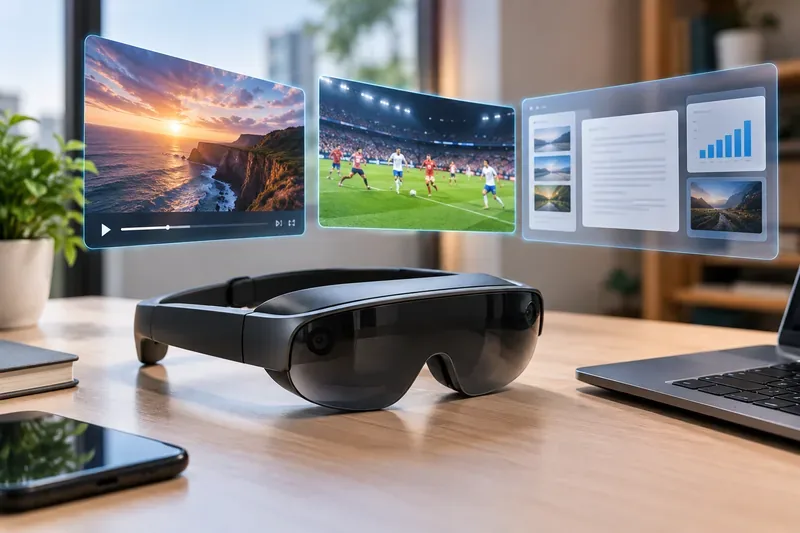
Meta VR Glasses are a new VR device announced at Meta Connect on September 23, 2026. Meta says the headset weighs about 100 grams and uses a two-part design: the glasses contain the displays and sensors, while a separate “puck” connected by an optical tether handles computing, battery, and storage. That separation is central to how Meta says it reduced the weight on the wearer’s face.
Meta says the device uses a 5K Infinite Display built on micro-OLED panels and compact pancake lenses. “Micro-OLED” means very small organic light-emitting displays designed for high pixel density, while “pancake lenses” are folded optical systems that can make a headset thinner than older lens designs. The company also lists 37 pixels per degree and support for Dolby Vision and Dolby Atmos spatial audio. These are manufacturer specifications, not independent test results, so real-world sharpness, comfort, glare, thermals, and battery behavior will need to be judged after production hardware is available.
The official product announcement is available in Meta’s newsroom: Meta’s announcement of Meta VR Glasses.
This is the most important distinction for newcomers. Meta also announced a broader range of AI glasses at Connect, including Ray-Ban Meta Audio and Ray-Ban Meta (Gen 3). Those products are designed primarily as everyday glasses with microphones, speakers, cameras or AI assistance, depending on the model. They are not full VR systems.
Meta VR Glasses, by contrast, are meant to place large virtual screens and immersive content in front of your eyes. Meta describes them as a personal cinema, workspace, and gaming platform. That puts them much closer to a VR headset than to ordinary smart glasses, even though the device is physically styled more like eyewear.
| Category | Main purpose | Display style | What Meta announced at Connect 2026 |
|---|---|---|---|
| Meta VR Glasses | Immersive VR, spatial work, games, media | Full immersive 5K display system | New product planned for Spring 2027 |
| Meta Ray-Ban Display | Everyday smart glasses with an in-lens display | Heads-up information | New navigation, apps, notifications, and market expansion |
| Ray-Ban Meta / Meta Glasses | AI assistance, audio, camera, calls, everyday wear | Mostly displayless depending on model | New styles, Audio model, Gen 3 upgrades, broader lineup |
For the broader AI-glasses announcements, see Meta’s Ray-Ban Meta Audio and AI glasses announcement and Meta’s update on Meta Ray-Ban Display.
Meta says the device will be the first IMAX Enhanced-certified VR product. The company is promoting 3D movies, expanded aspect-ratio content, immersive environments, Dolby Vision, and spatial sound. It also announced media relationships involving services such as Disney+, Prime Video, YouTube, DIRECTV, AMC+, Crunchyroll, ESPN, Tubi, Peacock, HBO Max, and Paramount+.
The practical point for a buyer is that the value of a media headset depends on both hardware and catalog availability. Meta says thousands of titles will be available internationally by launch, but availability can vary by country, service, subscription, licensing deal, and release date. Do not assume every named service or 3D title will be available in every region on day one.
Meta says the glasses will support more than 100 immersive live U.S. sports events per year, with partners including ESPN, MLB, NBC Sports, TNT Sports, and UFC. The company describes 8K streaming and 180-degree views for some immersive sports experiences.
For someone considering the device mainly for sports, the useful questions are not only “Does it support sports?” but also which leagues, which specific events, whether an additional subscription is required, whether blackouts apply, and whether the feed is available in your location.
Meta says users will be able to create a large private screen or several virtual screens and still see their physical surroundings through full-color passthrough. “Passthrough” is the camera-based view of the real world shown inside the headset. Meta also says a flat surface can become a virtual keyboard and touchpad, reducing the need to carry separate input hardware for some tasks.
This could be useful for travel or temporary workspaces, but buyers should wait for independent testing before assuming it can replace a laptop setup. Typing accuracy, hand tracking, eye tracking, app compatibility, text clarity, fatigue, and privacy in shared spaces will all matter.
Meta says more than 75 games will be available at launch that can be played using hand gestures, and that Xbox Cloud Gaming will provide access to hundreds more titles. The company says users can navigate with their eyes and natural hand gestures instead of dedicated controllers.
That is different from saying every VR game will work without controllers. Software compatibility will determine which games support the new input model, and cloud gaming will also depend on a suitable internet connection and the relevant service requirements.
Meta also introduced what it calls hologram calling. The company says the system can create a photorealistic digital representation of the wearer with real-time expressions and reactions. According to Meta, this can be used with calling apps including WhatsApp and Zoom, while people joining from phones or computers can see the user’s digital representation on their screens.
This is one of the features that deserves careful real-world evaluation. Meta has announced the capability, but users should still look for launch-day details on setup, supported apps, privacy controls, processing requirements, and how accurately the system represents a person in different lighting and network conditions.
You cannot buy Meta VR Glasses yet. Meta says they are scheduled to go on sale in Spring 2027 for $1,299.99 in the United States. Until preorders or final retail pages appear, treat that as the announced launch target rather than a guarantee that every configuration, accessory, or market will have the same timing.
Meta says the puck can provide up to three hours of continuous high-resolution media playback and supports 45W fast charging. “Up to” figures are measured under particular conditions, so real battery life may differ with brightness, app use, network activity, tracking load, or multitasking.
Three hours could be enough for many movies or a work session, but it is not the same as all-day glasses. That is another reason not to confuse Meta VR Glasses with lighter AI eyewear designed for intermittent daily use.
Meta’s announcement provides unusually detailed headline specifications, but several practical questions remain open. The company has not yet provided every retail configuration, final regional rollout plan, complete prescription-lens information, full app compatibility list, repair pricing, accessory lineup, or independent performance data. These gaps are normal this far ahead of a planned launch, but they matter if you are deciding whether to wait for this device or buy existing hardware now.
The simplest way to understand Meta VR Glasses is this: Meta is trying to shrink a full VR computing experience into eyewear-like hardware by moving much of the compute and battery into a separate puck. The confirmed pitch is broader than gaming. Meta is targeting movies, immersive live sports, private multi-screen work, hand-and-eye-controlled games, and spatial video calling in one device.
The most important confirmed numbers are about 100 grams for the glasses, a 5K micro-OLED display system, up to three hours of high-resolution media playback from the puck, more than 75 gesture-controlled games planned at launch, more than 100 immersive live U.S. sports events per year, and a U.S. launch target of Spring 2027 at $1,299.99. Those details come from Meta’s September 23, 2026 announcement and should be treated as pre-launch specifications until shipping hardware is independently tested.
Explore the XPeng L03’s announced range, charging, cabin tech, driver assistance, and what U.S. shoppers should verify about availability.
Bentley Torcal technology explained: EV power, charging, OLED display, cabin curation, driver assists, Torcal vs. Torcal S, and key U.S. unknowns.
Meta Connect 2026 introduced Meta VR Glasses, a 100-gram VR system due in Spring 2027. Here is what is confirmed, how it differs from Meta AI glasses, and what buyers should know.
USDA recalled about 167,639 pounds of raw beef, pork and goat products. Learn how to check labels, receipts and store information, and what to do next.
Learn how to track hurricanes with official NHC forecasts, phone alerts, local warnings, and NOAA Weather Radio, plus the trade-offs of each option.
IndiGo flight 6E04 returned to London Heathrow after a technical issue on September 22, 2026. Here is what is confirmed, what remains unclear, and what passengers should know.
Learn how hard, metered, freemium, and dynamic paywalls work, what they track, why search engines may see gated content, and legitimate ways readers can get access.
Seeing claims about new ergonomic Coles shopping baskets? Here’s what is verified, what remains unclear, and how to shop more comfortably if a basket feels awkward.
The FTC’s September 2026 Amazon Prime settlement update expands automatic refunds, raises the potential maximum to $200, and removes the need to file a claim. See eligibility, timing, payment options, and scam warnings.
Claude Opus 5.5 launched September 22, 2026. Review its context window, pricing, adaptive thinking, API changes, availability, and how to test its value for your work.