Home
» Today
»
Reece Walshs World Cup Comments: What Changes for Kangaroos Selection — Nov. 16, 2026
Reece Walshs World Cup Comments: What Changes for Kangaroos Selection — Nov. 16, 2026
Checked November 16, 2026, at 5:12 AM UTC (3:12 PM Brisbane AEST, UTC+10:00). Reece Walsh's defense of the Kangaroos after Australia's 32–12 Rugby League World Cup final victory over New Zealand on November 15 has put a fresh spotlight on what national selectors value. His remarks about loyalty, culture and respect for the forward pack do not constitute a selection announcement. But the Brisbane Broncos fullback's tournament-winning performances—and James Tedesco's newly announced international retirement—have tangible implications for the next Australian squad.
Walsh started the final at fullback, created Tom Trbojevic's second-half try and was awarded both the Harry Sunderland Medal as Australia's player of the tournament and the team's players' player honor. Tedesco, an experienced alternative in the No. 1 jersey, said after the final that he was retiring from international rugby league. Together, those are stronger indicators of the future fullback picture than Walsh's social-media criticism alone.
Destaques
Australia beat New Zealand 32–12 in the November 15 final at Suncorp Stadium in Brisbane; Walsh was the starting fullback.
Walsh defended the team's culture and its forwards after criticism from fans, but did not announce a new selection policy.
Walsh's tournament awards strengthen his case for retaining the No. 1 jersey; Tedesco's international retirement removes a proven competitor from future selection.
No next Kangaroos squad was announced in the official material checked for this article. Fitness, form and eligibility remain relevant to future choices.
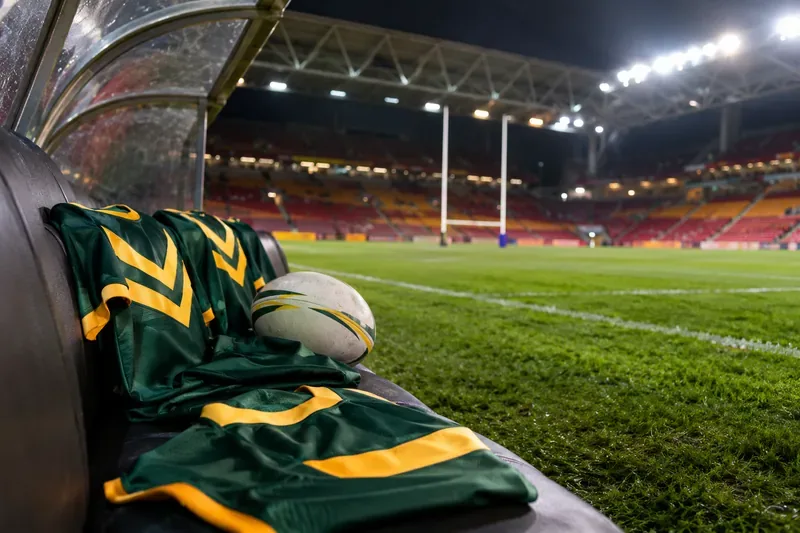
Illustration: Green-and-gold rugby league jerseys beside a stadium field. This generated image does not depict the World Cup final or an actual Kangaroos training session.
What do Reece Walsh's World Cup comments actually change?
The immediate answer is that they change the public discussion more than any formal roster. In post-final remarks reported by Australia's ABC and AAP on November 16, Walsh said he was disappointed that some Australian supporters wanted the Kangaroos to lose because they thought it would help the international game. He challenged doubts about Australia's team culture and emphasized the commitment of teammates, including captain Isaah Yeo and prop Tino Fa'asuamaleaui. Those are Walsh's views; they are not a directive from selectors and do not create a rule requiring particular players to be retained.
The comments matter because they put words to the qualities players believe supported the title run: cohesion, a willingness to compete through adversity and trust in teammates. Such qualities may inform a coach's assessment alongside technical performance. That is an interpretation, not evidence that the Kangaroos will select players based on public expressions of loyalty.
Why is Walsh now central to Australia's fullback selection?
Coach Kevin Walters named Walsh in the No. 1 jersey for the final, following a campaign in which the fullback's attacking threat became one of Australia's defining weapons. In its official match report, the NRL described Walsh beating multiple defenders and setting up Trbojevic in the second half. Australia won at Suncorp Stadium, Brisbane, on Sunday, November 15, 2026. The official team announcement gave kickoff as 6:35 p.m. Brisbane AEST (UTC+10:00), equivalent to 8:35 a.m. UTC and 7:35 p.m. Sydney AEDT (UTC+11:00).
Walsh was also recognized with the Harry Sunderland Medal, chosen by selectors for Australia's tournament-best player, and a separate players' player award. The two honors are relevant but not guarantees: selection for later Tests will still depend on available players, physical readiness, tactical requirements and club form at that time. There is no verified permanent appointment as Australia's future fullback.
How does James Tedesco's retirement affect the Kangaroos?
This is the clearest concrete squad consequence reported after the final. Tedesco confirmed he was ending his international career, according to the ABC's November 15 coverage. A former Kangaroos captain and established fullback, he had been named in the wider final squad and was brought onto the interchange after Latrell Mitchell withdrew because of illness. Walters had previously emphasized that competition for places was real: Walsh was selected to start while Tedesco could still contribute in another role.
With Tedesco retiring from Tests, selectors will no longer be weighing him against Walsh for upcoming Kangaroos appearances. This does not mean Walsh automatically owns the position indefinitely, nor does it mean a successor has been named. It does mean that an experienced alternative who was present at the 2026 tournament has stepped away from the international selection pool.
What does the World Cup final show about the rest of the squad?
The final also underscores why Walsh's praise for the forwards has a rugby league context. The NRL's report credits the middle-unit work of Yeo, Fa'asuamaleaui and Cameron Murray, with contributions from Harry Grant and Tom Dearden, as Australia established control. Liam Martin and Jack Bostock each scored twice in the 32–12 victory. Walsh's high-profile attacking moments did not happen independently of the team's territory, defense and service around him.
Walsh singled out Yeo's commitment while playing with a pectoral injury. Such comments are evidence of how the players view the group, not a medical clearance or a prediction about Yeo's availability for future matches. Readers should look to subsequent team medical updates and official selections rather than infer that any player will be fit or unavailable at the next international window.
Australia's formal 2026 World Cup roster included experienced names and debutants, according to the tournament's published squad list. That mix helps explain why changes cannot be predicted from one interview: selectors must weigh succession planning against the immediate demands of each opponent and fixture. Walsh's performance strengthened his claim, but it did not publicly settle every spot in the spine, the bench or the pack.
What should fans watch before the next Kangaroos squad is named?
Three checkpoints will be more informative than the reaction to Walsh's comments. First is the official announcement of the next international fixture and selection window. Second is the available player pool, including form and injuries during the NRL season. Third is Walters' eventual squad and match-day lineup, which distinguish a player's selection in an extended squad from a starting role or an interchange spot.
A further consideration is whether the coach continues to favor the attacking structure that featured Walsh at the back. That is a reasonable question after the final, not a confirmed plan. Equally, the team's success may encourage continuity among forwards and playmakers, but any proposed starting 13 for a future Test remains speculative until announced.
For supporters trying to judge the impact, the balanced reading is straightforward: Walsh has made a compelling performance-based case and emphasized the internal standards he believes made Australia successful. Tedesco's retirement changes the selection landscape in a definite way. Neither development should be mistaken for a published future squad.
Did Reece Walsh demand changes to Australia's World Cup squad?
No. His post-final comments defended Kangaroos culture and the effort of his teammates; they did not announce selection changes.
Is Reece Walsh guaranteed to start at fullback in Australia's next Test?
No. He started the 2026 final and earned tournament honors, but future selections have not been confirmed.
Will James Tedesco play for the Kangaroos again?
Tedesco announced his retirement from international rugby league after the November 15, 2026, final. On that announcement, he is not expected to be available for future Kangaroos selection.