Would Europe Be Drawn into a Hypothetical U.S.-Israel-Iran Nuclear War? NATO Rules Explained

A guide to NATO Articles 4 and 5, UN self-defense rules, and why consultation does not mean automatic European entry into war.
With the arrival of the Blue Ghost lander on the Moon this weekend, astronomers around the world are eagerly awaiting a series of stunning new images that will provide a truly immersive, and even unprecedented, look at our planet's natural satellite.
The Firefly Aerospace mission successfully landed in the Mare Crisium region of the Moon on Sunday, March 2, and the company has immediately shared the first images taken by the Blue Ghost lander.

Along with the impressive image showing the lander's shadow on the lunar surface (as shown above), another image depicts Earth clearly visible in the beautiful night sky:

This image also shows two of the lander's instruments: the X-band antenna to send data back to Earth and the Lunar Environment Heliospheric X-ray Imager (LEXI), which will use X-rays to study how solar winds interact with Earth's magnetic field and is one of several NASA instruments on the lander.
Speaking about the lander's complex landing technique, NASA Administrator Janet Petro said:
This incredible achievement demonstrates how NASA and American companies are leading the way in space exploration for the benefit of all. We learned many lessons – and the technology and science demonstrations on Firefly’s Blue Ghost Mission 1 will improve our ability not only to explore the Moon further, but also to ensure the safety of our spacecraft for future manned missions – both short-term and long-term.
Another newly released image shows a top-down view of the lunar surface with the lander's thrusters clearly visible:

Deployment of the lander's instruments has begun, and today Firefly announced that the X-band antenna is fully deployed. Compared to the lander's S-band antennas, which are used to send back low-quality images, the X-band antenna will allow for higher-quality images, scientific data, and even video to be sent back to Earth.
NASA Associate Administrator for Science Nicky Fox said:
The science and technology we send to the Moon today prepares for future NASA exploration missions and a long-term human presence that will inspire the world for generations to come.
A guide to NATO Articles 4 and 5, UN self-defense rules, and why consultation does not mean automatic European entry into war.
Assess claims about Iran in six steps, distinguishing uranium enrichment, weapons development and verified possession.
Understand nuclear decision authority in six steps, including US civilian control and the limits of public information about Israel.
A guide to official 2026 evidence on Hormuz shipping disruption, Iran-related claims, confirmed incidents, and what remains uncertain.
A source-based guide to nuclear escalation risks, UN Charter rules and NATO Article 5 in a strictly hypothetical Iran scenario.
Use five steps to prepare for an outage; nuclear and EMP scenarios are hypothetical, and official shelter instructions come first.
Use 5 defensive steps to verify a cyber disruption, protect household accounts, and avoid mistaking an outage for war.
Use these 5 steps to assess climate effects from a hypothetical Iran strike, compare model assumptions, and avoid unsupported predictions.
Explore six steps for reading research on climate, food and ecosystem recovery after a hypothetical nuclear conflict.
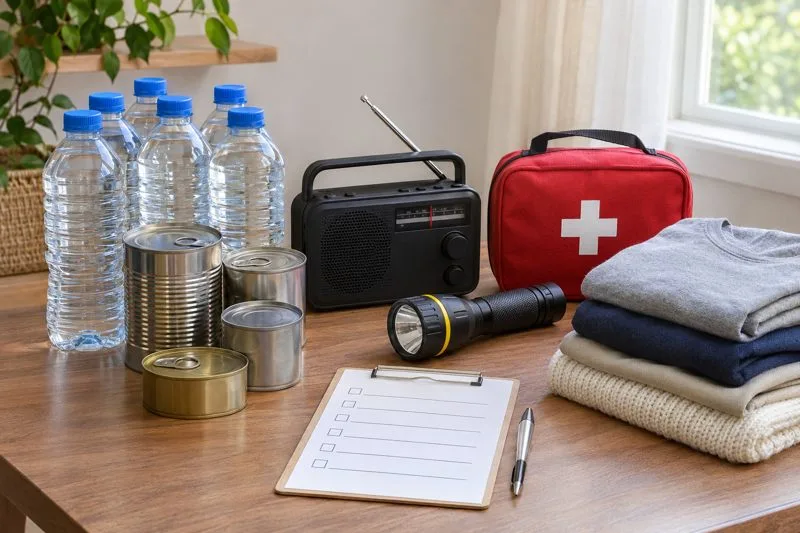
Build a practical fallout preparedness kit in six steps, with sealed food and water, a radio, medical supplies and shelter guidance.