Checked November 16, 2026, at 9:09 a.m. UTC (4:09 a.m. EST, UTC−05:00). Army Maj. Stephen Ramsbottom, who survived a deadly March 1 drone attack on a U.S. military command post at Port Shuaiba in Kuwait, has taken his warnings about troop protection to Congress. In a November 15 60 Minutes report, Ramsbottom alleged that military leaders had been warned about inadequate defenses against drones before the strike killed six U.S. service members. The allegations are serious, but they have not been established as findings by an independent military or congressional investigation.
The concrete new development is a whistleblower complaint submitted to the House and Senate Armed Services Committees on Friday, November 13, followed by public scrutiny of the military’s pre-attack planning. Senator Richard Blumenthal has sought force-protection assessments and a classified briefing from Defense Secretary Pete Hegseth. CBS reported that a Pentagon spokesperson declined to comment on Ramsbottom’s allegations, including whether sufficient protection was in place.
Destaques
Ramsbottom’s complaint says warnings about drone vulnerability at Port Shuaiba were not adequately addressed before the March 1 attack.
The attack killed six American service members; the complaint also raises concerns about medical support at the installation.
CBS’s November 15 60 Minutes report brought survivor testimony and the newly submitted complaint together.
Congressional requests for records and testimony are a step toward oversight, not proof of wrongdoing.
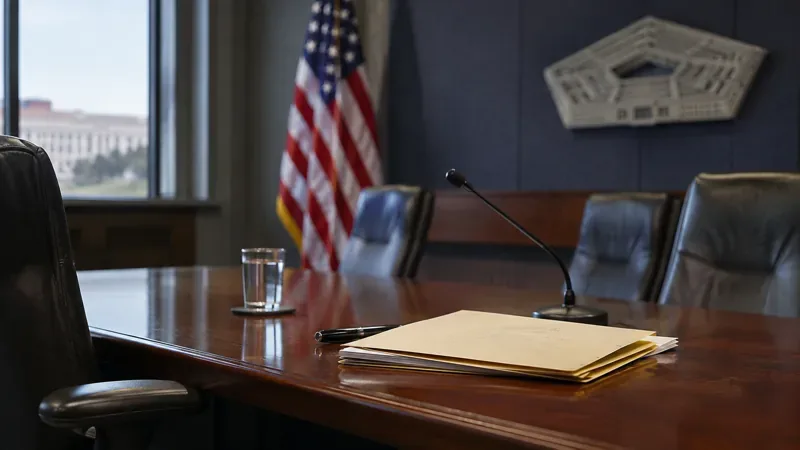
Illustrative image of a government briefing room. This is not a photograph of Ramsbottom, Port Shuaiba, or a congressional hearing.
What did Stephen Ramsbottom reveal in the new 60 Minutes report?
In his interview with Norah O’Donnell, Ramsbottom described an operations site that he said had defenses suited to threats such as vehicle bombs, but lacked protection designed for an attack from above. He said he raised the vulnerability in meetings with commanders and was reassured about protection. The 60 Minutes transcript also reports that other soldiers said they had seen intelligence indicating Port Shuaiba could be targeted.
Ramsbottom said a counter-drone system was discussed before the strike but never arrived. He did not claim to know whether it had actually been ordered or formally requested. That distinction matters: a reported promise to seek equipment does not by itself establish who made a procurement decision, whether a request was processed, or why the defenses were absent.
CBS said its investigation included survivor interviews and imagery of the attack’s aftermath. Ramsbottom’s account is firsthand testimony from a person wounded in the attack, while the broader question of command responsibility requires additional records, operational timelines, and testimony from the leaders involved.
What happened at Port Shuaiba on March 1, 2026?
The strike hit a U.S. command post at Port Shuaiba, Kuwait, amid the opening phase of the U.S.-Iran conflict. Six U.S. military personnel were killed and others were wounded. The attack itself occurred in Kuwait, but the 60 Minutes broadcast and congressional response are U.S. news developments. The reporting describes a drone hitting the operations center after personnel had returned to their workspace.
The complaint further alleges that the location had no physician, no fixed aid station, and only one ambulance. Those are allegations about the site’s emergency readiness at the time, not a verified determination that any specific casualty would have survived with different medical resources. A full assessment would require medical records, incident-response logs, and an official review.
What has changed since the attack?
Months after the March strike, the issue has shifted from survivor accounts to a formal congressional disclosure and requests for supporting documents. CBS reported that Ramsbottom submitted his complaint on November 13 to both congressional Armed Services Committees. The November 15 television investigation then made the claims and supporting witness accounts more visible to the public.
Blumenthal, the ranking Democrat on the Senate Permanent Subcommittee on Investigations, called for a classified briefing by Hegseth and production of force-protection assessments concerning the port. The senator’s demands indicate a push for answers; they do not mean a hearing has occurred or that lawmakers have reached conclusions. No completed disciplinary proceeding, judicial finding, or official assignment of fault was established in the source material checked for this article.
How has the Pentagon responded to the whistleblower allegations?
The public accounts remain in dispute. At a March press conference, Hegseth characterized the command post as fortified while acknowledging that a projectile got through air defenses. Ramsbottom’s later account challenges whether the position was suitably protected against the particular threat that struck it. Both statements can be accurately reported without treating either as the final technical assessment.
When CBS sought comment on the November complaint, a Pentagon spokesperson declined to address its allegations. That is not confirmation of the complaint, and it is not a rebuttal of its individual claims. The unanswered questions include what risks commanders had been told about, which protective systems were available or requested, and whether decisions were consistent with the threat assessments then in force.
What will congressional oversight examine next?
If the requested records are provided, investigators may be able to compare intelligence warnings, protective-equipment requests, orders, and medical-readiness plans with the firsthand testimony. A classified briefing could clarify some decisions for lawmakers without making all underlying material public. The timing of any briefing, the release of documents, and the outcome of possible investigations were not confirmed at the time of this check.
The broader question is whether military force-protection practices are keeping pace with inexpensive, one-way attack drones. But this specific case must be evaluated on contemporaneous evidence: what personnel knew before March 1, what resources could realistically be deployed, and who had the authority to act. It would be premature to infer criminal misconduct, deliberate disregard, or a particular chain of causation from an interview and a complaint alone.
Did Stephen Ramsbottom file a formal whistleblower complaint?
Yes. CBS reported that the Army major submitted a complaint to the House and Senate Armed Services Committees on November 13, 2026.
What did he allege about the Kuwait base?
He alleged that warnings about inadequate drone defenses were disregarded and that the Port Shuaiba site lacked sufficient medical support when it was struck on March 1.
Has the Pentagon admitted wrongdoing?
No such admission was confirmed in the sources checked. CBS reported that a Pentagon spokesperson declined to comment on the specific allegations.