Home
» Today
»
Tesla Roadster: Latest Details, Specs, and What to Expect
Tesla Roadster: Latest Details, Specs, and What to Expect
The Tesla Roadster remains one of the most ambitious unfinished stories in the electric-car market. It was unveiled as a 2+2 electric sports car in 2017, yet it still has not reached normal customer production. The useful way to read the latest Roadster news is to separate three things: figures Tesla has published as targets, details that have been discussed but not finalized, and proof that the car is actually ready for delivery.
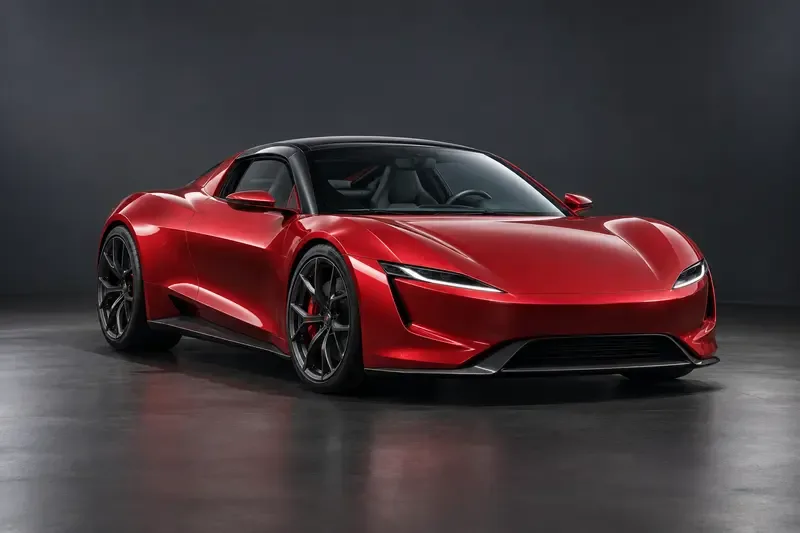
A generic electric-roadster concept used to illustrate the performance discussion; it is not a confirmed photograph or production specification of the Tesla Roadster.
What is the latest Tesla Roadster status?
As of September 20, 2026, Tesla still presents the Roadster as a future electric sports car rather than a model with a normal customer-delivery schedule. The company’s official product page continues to emphasize record-setting acceleration, range, and performance, but it should not be read as a final window sticker or a completed homologation document.
Recent reports point to an expected Roadster reveal on October 1, 2026. That would be an important milestone, but a reveal is not the same as the start of production. The result readers should look for is not simply a dramatic prototype video. The stronger evidence would be a production-intent vehicle, a confirmed factory plan, a final specification sheet, a price that Tesla will honor, and a delivery schedule with conditions clearly stated.
For now, the most accurate expectation is therefore cautious: Tesla may be preparing to show a more mature version of the car, but the final launch timing, customer configuration, and production volume remain unconfirmed in the public product information.
Published performance targets versus confirmed specifications
The numbers below are useful for understanding Tesla’s original promise. They are not independent production-car test results. Until Tesla publishes final certification data and a production vehicle is tested, treat them as announced targets.
Item
Published or discussed figure
How to interpret it
0–60 mph
1.9 seconds
A Tesla-stated target associated with the original Roadster presentation, not a verified customer-car result.
Top speed
More than 250 mph
An ambitious target that still requires production tires, cooling, brakes, software, and regulatory validation.
Driving range
Up to 620 miles
A headline target; the final EPA-rated range, wheel choice, speed, weather, and test configuration matter.
Powertrain concept
Three electric motors and all-wheel drive have been associated with the Roadster plan.
The final motor layout, output, battery chemistry, and thermal limits should be confirmed on the production car.
Seating
2+2 sports-car layout
The rear seats may be useful for occasional passengers rather than full-size everyday seating.
Tesla’s official Roadster page is the primary place to check the company’s current wording. Notice the difference between “Tesla says the vehicle is designed to achieve” and “an independent test measured.” That distinction is especially important for a car whose original launch date slipped for years.
What could change before production?
Battery size and thermal management
The Roadster’s promised acceleration and range point to a very large battery and a demanding cooling system. A production design may use a different cell format, structural pack, inverter, or thermal strategy from the 2017 concept. Those changes could improve efficiency or manufacturing cost, but they could also alter weight, range, charging behavior, and sustained track performance.
A good update should therefore include more than peak acceleration. Look for a charging curve, usable battery capacity, repeatability after several hard launches, and a clear statement about whether the range number is an estimate or an EPA result. If Tesla shows only one short acceleration run, the available evidence is still narrow.
SpaceX package and extreme-performance claims
The long-discussed SpaceX package has been presented as a possible performance option involving rocket-style cold-gas thrusters. It remains one of the least certain parts of the Roadster story. A serious production update would need to explain the hardware, storage, safety controls, service requirements, passenger-space impact, and where the option could legally be used.
Until those points are documented, the SpaceX package should be treated as a concept or optional engineering direction, not as a standard Roadster feature. It should not be used to compare the car with conventional production EVs or to calculate a realistic road-driving experience.
Design and interior practicality
The 2017 Roadster was shown as a low, rounded sports car with a removable glass roof and compact rear seats. A later production design may look different because of crash requirements, visibility, cooling airflow, battery packaging, or manufacturing cost. A reveal photo can confirm the general shape, but it cannot confirm cargo space, seat comfort, ingress, roof storage, or long-distance usability.
How to judge the next Roadster announcement
Use a simple evidence ladder. Each level answers a different question:
Reveal: Does Tesla show a new design, or only reuse the old 2017 concept?
Production intent: Does Tesla identify a factory, a build phase, suppliers, or a validated production prototype?
Certification: Are the acceleration, top-speed, range, lighting, crash, and emissions-related requirements addressed for the intended markets?
Commercial terms: Are the final price, reservation terms, taxes, options, warranty, and delivery sequence published?
Customer proof: Are independent tests, customer deliveries, and repeatable performance results available?
This order helps prevent a common mistake: treating a prototype’s headline specification as if it were a product a buyer can order today. If the next announcement stops at the first level, enthusiasm may be justified, but a firm purchase decision is premature. If it reaches the third or fourth level, the Roadster becomes easier to evaluate as a real vehicle rather than a long-running promise.
What should potential buyers expect to pay and when?
The original Roadster announcement placed the base model at a supercar-level price, but a historical reservation price is not a reliable prediction of the final transaction price. Battery costs, inflation, options, taxes, destination charges, and any special package could change the total substantially. Tesla’s official reservation page should be checked for the current terms, but a reservation should not be treated as a guaranteed delivery date or a final vehicle specification.
The same caution applies to timing. A reveal in 2026 could be followed by engineering validation, regulatory work, supplier preparation, and production ramp-up. Change your expectations if Tesla provides a clear delivery sequence and customer contract terms. Keep expectations provisional if the company supplies only a presentation date, a reservation form, or a statement that production is planned.
The practical limit of the current information
There is no independent road test of the final production Tesla Roadster because the final production car has not been publicly established. The most frequently repeated figures come from Tesla’s original announcement and later discussion of the program. They are useful for understanding the intended performance envelope, but they cannot prove range in winter, braking distance, cabin noise, reliability, service cost, charging speed, or track durability.
That limitation matters for consumers. If you need an electric car now, the Roadster should not be treated as a near-term substitute for an available model. If you want a low-volume performance car and can tolerate uncertain timing, follow the official page and wait for the evidence ladder to move beyond a reveal. Avoid making a non-refundable financial commitment based only on a render, a social-media teaser, or a repeated target from 2017.
Bottom line
The Tesla Roadster still promises an unusual combination of supercar acceleration, long-range electric driving, and a compact 2+2 layout. The published targets remain impressive: 1.9 seconds to 60 mph, more than 250 mph, and up to 620 miles of range. The important qualification is that these are targets associated with Tesla’s Roadster program, not a complete set of independently verified production specifications.
The next meaningful update will be measured by what Tesla proves: the production design, final battery and motor details, certified performance, price, reservation conditions, and a credible delivery schedule. Until those signs appear together, the Roadster is best understood as a highly promising future product with substantial uncertainty still attached.
Information checked on September 20, 2026. Tesla may change specifications, timing, pricing, reservation terms, and availability before production. The official Tesla pages remain the reference point for company-stated information.