Desk Decorating Ideas for a Spooky Office Cubicle

Create a spooky office cubicle with Halloween desk decor ideas that keep your workspace usable, tidy, and mindful of workplace safety.
From air pollution to oil spills, man-made disasters can spiral out of control. Here are the worst man-made environmental disasters .
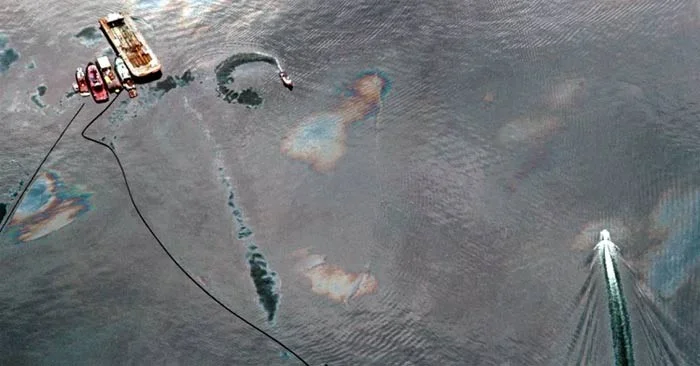
When you hear the word “disaster,” you probably think of major events that are beyond human control. Hurricanes, earthquakes, and wildfires are just a few examples of unavoidable natural disasters. But nature isn’t always to blame. Throughout history, humans have caused some of the most devastating environmental events.
From air pollution to oil spills, man-made disasters can easily spiral out of control. Sometimes, these accidents cause irreparable damage to the Earth and the creatures that inhabit our blue planet. So, we should learn from the worst disasters.
Here are some famous environmental disasters that originated from human error.
The terrible environmental disaster caused by humans
In 1985, scientists began mapping the dead zone in the Gulf of Mexico. A “dead zone” is an area of low oxygen and nutrient levels that is unsuitable for most marine life. The dead zone in the Gulf of Mexico begins at the Mississippi River and recurs every summer.
Over the years, humans have polluted the Mississippi River with pesticides, industrial waste, and toxic chemicals. As the river flows into the bay, it dumps excess nitrogen and phosphorus into the water, causing algal blooms. These blooms create hypoxic zones in the bay as they decompose and take oxygen with them.
Scientists measure the dead zone in the Gulf of Mexico every year to track its growth. According to the National Oceanic and Atmospheric Administration, the disaster area measured 6,334 square miles in 2021.
An environmental disaster caused by human waste, this marine debris patch in the North Pacific Ocean is made up of barely visible pieces of plastic brought together by the North Pacific Gyre (NPG). The NPG is a whirlpool of four ocean currents—the California, North Equatorial, Kuroshio, and North Pacific—that converge and transport water and debris in a clockwise direction. This creates a “patch” of trash and microplastics that get trapped in the ocean currents.
It is impossible to estimate the size of this garbage patch, but it is just one of many polluted areas in the ocean.
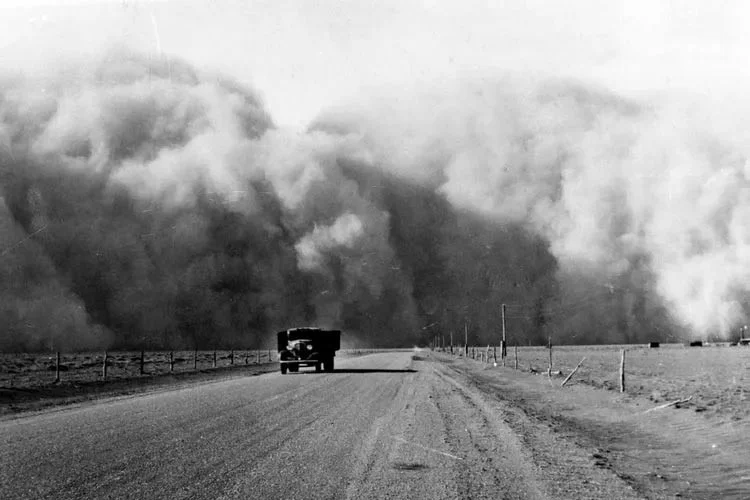
Beginning in 1930, dust swept across the Great Plains of the United States in a decade-long, partly man-made disaster called the Dust Bowl. During that time, much of the region’s land was over-farmed, and most farmers failed to conserve soil. As a result, the land became dry, and severe droughts made matters worse.
Those factors caused the Dust Bowl, an event that left nineteen states in the United States covered in dust. The dust and dirt were blown by strong winds, creating a massive dust storm that covered 10 million acres and destroyed farms and buildings. When the drought ended in 1940 and the dust settled, 400,000 people had fled their homes.
One of the most serious accidents in the history of US nuclear power occurred on March 28, 1979. The disaster occurred at the Three Mile Island Nuclear Power Plant near Harrisburg, Pennsylvania.
First, a reactor at the plant failed and automatically shut down. Then a relief valve in the booster, designed to keep the core cool, stuck open. That caused the system to lose coolant and the reactor core to partially melt down. The unit was damaged beyond repair and released radioactive material into the environment. The damage took 12 years to clean up and cost $973 million, according to the World Nuclear Association.
By the late 1970s, Love Canal had become the site of a decades-long environmental disaster. In the 1800s, William T. Love decided to build a canal in New York’s Niagara Falls neighborhood. However, he abandoned the canal a few years later. In 1942, the Hooker Chemical Company began using the site as an industrial landfill. The company dumped approximately 21,000 tons of toxic chemicals and compounds into the canal before selling the land for development.
After heavy rains in the 1970s, barrels of chemicals from the landfill washed away, contaminating the area with toxic substances and forcing the 239 families closest to the landfill to evacuate. Officials discovered 421 different chemicals in surrounding homes, water, and soil.
Create a spooky office cubicle with Halloween desk decor ideas that keep your workspace usable, tidy, and mindful of workplace safety.
Plan a recognizable Halloween 2026 look with pop culture costumes inspired by Spider-Man, Supergirl, Toy Story 5, Moana, Mario, and Wednesday.
Sort leftover Halloween candy safely, share or repurpose sealed treats, and choose food use or compost for pumpkins based on their condition.
Compare workplace Halloween costume choices by respect, dress code, mobility, and safety—and learn when a subtle accessory or a policy check is the better option.
Find a couples costume that fits your style, budget, and comfort level, from Addams Family classics to original inside-joke duos.
Need a last-minute high school Halloween costume? Compare 10 easy closet-based ideas by prep time, comfort, school-day practicality, and simple safety checks.
Use a simple 2026 Halloween decorating timeline for indoor décor, outdoor displays, and fresh pumpkins, with practical adjustments for weather and events.
Mix five vivid, approachable Halloween cocktails with measured recipes, simple prep tips, and an alcohol-free option for your party guests.
Find 15 office-friendly Halloween costume ideas for 2026, with practical checks for dress codes, respectful themes, comfort, and workplace safety.
Plan a fun elementary school Halloween party with easy crafts, games, inclusive treats, costume tips, and a sample 75-minute classroom schedule.