Home
» Today
»
Toyota NHTSA Recalls: Airbag and Tundra Safety Steps — Nov. 21, 2026
Toyota NHTSA Recalls: Airbag and Tundra Safety Steps — Nov. 21, 2026
Verified: November 21, 2026, 17:07 UTC (12:07 p.m. Eastern Standard Time, UTC−05:00).
Toyota owners in the United States face two newly announced safety recalls with very different risks: a November 12 recall involving approximately 314,000 Toyota and Lexus vehicles with potentially dangerous front-passenger airbag inflators, and a November 13 recall involving approximately 62,000 non-hybrid Toyota Tundra pickups whose camshafts could break and cause a loss of power while driving. Owners should check their specific vehicle identification number (VIN) now, read the applicable safety instructions and arrange a free authorized repair rather than waiting for a mailed notice.
The notices do not mean every vehicle with a listed model name or model year is affected. Toyota says owners in both campaigns are expected to receive notification by mid-January 2027. That future mailing date is not a reason to ignore an open recall or a possible safety symptom today. The immediate decision depends on the defect, the vehicle’s VIN and instructions from Toyota or the servicing dealer.
Destaques
Toyota announced separate U.S. recalls for certain passenger airbag inflators and non-hybrid Tundra camshafts on November 12–13, 2026.
Owners can search a 17-character VIN through Toyota or NHTSA; a matching year and model alone does not establish inclusion.
Both announced repairs are free: an airbag inflator or assembly replacement, or camshaft inspection and replacement when required.
Ask the dealer for campaign-specific driving guidance, repair availability and documentation, particularly if the vehicle shows related symptoms.
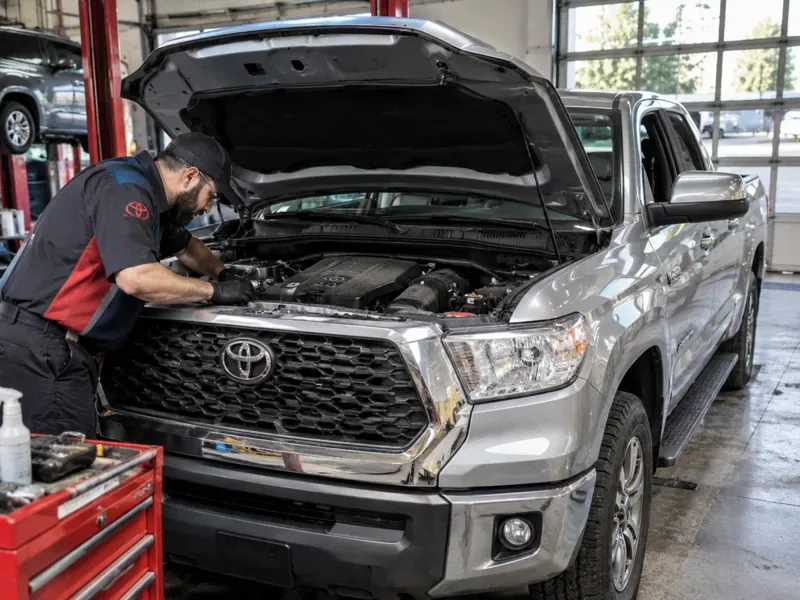
Illustrative image of a Toyota pickup receiving a service inspection; not a photograph of a recalled vehicle or a confirmed recall repair.
What changed in the latest Toyota NHTSA safety recalls?
The most recent recall announcements identified in Toyota’s official U.S. recall newsroom as of this verification were the November 13 Tundra campaign and November 12 airbag campaign. Both are manufacturer recalls reported under the U.S. federal safety-recall system. The affected populations are approximate announced totals, not counts of vehicles confirmed to have failed or counts of crashes.
Which Toyota and Lexus vehicles are covered by the airbag action?
The November 12 front-passenger airbag recall covers certain 2003–2008 Corolla, 2005–2006 Tundra, 2005–2007 Sequoia and 2016–2017 4Runner vehicles, plus certain Lexus SC 430, IS 250 and GX 460 vehicles in specified model years. Toyota reports approximately 314,000 U.S. vehicles in the campaign. Affected Takata inflator propellant may deteriorate after long-term exposure to heat and humidity; in an airbag deployment, a rupturing inflator can send metal fragments into the cabin, potentially causing severe injury or death. Dealers will replace the passenger inflator or, on some vehicles, the airbag assembly at no cost. The precise affected VIN population should be checked against official records; not every example of those models is necessarily included. See the Toyota airbag recall announcement.
What is wrong with the recalled Tundra pickups?
Toyota’s November 13 notice covers certain 2022–2023 and 2025–2026 Tundra non-hybrid pickups, approximately 62,000 in the United States. An engine camshaft from a particular supplier production lot may have been improperly manufactured and could break while the truck is moving, potentially causing loss of propulsion at higher speeds and increasing crash risk. Toyota says an estimated 300 camshafts from the affected lot may have been installed in these vehicles; that estimate does not mean 300 confirmed failures. Dealerships will inspect the camshaft and replace it free of charge if it belongs to the affected lot. Read the official Toyota Tundra recall notice.
What should Toyota drivers do immediately?
Identify the car accurately. Find the 17-character VIN at the lower windshield on the driver’s side or on registration or insurance documents. Do not rely only on the model year.
Contact an authorized dealership. Give the VIN and recall number or campaign description. Ask whether the remedy can be completed now, whether parts need ordering and what the manufacturer advises about continued use.
Respond to danger signs, not just notices. If an engine loses power or drives abnormally, move out of traffic as safely as possible and arrange roadside assistance as needed. If the vehicle cannot be operated safely, do not attempt to drive it to the dealership. For an airbag recall, obtain model-specific instructions directly from the manufacturer; do not attempt to disable or repair the airbag yourself.
Keep records. Save the VIN search result, dealer confirmation, appointment and completed repair paperwork. Check again if a campaign is newly announced but your VIN is not yet shown.
Neither announcement should be read as a blanket instruction that all Toyota owners must stop driving. Likewise, the absence of a universal “do not drive” notice is not a guarantee that a vehicle is safe under every circumstance. Ask Toyota or the dealer for guidance tied to your VIN and symptoms. If a dealer cannot promptly provide an answer for an actively malfunctioning vehicle, seek safe towing and roadside help rather than testing it on the road.
Are Toyota recall repairs free, and how long will owners wait?
Toyota states that the specified repairs in both November recalls will be provided without charge. The airbag campaign calls for an inflator or airbag assembly replacement; the Tundra campaign starts with inspection and requires camshaft replacement only when the part is from the implicated lot. The time a driver spends without a vehicle will depend on dealer scheduling, parts availability and the work needed on the individual vehicle. Toyota did not provide a universally applicable appointment or repair-duration guarantee in these notices, so drivers should not treat any unofficial time estimate as confirmed.
Owners should ask dealers whether the remedy is currently available, whether an interim measure applies, whether towing support is available and whether transportation assistance might be offered. Transportation and reimbursement arrangements are not automatically identical for every campaign; ask for a written explanation of what is covered. If a related repair was already paid for, retain receipts and request an eligibility review rather than assuming reimbursement is guaranteed.
Why can a VIN search show no recall after an announcement?
NHTSA explains that VIN results focus on unrepaired recalls, and some recently announced campaigns may not display every affected VIN immediately. Already completed recalls may not appear in the unrepaired recall results. A “0 unrepaired recalls” response therefore describes the database result at that moment; it is not proof that a vehicle never had a recall or that no new campaign will be added. Toyota’s campaign lookup can also show manufacturer service programs that differ from federal safety recalls. If a driver believes their vehicle falls within an announced campaign, they should recheck and contact Toyota with the VIN.
How will the recalls affect drivers through early 2027?
The confirmed near-term impact is the need for VIN checks and dealership contact. Toyota expects to notify owners of both newly announced campaigns by mid-January 2027, but the precise appointment load and parts supply across dealerships have not been established in the reviewed notices. It is reasonable to expect some scheduling variation as owners respond; it would be speculative to claim a national parts shortage or a specific wait time without evidence.
For household vehicles used for school runs, commuting or interstate trips, the main practical consequence is planning: confirm the recall, seek safety guidance, arrange a service visit and consider alternative transportation if the vehicle exhibits a relevant fault. Fleet operators and used-car buyers should run individual VIN checks across their vehicles and retain maintenance records. Toyota’s Brand Engagement Center can be reached at 1-800-331-4331 for questions about these campaigns.
FAQ
Does every Toyota Tundra need a camshaft replacement?
No. The November campaign concerns certain non-hybrid 2022–2023 and 2025–2026 Tundras. Dealers inspect affected vehicles and replace the camshaft only if it is from the implicated production lot.
Can I get my Toyota recall repaired for free?
Yes. Toyota says the specified safety-recall remedy for affected vehicles in these two campaigns will be provided free of charge by an authorized dealer.
Should I wait for the recall letter to check my car?
No. Search your VIN now through Toyota or NHTSA, then ask a dealer about the appropriate next steps. Recheck if a newly announced campaign has not yet populated every VIN.