Home
» Today
»
WA Police Facial Recognition: 122 Arrests and How It Works — Nov. 5, 2026
WA Police Facial Recognition: 122 Arrests and How It Works — Nov. 5, 2026
Information checked: November 5, 2026, 1:27 a.m. Australian Western Standard Time (AWST, UTC+08:00), equivalent to November 4, 2026, 17:27 UTC. The latest WA Police trial totals cited here were published on November 2, 2026.
Western Australia Police says its five-month trial of live facial recognition has ended after 1,380,882 face scans and 122 arrests. The force reported 292 system alerts, including nine incorrect alerts, during 100 deployments at 43 locations. The announcement raises a practical question for anyone who walked past a camera-equipped police van: what exactly did the system record, and what happened when it flagged a face?
The trial stopped operating on October 31, 2026. WA Police is now evaluating the technology, its effectiveness, its effects on the community, and whether its controls worked as intended. An alert is not automatic proof of identity or criminal wrongdoing; police say an officer must assess it and have a separate lawful basis for taking action. These figures come from the WA Police official trial update.
Destaques
The live facial recognition trial ran from June 22 to October 31, 2026, in metropolitan and regional Western Australia.
Police reported 1,380,882 scans, 292 alerts, nine incorrect alerts, 122 arrests, and 10 welfare checks.
A possible facial match prompted human review; the technology alone did not give officers grounds to arrest someone.
The trial has ended. A decision to introduce permanent live facial recognition deployments has not been confirmed in the official update.
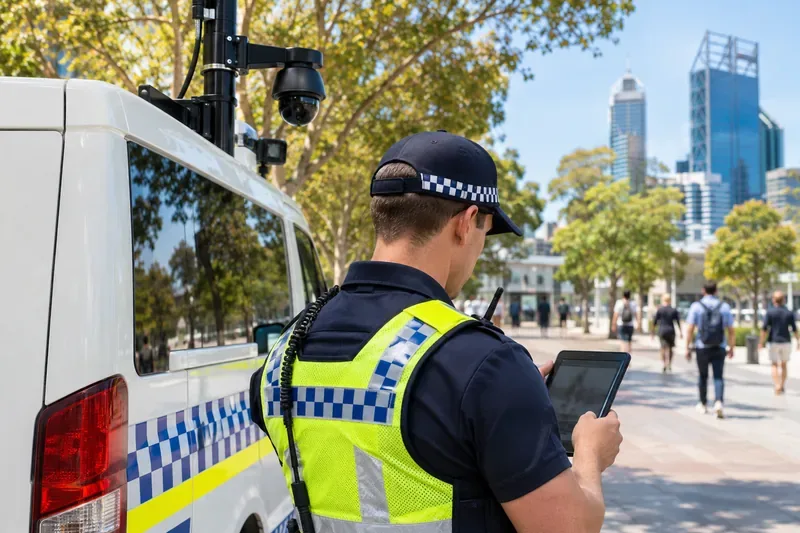
Illustrative image of a camera-equipped police vehicle in a public setting; this is not a photograph of a specific WA Police deployment or arrest.
What happened in the WA Police facial recognition trial?
WA Police began testing overt live facial recognition on June 22, 2026. The cameras were placed on or near visibly marked police vehicles and used at designated public locations, including busy urban areas and large events. Police say deployments were based on operational needs rather than continuous, statewide camera coverage.
Measure
Police-reported trial result
Operational period
June 22–October 31, 2026
Deployments and locations
100 deployments at 43 locations
Faces scanned
1,380,882
Alerts generated
292, including nine deemed incorrect
Arrests reported
122
Registered sex offenders identified and engaged
146
People located for welfare checks
10
The count of scans should not be interpreted as a count of unique people: an individual might pass a camera more than once. Likewise, 122 arrests is an operational total, not a published count of convictions or a verified number of arrests caused exclusively by algorithmic matches. Police previously described other arrests arising from targeted policing alongside facial recognition deployments, as shown in an earlier official operational update.
What happened at the Perth Royal Show?
At the Perth Royal Show, three deployments scanned 223,749 faces and generated 15 alerts. Police reported three arrests and seven interactions with registered sex offenders. These are included within the overall trial totals, not additional arrests. Interaction with a person on a police alert list does not necessarily mean that person committed a new offense.
How does WA Police live facial recognition technology work?
Live facial recognition is a real-time comparison tool, not a camera that independently establishes someone's legal identity. WA Police describes the process as follows:
Capture: A camera on or near a marked police van detects faces passing through its field of view in a selected public space.
Template creation: Software converts visible facial features into a biometric template, a mathematical representation used for comparison.
Watchlist comparison: The template is checked against a predefined list of facial images lawfully held by police. Categories can include people with outstanding warrants, people suspected of serious offenses, missing people, and people subject to certain restrictions or welfare concerns.
Possible-match alert: When the similarity score crosses a preset threshold, the system issues an alert. A score indicates statistical resemblance; it is not a finding of guilt.
Officer verification: Trained officers review the alert alongside observations and other information, decide whether to approach the person, and establish whether they have legal grounds for any further action.
WA Police says it uses a conservative similarity threshold and reviews all alerts. This use of a limited police alert list should not be confused with the separate National Driver Licence Facial Recognition Solution, which is described by Transport WA as a consent-based identity verification service rather than a mass-surveillance tool.
How accurate was the facial recognition system?
The most widely circulated statistic needs context. Police described nine incorrect alerts among 1,380,882 scans as an incorrect-alert rate of approximately 0.00065% per scan. That calculation is mathematically consistent with the published counts, but it does not tell the whole story of what a flagged person might experience.
Measured against the 292 alerts, nine incorrect alerts represent approximately 3.1% of alerts. These denominators answer different questions. The first describes how rarely any scan led to a reported incorrect alert; the second describes how many reported alerts were considered incorrect. Neither establishes the system's false-negative rate, demographic performance in this deployment, or the ultimate court outcomes of arrests.
The police report does not provide a complete public breakdown of alert outcomes, prosecutions, or convictions. That matters because a system can produce few mistaken alerts while still raising questions about missed matches, human decisions after alerts, or disproportionate effects on certain communities. A face match should be treated as an investigative lead requiring verification, not a substitute for evidence.
What happens to your face if you walk past a police camera?
According to WA Police, a face that does not trigger an alert is pixelated on the operator's display, and the biometric information is deleted automatically and immediately, rather than retained as a searchable record. Police also say biometric data is deleted after each deployment, while details of an alert may be retained where needed for an investigation or complaint. The force states that data is not shared with third parties.
These are the agency's stated handling rules; they are not proof that an independent reviewer has audited every deletion or access event. The police published a privacy impact assessment and says every deployment required authorisation by an officer of Superintendent rank or above, including consideration of necessity, proportionality, location, and the alert-list categories. The public-facing procedures also describe extra scrutiny near sensitive settings such as hospitals, schools, and places of worship.
Why are privacy advocates concerned about WA Police facial recognition?
The central debate is not whether officers may try to locate wanted people. It is whether scanning large numbers of bystanders is proportionate to that goal, whether the public can scrutinize results, and how errors are identified and corrected. Reporting by ABC News on privacy and legal advocates' concerns described questions about oversight, transparency, and effects on Aboriginal communities.
Facial recognition can also reflect the composition of a watchlist and the circumstances in which police deploy it. Even if software performs similarly across demographic groups in a laboratory, disparities can arise in who is on the list, which public places are scanned, and how people are treated after an alert. Police cite external testing of the underlying algorithm, but the public trial totals alone do not establish equal performance across every demographic group or use case in Western Australia.
Western Australia's Office of the Information Commissioner explains that most obligations under the Privacy and Responsible Information Sharing Act 2024 commenced on July 1, 2026, and that WA Police is among the public entities subject to its privacy framework. Whether a particular collection, disclosure, or action is lawful depends on the circumstances and applicable legal provisions; a police statement that a technology is lawful is not the same as an independent legal finding about every deployment.
Will WA Police use live facial recognition again?
That decision has not been announced in the official November 2 report. The cameras' trial operations ended on October 31, and the next step is an internal evaluation of system performance, operational effectiveness, community impact, governance, and compliance.
For a meaningful public assessment, the key information to watch will be the completed evaluation, any independent scrutiny, the relationship between machine alerts and arrests, how mistaken alerts were handled, and whether new limits or approvals would apply to a future rollout. Those are issues for the review, not confirmed outcomes. People looking for updates should check the WA Police live facial recognition information page rather than assuming the trial is still running.
FAQ
Did WA Police arrest 122 people using facial recognition?
WA Police reported 122 arrests during its live facial recognition trial. It has not published a complete breakdown proving how many arrests were directly attributable to system alerts, or their eventual court outcomes.
Can a facial recognition match alone justify an arrest?
No. WA Police explicitly says an alert alone is not grounds to arrest someone or exercise police powers. Officers must verify the situation and act under applicable law.
Is WA Police still scanning faces in public with this trial?
No. The specified trial ended on October 31, 2026. As of the November 5 information check, the official update described an internal evaluation, not a confirmed permanent rollout.