01. Historical Context
Walmart in context: what the current price already assumes
Walmart closed at $132.46 on May 14, 2026. Over the last 10 years, adjusted monthly closes ran from $19.00 to $132.46, which translates to an approximate 20.5% compound annual return from the first monthly close in the series to the latest one. That long record matters because it shows Walmart is no longer trading like a low-multiple legacy retailer; the market now prices it more like a resilient platform with multiple profit pools.
| Horizon | What matters most | What would strengthen the thesis | What would weaken the thesis |
|---|---|---|---|
| 1-3 months | Quarterly guidance, comp sales, and the market's tolerance for 44x forward earnings | Comp growth remains firm and the stock holds near the current price despite a tougher macro tape | EPS guidance slips or ad growth cools faster than expected |
| 6-18 months | Whether ad, marketplace, and automation economics keep lifting margins | Adjusted EPS tracks above the official FY27 range and cash flow stays strong | Operating leverage fades while the premium multiple remains elevated |
| To 2030 and beyond | Share gains plus margin mix | Walmart keeps widening non-retail profit pools | The stock reverts toward a normal staples multiple before earnings catch up |
The operating evidence behind that rerating is real. Walmart's FY26 revenue reached $713.2 billion, up 4.7%, while global eCommerce grew 24% and the advertising business grew 46% to nearly $6.4 billion. That mix shift is why investors are willing to pay 44.05x forward earnings instead of a historical staples multiple.
The important distinction now is between a strong company and an easy stock. The company can keep executing while the stock delivers only moderate returns if valuation, rates, or estimate revisions stop helping at the same time.
02. Key Forces
Five forces that will decide whether the stock can outperform from here
The first force is valuation discipline. Yahoo Finance showed Walmart at 47.78x trailing earnings and 44.05x forward earnings in early May 2026, versus FactSet's 20.9x forward 12-month P/E for the S&P 500 on May 1, 2026. That premium can hold, but it requires the market to keep believing Walmart deserves a structurally higher multiple than the index.
The second force is earnings conversion. Walmart's official FY27 guide calls for net sales growth of 3.5% to 4.5% and adjusted operating income growth of 6.0% to 8.0% in constant currency, with adjusted EPS of $2.75 to $2.85. Yahoo Finance analyst pages also showed an average FY27 EPS estimate of $2.92 and FY28 of $3.28. The stock can work if those numbers hold or rise; it gets vulnerable if they drift lower.
The third force is profit mix. FY26 global eCommerce growth of 24%, advertising growth of 46%, and membership-fee growth of 15.1% all point to a business becoming less dependent on traditional store economics. That is the main reason Walmart can plausibly defend a premium valuation even if core retail stays low margin.
The fourth force is macro. The BLS reported headline CPI at 3.8% year over year in April 2026, while BEA reported headline PCE at 3.5% and core PCE at 3.2% for March 2026. If inflation stays sticky, the discount-rate headwind is real; if it cools again without a growth scare, Walmart keeps the kind of macro backdrop that supports defensive compounders.
The fifth force is estimate breadth. FactSet said on May 5, 2026 that the Q2 2026 bottom-up EPS estimate for the S&P 500 rose +2.1% in April and the full-year estimate rose +3.4% to $331.23. In a rising-estimate tape, expensive stocks can stay expensive. If that breadth rolls over, the market becomes less forgiving toward premium names like Walmart.
| Factor | Current data | Current assessment | Bias |
|---|---|---|---|
| Valuation | Trailing P/E 47.78x; forward P/E 44.05x versus S&P 500 20.9x | Rich but still explainable if EPS revisions stay positive | Neutral to Bear |
| Fundamentals | FY26 revenue $713.2 billion; eCommerce +24%; ads +46% | Operations support the thesis | Bull |
| Guidance | FY27 sales 3.5% to 4.5%; adjusted EPS $2.75 to $2.85 | Good, but not loose enough for valuation mistakes | Neutral |
| Macro | CPI 3.8%; PCE 3.5%; core PCE 3.2%; GDP 2.0% | Still a live rate risk | Neutral |
| Estimate breadth | FactSet: Q2 bottom-up EPS estimate rose +2.1% in April | Supportive backdrop for high-quality equities | Bull |
This setup should be read as a probability distribution, not a slogan. The stock can still work from here, but the next return profile will be determined by how these factors interact, not by brand strength alone.
03. Countercase
What would break the thesis
The first risk is simple valuation compression. With Walmart at 47.78x trailing earnings and 44.05x forward earnings in early May, investors are already paying well above the broader market multiple that FactSet measured at 20.9x on May 1, 2026. That gap can close even if the underlying business remains healthy.
The second risk is macro stickiness. BLS reported headline CPI at 3.8% in April 2026 and BEA reported headline PCE at 3.5% in March 2026. If inflation stays hot enough to keep real yields elevated, Walmart's premium multiple becomes harder to defend because the stock behaves more like a duration asset than it used to.
The third risk is that official guidance is solid rather than explosive. Management guided FY27 adjusted EPS to $2.75 to $2.85. That is respectable, but when the stock trades around $132.46, the market needs at least stable revisions and preferably higher estimates to justify incremental upside.
The fourth risk is mix fatigue. Advertising grew 46% and global eCommerce grew 24% in FY26, but if those higher-margin streams slow toward the growth rate of the core business, investors may stop paying a platform-style multiple for a retailer with a still-thin consolidated margin profile.
| Investor type | Main risk | Suggested posture | What to monitor next |
|---|---|---|---|
| Already profitable | Multiple compression from premium valuation | Trim into sharp strength if fundamentals do not improve with price | FY27 EPS trend versus the $2.75 to $2.85 guidance range |
| Currently losing | Averaging into an expensive but slowing stock | Add only if guidance and margin mix stay intact | Ad growth, eCommerce growth, and quarterly comp sales |
| No position | Buying a great business at a poor entry multiple | Wait for either better estimates or a better valuation | Forward P/E versus the S&P 500 and estimate revisions |
The point of the countercase is not to force a bearish conclusion. It is to define the specific evidence that would make the current base case too optimistic.
04. Institutional Lens
What the current institutional data actually say
The institutional picture is supportive but not euphoric. IMF's April 14, 2026 World Economic Outlook projects global growth of 3.1% in 2026 and 3.2% in 2027. BEA then printed U.S. real GDP growth at 2.0% annualized for Q1 2026. That is enough growth to support a defensive share-gainer like Walmart, but not so strong that valuation stops mattering.
The inflation backdrop is still mixed. BLS reported 0.6% month-over-month CPI and 3.8% year-over-year CPI for April 2026, while BEA reported 3.5% headline PCE and 3.2% core PCE for March 2026. In practice, that means Walmart keeps its defensive demand characteristics, but rate-sensitive rerating upside is capped until inflation cools more convincingly.
FactSet's May 1, 2026 update showed 84% of S&P 500 companies beating EPS estimates and aggregate earnings landing 20.7% above estimates, with blended Q1 growth at 27.1%. On May 5, 2026, FactSet also said the Q2 bottom-up EPS estimate rose +2.1% in April instead of falling, which is unusual. That kind of positive breadth helps premium stocks hold up, but it does not erase Walmart's company-specific valuation risk.
| Source | Latest update | What it says | Why it matters here |
|---|---|---|---|
| IMF | April 14, 2026 | Global growth projected at 3.1% for 2026 and 3.2% for 2027 | Defines the macro corridor for demand and discount rates |
| BLS | May 12, 2026 | CPI 0.6% month over month and 3.8% year over year in April 2026; core CPI 2.8% | Shows how much rate pressure may still matter for valuation |
| BEA | April 30, 2026 | Headline PCE 3.5% and core PCE 3.2% in March 2026; GDP 2.0% annualized in Q1 2026 | Tracks inflation persistence and growth resilience |
| FactSet | May 1, 2026 | 84% of reporting S&P 500 companies beat EPS; blended Q1 growth 27.1%; forward P/E 20.9x | Measures whether the tape still rewards premium equities |
| Walmart | February 19, 2026 | FY26 revenue $713.2 billion; FY27 adjusted EPS guidance $2.75 to $2.85 | Company baseline for scenario ranges |
The useful takeaway is that institutional data are not pointing in one direction only. They support owning quality, but they do not support ignoring valuation or timing risk.
05. Scenarios
Actionable scenarios with probabilities, triggers, and review points
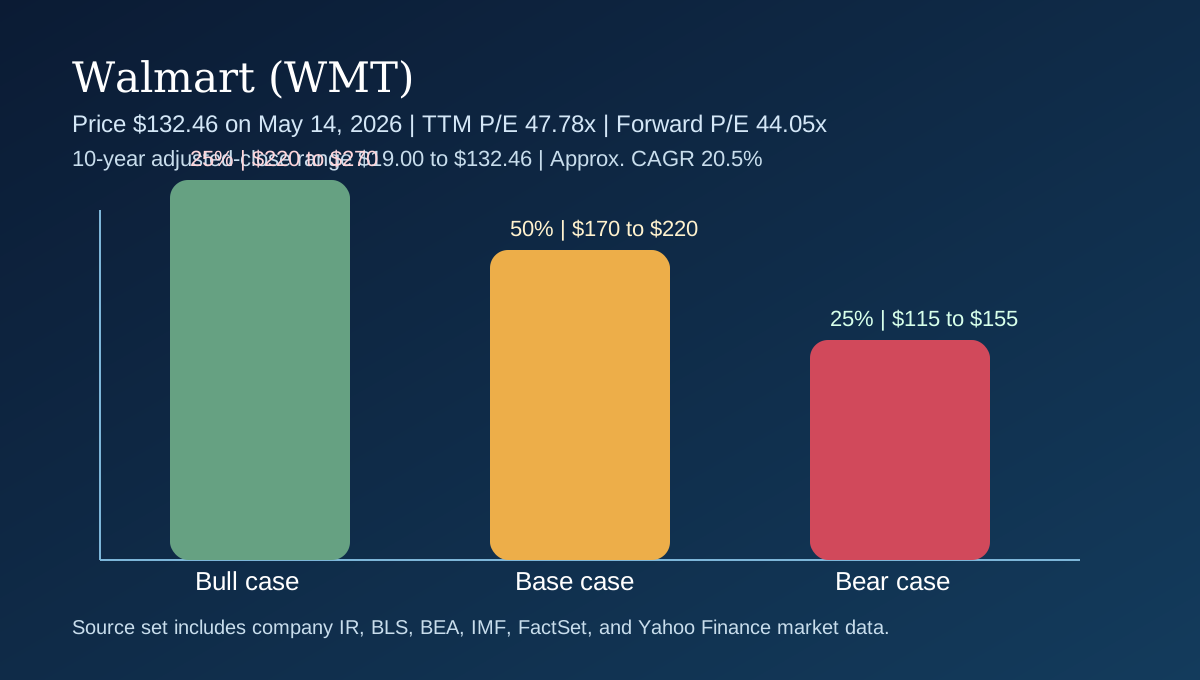
The scenarios for 2030 work best when they are tied to concrete numbers: the current share price of $132.46, FY27 adjusted EPS guidance of $2.75 to $2.85, and a forward multiple already sitting at 44.05x.
Those inputs make the framework actionable. The right question is not whether Walmart is a good company; it is what would have to happen for returns from this starting point to be attractive, mediocre, or poor.
| Scenario | Probability | Target range | Activation trigger | Review point |
|---|---|---|---|---|
| Bull case | 25% | $220 to $270 | Marketplace, automation, and advertising keep widening profit mix and annual EPS compounds comfortably above low double digits. | Recheck each annual report, with the next major review after FY28 and FY29. |
| Base case | 50% | $170 to $220 | Walmart keeps taking share in grocery and general merchandise, but the multiple fades from the current 44x forward level toward a still-premium range. | Recheck after each fiscal year close through 2029. |
| Bear case | 25% | $115 to $155 | Margins plateau, rate pressure keeps the market unwilling to pay a premium, and digital profit pools mature faster than expected. | Recheck if free cash flow stalls or if international and ad growth both slow sharply. |
The scenarios are intentionally range-based because a stock this widely followed can overshoot in both directions. What matters is whether the evidence set is moving toward the bull, base, or bear path when each review point arrives.
That approach makes the article more useful in practice: it gives readers a checklist for when to add, when to wait, and when to reduce risk.
References
Sources
- Yahoo Finance 10-year monthly chart data for Walmart (WMT)
- Yahoo Finance quote page for Walmart (valuation measures and analyst targets)
- Walmart Q4 FY26 earnings release
- Walmart 2026 annual report and proxy statement release
- BLS Consumer Price Index News Release for April 2026
- BEA Personal Income and Outlays for March 2026
- BEA GDP advance estimate for Q1 2026
- FactSet S&P 500 Earnings Season Update, May 1, 2026
- FactSet estimate revision update, May 5, 2026
- IMF World Economic Outlook, April 2026