Home
» Today
»
Wetherspoons Poppy Ban: What the Claims Mean and What to Check
Wetherspoons Poppy Ban: What the Claims Mean and What to Check
Searches for “Wetherspoons poppy ban” rose after footage from The Star, a Wetherspoon pub on Gosport High Street in Hampshire, circulated on Sunday, October 25, 2026. Local reporting described a veteran and other customers being refused entry while wearing red remembrance poppies. In the clip, a staff member appears to call the poppy political and tells customers they can enter if they remove it. That exchange is evidence of what happened at the door; it does not, by itself, prove a written rule across the chain. The News’ report from Portsmouth describes the video and the responses that followed.
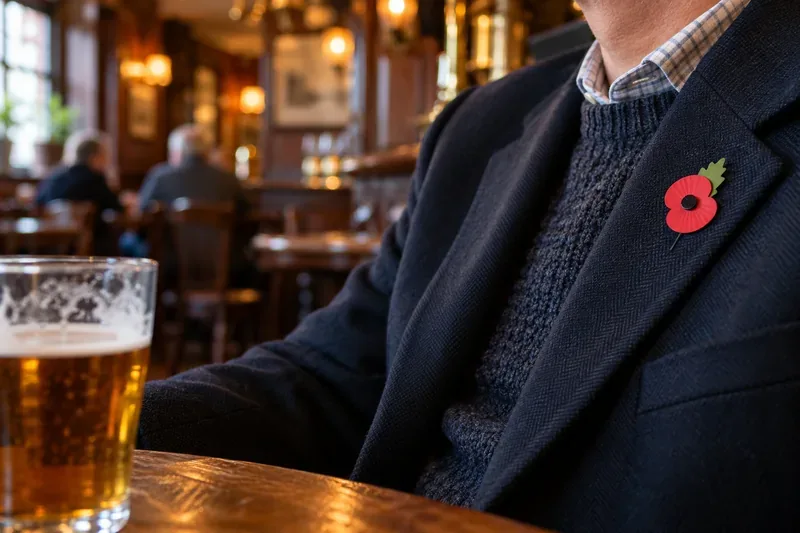
A red remembrance poppy pin on a dark jacket inside a pub; this is a general scene, not a photograph of the Gosport incident.
What Wetherspoon has confirmed
In a company release dated October 26, Wetherspoon rejected the claim that it had banned veterans from wearing poppies. It said the company has long supported the Royal British Legion’s Poppy Appeal and sells poppies in its pubs. The release also said demonstrations were taking place near The Star, additional security measures were in place, and some people wearing poppies—as well as other members of the public—were refused entry. The company apologized to customers for the disruption. Read the company’s October 26 release.
Those points can be true at the same time: Wetherspoon can deny a chain-wide poppy policy while customers wearing poppies were turned away during a specific incident at one pub. The release does not explain who gave staff the instruction heard in the footage, whether it was approved by head office, or exactly how the security rule was applied. So the broad headline “Wetherspoons bans poppies” goes further than the company’s published explanation supports, while “nobody was turned away for wearing a poppy” would also misstate the company’s own account.
One unresolved detail: the pub closure
Wetherspoon said The Star closed for the rest of the day on police advice. The News reported that Hampshire Constabulary disputed being the source of that instruction: police said officers did not ask pubs to close, no offenses were identified, and the group dispersed. That disagreement concerns the reason for the closure; it does not erase the reported refusals at the entrance or establish why each person was refused. Keep the two questions separate when you see a post about the incident.
What “ban” can mean in a viral post
Check what the post actually alleges before repeating it. A chain-wide policy would mean a rule applying across Wetherspoon pubs. A branch-level instruction would be limited to a particular pub, staff team, or period. A refusal of entry describes what happened to a person on a specific visit. These claims have different levels of evidence. The reported Gosport incident supports the narrower point that some people wearing poppies were refused entry at The Star on October 25; it does not establish a permanent or nationwide rule.
Also separate what can be heard or seen from what someone infers. A short video may show a customer being told to remove a poppy, but it may not show the full conversation, the preceding events, or the manager’s instructions to other staff. A social media caption may add claims about company policy that are not in the footage. Attribute each statement to its source—customer, staff member, company, police, or reporter—rather than folding them into one asserted fact.
How to check the claim before sharing it
Confirm the date and place. Look for the original upload or a full report naming The Star in Gosport, not just a repost with a dramatic caption. Older poppy-related stories can be recirculated as if they are new.
Read the company’s own update. Compare the official statement with the viral wording. Note both what the company denies and what it acknowledges: security measures, refusals, and an apology.
Check independent, local reporting. For details about the police response or the sequence of events, look for reporting that quotes Hampshire Constabulary and identifies where the information came from. Do not treat the company’s account of police advice as a police statement.
Look for a follow-up about policy. A public clarification, branch notice, or response to a customer complaint can show whether the company explained the instruction or changed its guidance. Until then, do not describe the unanswered points as settled.
Avoid legal conclusions from a clip. Whether a particular refusal was lawful depends on facts and applicable rules that a short video cannot establish. The footage is not, on its own, a legal finding.
What the poppy means—and what it does not prove
The Royal British Legion describes the red poppy as a symbol of remembrance, support for the Armed Forces community, and hope for a peaceful future. It says wearing one is a personal choice. The Legion’s 2026 Poppy Appeal launched on October 22 and supports serving personnel, veterans, and their families. The Legion’s explanation of the poppy and its 2026 Appeal information provide useful context.
That context explains why the refusal prompted a strong reaction, but it does not answer the separate question of who set the door policy that day. Nor should a person’s choice to wear—or not wear—a poppy be treated as proof of their political views. Wetherspoon’s own charity information also says its UK pubs support the Royal British Legion’s appeal by selling poppies and fundraising. Check Wetherspoon’s charity and community information for the company’s standing relationship.
What can be concluded now
The clearest supported account is specific: on October 25, customers wearing poppies were refused entry at The Star in Gosport during a period of demonstrations and extra security. Wetherspoon says there is no chain-wide poppy ban, while its release does not fully explain the instruction heard in the video. The police advice behind the pub’s closure is also disputed in local reporting. When sharing the story, state those distinctions plainly and revisit the claim if the company or police publish a fuller account.