Have you ever heard of the most accurate clock , 14 billion years off 1 second? That is the atomic clock! Check out this article to learn more about an atomic clock and how it works!
1. What is atomic clock?
An atomic clock is a clock used to count time according to the number of fluctuations of an atom .
The oscillation frequency of the atom is fixed and can be measured, so an atomic clock is an absolutely accurate clock with no errors .

Currently atomic clocks are used to determine UTC International time (short for Coordinated Universal Time, international coordinated time proposed by the International Metrology Agency (BIPM) as the legal basis for locating time. time).
Atomic clocks are widely used in rockets, drones , and are used to measure distances on satellites for GPS, GLONASS, Galileo satellite systems .
See also: What are GPS and GLONASS navigation systems?
2. Is the atomic clock accurate?
The best mechanical watches have an error of between -4 and +6 seconds in a day , while quartz watches (battery-powered watches) are within + -2 seconds in 10 days .
![What is atomic clock? The principle of atomic clock operation]()
Whereas atomic clocks are out of error 1 second in about 14 billion years , which means there is almost no error. We need not doubt the accuracy of the atomic clock. Because no one has had enough time to check its accuracy.
Also because it is turned on, this type of clock is trusted by scientists , used as a measure of time in all high-tech fields . Contributing a large role in the development of science and technology around the world.
3. Principle of atomic clock operation
An atomic clock is a clock used to count time according to the number of fluctuations of an atom:
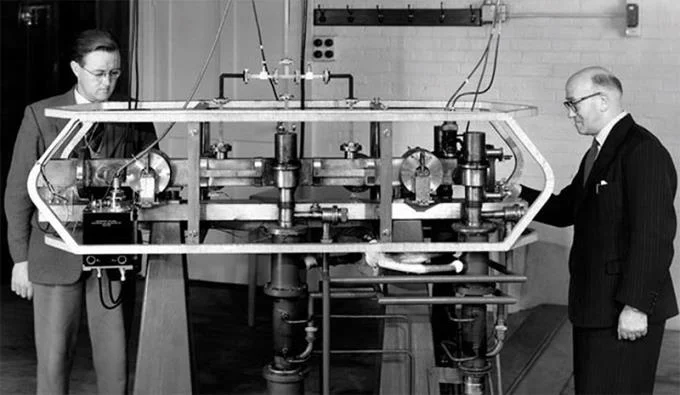
In 1949, the first atomic clock operated by oscillation of the ammonia atom .
Since 1955, the next atomic clock works on the oscillation number of the cesium atom (133Cs) .
![What is atomic clock? The principle of atomic clock operation]()
By 1967, atomic clocks operating on the oscillation number of the cesium-133 atom were used as the standard for determining a second in the Universal Time System. Cesium-133 atom is a safe, non-radioactive atom.
![What is atomic clock? The principle of atomic clock operation]()
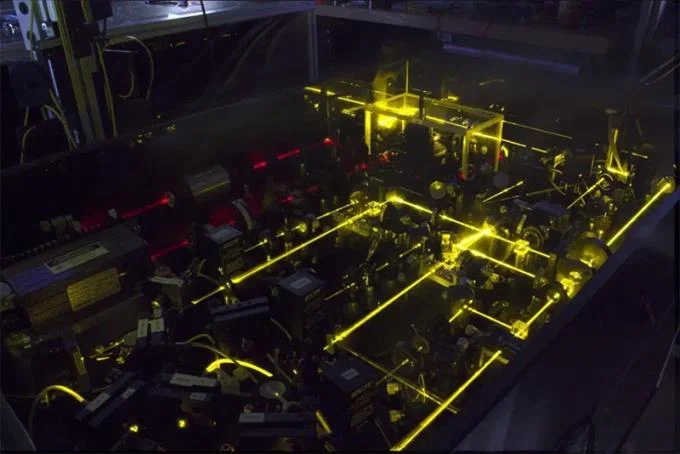
Currently, scientists are working on using light to create an atomic clock.
Atomic clocks work on the basis of excitation for the atom's electrons to jump from low energy to high energy level and vice versa. The electrons of the atom emit electromagnetic waves of a very certain frequency and take the oscillation period of that electromagnetic wave as a standard to measure time.
![What is atomic clock? The principle of atomic clock operation]()
The scientists calculated the Cesium-133 atom for 1 second every 9192631770 cycles of electromagnetic waves emitted. You can simply understand that in 1 second the cesium-133 atom moves between two states of low energy and high energy 9192631770 times, this is the principle of operation of the atomic clock Cesium-133 .
4. Should I buy an atomic clock?
![What is atomic clock? The principle of atomic clock operation]()
Atomic clocks play a very important role in the development of science and technology today and if you are the one who pays attention to every second, the accuracy of an atomic clock will make you satisfied.
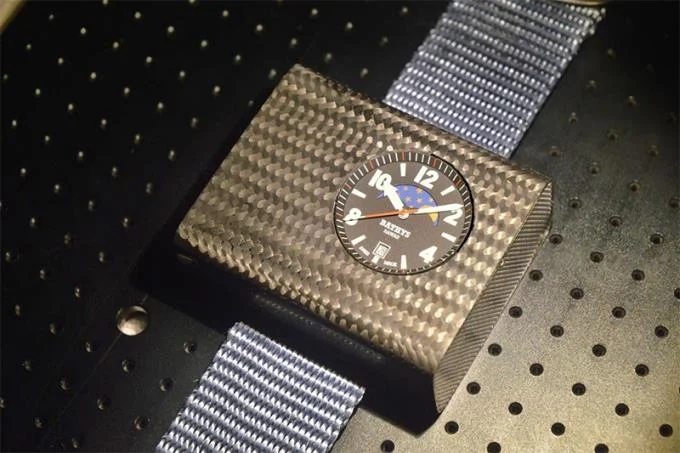
If you love the new, special and the technology to invest in an atomic watch then atomic watches are for you, but the price of these watches is not cheap and the quantity is produced very little. .
See more:
- What is GMT clock? Instructions on how to view GMT clock properly
- What is the water resistance rating of the watch? What do they mean?
- What is automatic movement (Automatic)?