The "CEC" in HDMI-CEC stands for Consumer Electronics Control. It is an optional feature that allows control of multiple HDMI-connected devices from a single remote control (such as a TV remote).
HDMI is the primary connection standard used in AV environments. However, in addition to HDMI-ARC and HDMI-CEC, there is another HDMI feature that not many consumers are aware of. In fact, HDMI-CEC may already be enabled on the device you already own (or you may need to enable it through your TV or device settings menu).
HDMI is the primary connection standard used in AV environments.
Features of HDMI-CEC
HDMI-CEC offers a number of capabilities, which are listed below. However, not everything listed is available on all HDMI-CEC-enabled products. Additionally, compatibility may vary between product brands.
Remote Control Pass - Allows remote control commands to be passed to other devices in a system. For example, you can use your TV remote to control certain functions of other devices connected to the TV via HDMI.
One-Touch Play - When you start playing on your source device, it switches the TV to the HDMI input the device is connected to. For example, when you insert a disc into a Blu-ray Disc player and press Play , it can tell the TV to switch to the HDMI input the player is connected to.
Routing Control - Allows the user to control input source selection. For example, using a TV remote, you can switch input selections on a connected Home Theater receiver.
Deck Control - This feature allows the user, via the TV remote, to control playback features, such as Play, Pause, Rewind, Fast Forward on an HDMI-connected Blu-ray/Ultra HD player, media streaming device and/or cable set-top box.
One-Touch Record - If you have a DVR or DVD recorder that supports HDMI-CEC, you can start recording when you see a program you're interested in on your TV screen.
Timer Programming - You can use an EPG (Electronic Program Guide) included with your TV or cable box, to set the timer with a compatible DVD recorder or DVR.
System Audio Control - Allows the user to control the volume level (or other compatible audio settings) of an HDMI-CEC equipped Home Theater receiver or AV processor/preamp using the TV remote.
Device Menu Control - This feature allows your TV to control the menu system of another device. For example, you can use your TV remote to navigate the menu settings on a connected source device, such as a Blu-ray player, media streaming device, DVR, etc.
System Standby - This feature allows users to put multiple devices into standby mode using one remote control. Using your TV remote, you can switch to each input the source devices are connected to, switching them in and out of standby mode as desired.
Other names for HDMI-CEC
One confusing thing about HDMI-CEC is that it's not always called that by devices. To avoid confusion, here's a list of some of the other names that Home Theater and TV component manufacturers have given HDMI-CEC.
Anthem: CEC Control
Denon: CEC or HDMI Control
Funai, Emerson, Magnavox, Sylvania and some Philips devices : Fun-Link
Hitachi: HDMI-CEC
Insignia: InLink
LG: SimLink
Mitsubishi: NetCommand
Onkyo: RIHD
Panasonic: Viera Link, HDAVI Control, EZ-Sync
Philips: EasyLink
Pioneer: Kuro Link
Samsung: Anynet, Anynet+
Sharp: Aquos Link
Sony: Bravia Sync, Bravia Link
Toshiba: Regza Link, CE-Link
Vizio: CEC
Note : There are other brands not listed and names may change over time.
Pros and cons of HDMI-CEC
Advantage
You can use your TV remote to control some features of devices connected to your TV using HDMI.
The same HDMI cables that connect your audio and video components together can be used as a conduit to control those devices.
Disadvantages
CEC functionality is not required on all HDMI-equipped devices.
On devices with HDMI-CEC, feature access is not always consistent when using components from different brands.
There is no comprehensive control like using the device's own remote or the Universal Remote.
In some cases, HDMI-CEC must be enabled for HDMI-ARC to work.
Sometimes HDMI-CEC will enable or disable devices when you don't want it to.
How to enable HDMI-CEC
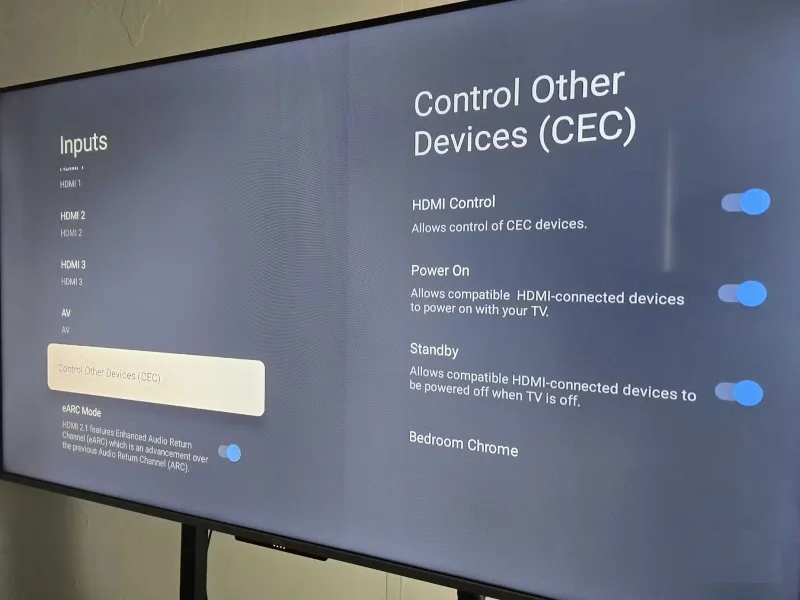
CEC Settings on TCL TV
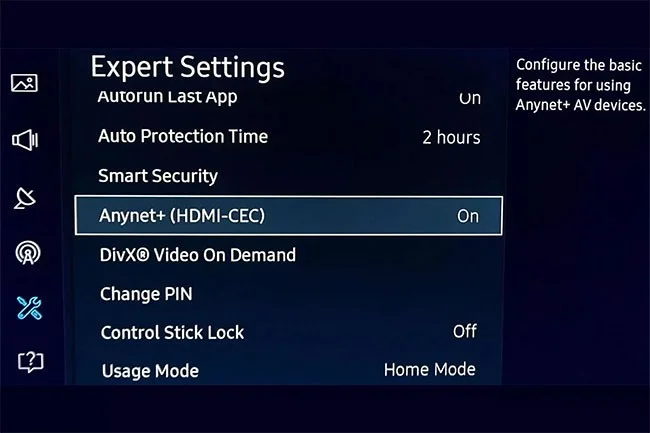
HDMI-CEC goes by a few different names—Samsung calls it Anynet+, LG calls it Simplink, and Sony calls it Bravia Sync. So if you want specific instructions for your TV, you'll have to check your manual or call customer service. But you can usually find it in your TV's settings.
On TCL TVs, to enable HDMI-CEC, go to Settings > Channels & Inputs > Inputs > Control Other Devices (CEC) . Samsung users will find the feature under General > External Device Manager > Anynet+ (HDMI-CEC) .
In addition to enabling this feature on your TV, you should also make sure your streaming box has HDMI-CEC enabled. If you have a Chromecast with Google TV, you'll be able to find it in Settings, under Display & Sound > HDMI-CEC .
Note that not all features work with HDMI-CEC. For example, TCL TVs only recognize and send source commands to Chromecast. So to ensure you can change the TV’s volume and turn it on or off with your streaming device’s remote, you’ll have to configure your remote’s IR blaster to match your TV.
Other ways to control stream settings with a remote
While HDMI-CEC makes it convenient to control some basic functions on your TV with a remote, it’s still not a perfect solution to having just one remote for everything. If you want to simplify your life, buying a universal programmable remote is the best thing you can do. For example, the SofaBaton X1S Universal Remote Control has wide compatibility with a variety of IR devices, potentially allowing you to combine the remotes for your TV, soundbar, and streaming device into one.
The SwitchBot Universal Remote is also perfect if you have multiple SwitchBot smart devices. It's perfect if you want to go beyond controlling your entertainment system and have the ability to control your SwitchBot's lights, blinds, and other smart accessories.
Additionally, if your TV and other streaming devices have an Android or iPhone remote control app, you can download that app to control your devices. Some phones also have built-in IR blasters and remote control apps, allowing you to pair them with your entertainment devices and control them from your phone. Finally, some smart TVs and streaming devices can be controlled with a compatible smarthome hub, like the Amazon Echo or Google Home, allowing for universal voice control.
HDMI-CEC makes it easier to control your TV and streaming devices with a single remote. While it may not give you all the functionality you need to ditch all your other remotes, it does at least give you the basic functionality you need (like changing the volume or turning a device on/off) without having to reach for another one. But if you want to keep things simple, you can ditch a few of the bells and whistles and get a smart TV instead.