Home
» Today
»
Why did Hong Kong stocks fall on November 19, 2026? Reasons for Tencent's 6.55% drop and Alibaba's 5.51% drop, and an outlook for the next trading day.
Why did Hong Kong stocks fall on November 19, 2026? Reasons for Tencent's 6.55% drop and Alibaba's 5.51% drop, and an outlook for the next trading day.
Data verification time: 16:40 on November 19, 2026, Hong Kong time HKT (UTC+08:00; 08:40 UTC).
Hong Kong stocks closed lower on November 19: the Hang Seng Index closed at 22,855.46 points, down 439.29 points, or 1.89%. According to delayed closing data from Yahoo Finance, Tencent (0700.HK) closed at HK$348.40, down 6.55% from the previous close; Alibaba (9988.HK) closed at HK$80.55, down 5.51%. These two large-cap tech stocks fell more than the Hang Seng Index, dragging down sentiment in the tech sector, but the closing decline cannot be attributed to a single reason.
The confirmed pressure comes from several converging factors: Tencent's Q3 results released the previous day showed a year-on-year decrease in operating profit; investment in AI and computing power increased capital expenditures and reduced free cash flow; the minutes of the US Federal Reserve's October meeting again highlighted inflation risks and the possibility of further interest rate hikes; and Alibaba's stock price faced uncertainty ahead of its earnings release. Alibaba is scheduled to hold an earnings conference call at 20:00 Hong Kong time on November 19, which is later than the Hong Kong stock market closes at 16:00, therefore the content of this earnings call cannot be used to explain the Hong Kong stock market decline that has already occurred that day.
Key Points Summary
The Hang Seng Index closed down 1.89% at 22,855.46 points on November 19.
Tencent closed down 6.55%, and Alibaba closed down 5.51%; both fell more than the broader market.
Tencent announced a year-on-year decrease in operating profit and non-IFRS profit, and its free cash flow turned negative in the third quarter. The market is paying attention to the timeline for the return on AI investments.
The focus for the next trading day will be on Alibaba's earnings report and conference call, Fed interest rate expectations, and news on Sino-US technology policies; the market trend will still depend on how new information changes expectations.
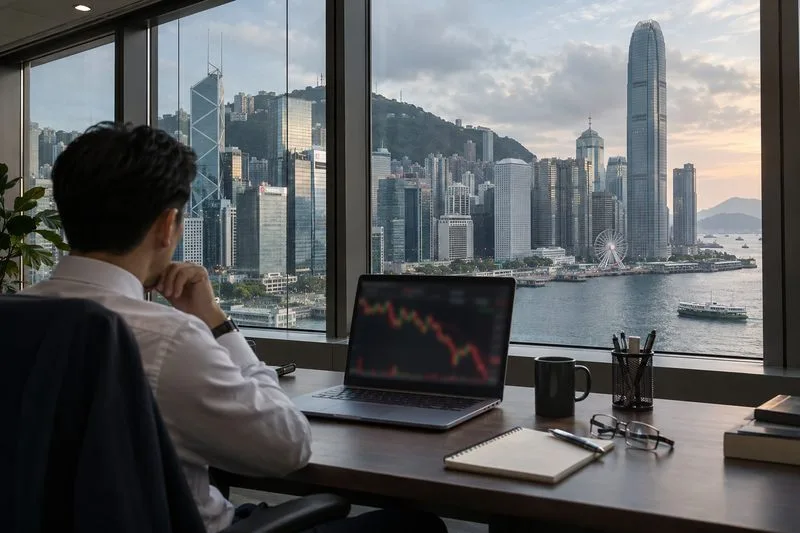
Illustration: A window view of Central, Hong Kong, and a blurry market display; not an actual trading terminal or a photo of the market on that day.
How did Hong Kong stocks perform at the close on November 19?
According to official Hang Seng Index data, the index closed at 22,855.46 points, down 439.29 points, or 1.89%, from the previous trading day; the intraday low was 22,802.21 points. Daily closing data shows Tencent closing at HK$348.40, compared to HK$372.80 the previous close, and Alibaba closing at HK$80.55, compared to HK$85.25 the previous close. These prices and percentages are closing comparisons for a specific trading day and do not represent real-time intraday quotes, nor should they be interpreted as all Hong Kong stocks falling in tandem.
The Hang Seng Index fell less than Tencent and Alibaba, reflecting additional pressure on large platform stocks. These two stocks have high weighting and market attention, so when they decline due to earnings, valuation, or policy risks, it easily amplifies the perception of weakness in the technology sector; however, daily performance is still influenced by other constituent stocks and overall risk appetite.
Why did Tencent's decline exceed that of the Hang Seng Index?
Tencent announced its third-quarter results for the period ending September 30 on November 18. The company reported revenue that increased by 8% year-on-year to RMB 207.336 billion, but operating profit decreased by 7% year-on-year to RMB 59.147 billion, with non-IFRS operating profit decreasing by 6% year-on-year; non-IFRS profit attributable to shareholders also decreased by 6% year-on-year. While revenue still grew, the profit figures have prompted the market to reassess the quality of growth and cost trends.
Investors are particularly focused on the computing power procurement required for AI investments. The company disclosed that its capital expenditures in the third quarter were RMB 81.433 billion, higher than the RMB 52.784 billion in the previous quarter and RMB 12.983 billion in the same period last year; its free cash flow in the third quarter was negative RMB 69.1 billion, and it turned from net cash of RMB 58.2 billion in the previous quarter to net debt of RMB 13.7 billion at the end of the period. The company explained that advance payments for computing power procurement are a significant factor in cash flow; excluding these advance payments, free cash flow would be positive RMB 16.9 billion. This supplement helps to understand the cash flow changes, but it does not eliminate market doubts about the scale of investment, payback period, and profit margins.
There are also external policy risks. A Reuters report on November 18th stated that US government departments were discussing whether to require US companies to publicly disclose their use of Chinese AI models; as of this verification, this is still a policy discussion reported in the media, not a formally implemented regulation. The market may view this as one of the uncertainties surrounding the commercialization of Chinese AI, but it cannot be proven that this report alone caused Tencent's stock price drop that day. The same Reuters report also pointed out that Tencent believes the new restrictions will not significantly impact its current cloud revenue, but may slow down the training of the next generation of models.
Why did Alibaba's stock price fall? Has its financial report been released?
Alibaba's Hong Kong-listed shares closed down 5.51% on November 19th, but the trading session ended earlier than the company's scheduled earnings call. The company's official investor relations announcement stated that it would release its results for the quarter ended September 30th before the US stock market opened on November 19th, followed by a conference call at 8:00 PM Hong Kong time. Therefore, before the Hong Kong stock market closed, the market was focused on the upcoming results and management outlook, rather than the already released quarterly results.
Alibaba is simultaneously affected by both technological and policy risks. A Reuters report on US discussions regarding the disclosure of Chinese AI model usage may cause the market to reassess the regulatory uncertainty surrounding the overseas commercial applications of Alibaba's Qwen and other products; however, there are currently no new disclosure rules in effect, and it cannot be inferred from this that Alibaba's business has been effectively restricted. Going forward, we should rely on the company's official financial results, cloud and e-commerce business data, capital expenditures, and management's statements on the future.
How will the Federal Reserve meeting minutes affect Hong Kong-listed technology stocks?
The Federal Reserve released the minutes of its October 27-28 meeting on November 18th (US time). The minutes stated that if inflation and the labor market develop as per the baseline scenario, almost all participants believed that further interest rate hikes might be necessary in the coming months to ensure inflation returns to the 2% target. Tighter interest rate expectations will increase discounting pressure on long-duration growth stocks and may also reduce investors' willingness to bear high capital expenditures and longer-term AI returns. This is a possible transmission mechanism used by the market in pricing, and does not mean that the Fed has decided to raise interest rates in December, nor does it mean that a single factor can explain the entire decline in Hong Kong stocks that day.
What should we watch for in the Hong Kong stock market on the next trading day?
The next trading day for Hong Kong stocks is Friday, November 20, 2026. The direction should not be predetermined; three scenarios can be used for observation:
Positive Scenario: If Alibaba's earnings report and outlook exceed market expectations and show that growth in cloud computing, AI, or core e-commerce can support investment, tech stocks may see short covering or valuation repair; however, it remains to be seen whether trading volume and other large tech stocks follow suit.
Baseline Scenario: If Alibaba's data largely meets expectations, but management fails to address concerns about the investment payback period, the stock price may remain highly volatile, with individual stocks showing divergent performance within the sector. The market will also continue to digest the risks associated with the Fed's data release and US-China technology policy.
Bearish scenario: If Alibaba's performance or outlook falls short of market expectations, or if the gap between computing power investment and profitability widens, selling pressure on technology stocks may continue; if interest rate hike expectations are revised upward again or Sino-US technology restrictions intensify, risk appetite may weaken further.
Investors should pay attention to Alibaba's conference call at 20:00 Hong Kong time, including its explanation of cloud and AI revenue, capital expenditures and cash flow, as well as the market's repricing of the Fed's December decision. The Hong Kong Stock Exchange calendar lists November 20th as the date for the Hang Seng Index review announcement, which may affect expectations of constituent stock adjustments; however, the announcement itself does not guarantee a directional movement of the index or individual stocks. The above scenario is a conditional analysis and not a price target or investment advice.
Frequently Asked Questions
How much did Tencent and Alibaba each fall on November 19th?
According to delayed closing data from Yahoo Finance, Tencent closed at HK$348.40, down 6.55%; Alibaba closed at HK$80.55, down 5.51%.
Was Alibaba's earnings report the reason for the decline in Hong Kong stocks that day?
The earnings conference call is scheduled for 20:00 Hong Kong time, which is after the Hong Kong stock market closes at 16:00. Trading on that day reflects expectations and uncertainties prior to the earnings release, and the closing price drop cannot be explained by the results not yet released.
Will Hong Kong stocks definitely rebound on November 20?
Not necessarily. Earnings reports, Fed rate expectations, and US-China technology policies can all influence market sentiment; the direction will depend on new information and market reactions.