Home
» Today
»
Why Madonna Is Trending After the 2026 VMAs: What’s Confirmed and What Isn’t
Why Madonna Is Trending After the 2026 VMAs: What’s Confirmed and What Isn’t
Madonna is seeing a sharp rise in U.S. search interest after the 2026 MTV Video Music Awards, and the strongest verified explanation is not a mystery scandal or an unconfirmed rumor. It is a combination of three concrete, high-attention events: she opened the VMAs with her first live performance at the show in 23 years, she entered the night as the leading nominee, and she finished as the night’s biggest winner with seven awards.
Those facts are supported by official MTV/CBS materials published around the Sept. 27 ceremony. What search data cannot tell us by itself is exactly which moment drove each person to look her up. Some searches may be about the performance, some about her wins, some about her collaborators, and some about her broader VMA history. That distinction matters because a trending name is evidence of attention, not proof of one single cause.
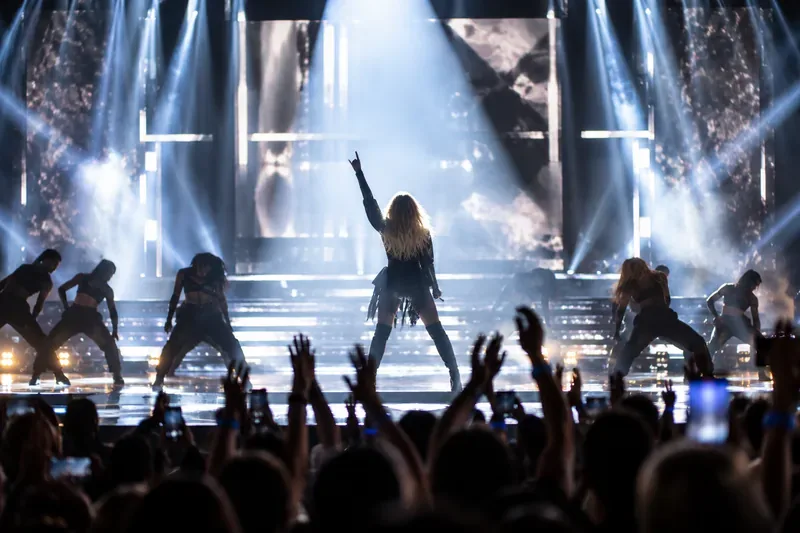
A high-energy arena performance scene reflects the kind of live-event visibility that can drive post-show searches for a major pop artist.
The biggest confirmed reason: Madonna opened the 2026 VMAs
The clearest trigger is Madonna’s return to the VMA stage. CBS and MTV announced before the show that she would open the 2026 ceremony, marking her first live VMA performance in 23 years. The official announcement also emphasized how closely her career is tied to the awards, including landmark appearances dating back to the first VMAs in 1984.
That kind of return naturally creates several layers of search demand at once. Longtime fans may look for video of the performance. Younger viewers may search her name after seeing her introduced as a major figure in VMA history. Others may search to understand why the comeback was being treated as a milestone.
Useful action: If you are trying to understand the trend, start with the event itself rather than social-media speculation. The official CBS/MTV announcement of Madonna’s VMA opening performance confirms the 23-year gap and the planned show-opening role.
She also led the night with seven wins
The second major reason is the awards result. Paramount’s official post-show release says Madonna “led the night with seven wins.” Among the categories listed there are Artist of the Year, Best Collaboration for “Bring Your Love” with Sabrina Carpenter, Best Dance for “Confessions II – The Film,” Best Cinematography, Best Choreography, Best Long Form Video and Best Album.
That is important because it turns the story from “Madonna returned to perform” into “Madonna returned and dominated the results.” A large awards haul produces its own second wave of interest after a live event, especially when viewers who missed the broadcast encounter winner lists, clips and social posts afterward.
Useful action: If you see a post claiming Madonna won a specific VMA, compare it against the official 2026 VMA winners release. That is a better check than relying on screenshots or reposted winner graphics.
Was she really the most-nominated artist? Yes, but the number changed
This is one area where readers can easily encounter apparently conflicting numbers. The original nominations announcement, dated Aug. 18, listed Madonna with 11 nominations, ahead of Taylor Swift with nine. A later VMA tip sheet published around the show listed Madonna with 13 nominations and Taylor Swift with 11.
Both figures can appear in legitimate official materials because the nomination picture changed as the event added later categories. The initial release explicitly described the first announced slate and listed 11 Madonna nominations. The final show materials counted additional categories that were introduced later in the voting cycle. What matters is the date and version of the source.
Useful action: When comparing nomination totals, check the publication date instead of assuming one source is wrong. The Aug. 18 official nominations release documents the initial 11-nomination count, while later show materials reflect the expanded total.
Is the trend mainly about nostalgia?
Nostalgia is likely part of the attention, but it is not the whole explanation. The official pre-show materials repeatedly framed the appearance as a return after more than two decades and highlighted Madonna’s long VMA history. That context gives older viewers a reason to revisit earlier performances and gives newer viewers a reason to search for those references.
At the same time, the 2026 story is current rather than purely retrospective. She was not appearing only for a tribute. She was nominated across major categories, performed as the opener and won Artist of the Year along with six other awards. In other words, the renewed search interest is tied to present-day activity as well as legacy.
Useful action: If you want context without getting lost in old clips, separate two questions: “What did Madonna do at the 2026 VMAs?” and “Why is Madonna historically important to the VMAs?” The official 2026 VMAs press page is a useful starting point for the current event.
Did one viral controversy make Madonna trend?
There is no need to assume that. A search spike often attracts explanations that are more dramatic than the available evidence. In this case, official event records already provide several strong reasons for elevated interest: a high-profile opening performance, a first VMA performance in 23 years, a leading nomination count and seven wins.
That does not prove no controversial post, meme or clip contributed to the trend. It means the trend can already be explained by verified event developments without inventing an additional cause. Unless a specific claim can be traced to a primary source or a clearly documented public statement, it should be treated as unverified.
Useful action: If a viral post says Madonna is trending “because of” one shocking incident, check whether the claim links to an original video, official statement or complete event footage. If it only points to other social posts repeating the same claim, the causal explanation is still weak.
What exactly happened with her performance?
Official pre-show materials confirm that Madonna was the show opener. Official VMA photo listings published after the event also identify images of Madonna performing, including images with Sabrina Carpenter and Charli XCX. Those records establish that the collaborations were part of the televised event.
For readers who mainly want the reason behind the trend, the most important point is simpler: this was positioned as a major live return, not a routine presenter appearance. The event placed Madonna at the front of the broadcast, and the awards results kept her name in circulation throughout and after the show.
Useful action: If you are searching for the performance itself, use official MTV, CBS or Paramount channels first. That reduces the risk of mistaking a shortened fan edit, rehearsal clip or unrelated archival performance for the 2026 VMA appearance.
Why are people also searching “Madonna age,” “Madonna VMAs 2003” and older performances?
Those follow-up searches would make sense in the context of a comeback appearance, but search-query patterns should not be treated as proof of one specific motivation unless the underlying trend data shows them. What is verified is that the 2026 promotion explicitly connected the new appearance to Madonna’s earlier VMA history, especially her last live VMA performance in 2003 and her famous appearances from the 1980s and 1990s.
When an awards show deliberately frames a performance as a historic return, viewers often move from the current clip to biography, past performances and career milestones. That is a normal information path after a live cultural event.
Useful action: If you are researching one of those historical moments, look for the date and original event context before sharing a clip. Short reposts can remove the year, song title or surrounding segment and make an old VMA moment look current.
What is still unknown about the trend?
The exact percentage of searches caused by each factor is not publicly established by the event organizers. We can say with confidence that Madonna had multiple major VMA-related triggers for attention. We cannot say, without query-level trend data and broader platform analytics, that one performance moment, one award or one social clip accounted for most of the search spike.
It is also too early to know how long the interest will last. Post-event search surges often fade quickly, but they can persist when official clips, interviews, streaming activity or follow-up announcements continue circulating. The current trend context indicates unusually strong U.S. interest in the hours after the VMAs, but that does not guarantee the same level will continue for days.
Useful action: Recheck the trend after 12 to 24 hours. If search interest remains elevated, look for a second confirmed development—such as an official performance upload, interview, chart movement or new announcement—rather than assuming the original VMAs moment is still the only driver.
Bottom line
Madonna is trending after the 2026 VMAs for reasons that are unusually easy to verify. She returned to the VMA stage for her first live performance there in 23 years, opened the broadcast, entered the event as its leading nominee and finished with seven wins. Those facts alone are enough to explain a major burst of post-show curiosity.
The main misunderstanding to avoid is treating a trend as proof of a single hidden controversy. Search interest tells us that many people are looking for information; it does not identify one universal reason. In this case, the official record points to a convergence of comeback performance, awards success and VMA history.