Home
» Today
»
Why Meta Platforms is up today — September 9, 2026: Muse is the clearest catalyst, plus the next-session outlook
Why Meta Platforms is up today — September 9, 2026: Muse is the clearest catalyst, plus the next-session outlook
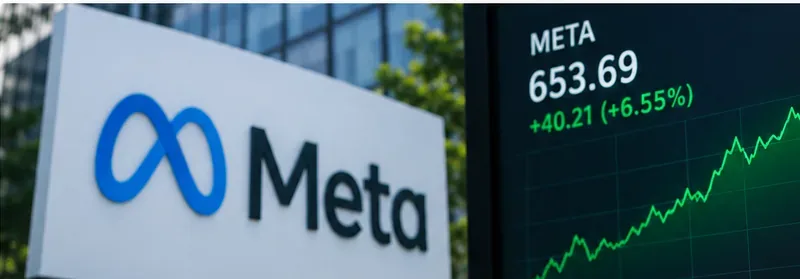
Meta Platforms (META) closed at $653.69 on September 9, 2026, up 6.55% from the prior valid close of $613.48. The clearest verified company-specific catalyst is Meta's September 8 launch of Muse, a personal AI agent that can work across apps, take actions on a user's behalf, and is rolling out in the U.S. through the Muse app, the web and WhatsApp. The timing fits the stock reaction, and the move was notably company-specific: the Nasdaq-100 finished September 9 down 0.42%, so Meta's jump was not simply part of a broad large-cap tech rally.
That said, a large one-day move does not prove a single cause. Meta did not publish a filing saying “the stock rose because of Muse,” and the company has not yet disclosed Muse adoption, revenue or retention data. The most defensible explanation is therefore: Muse was the strongest fresh catalyst, while investors also appear to have reassessed Meta's AI monetization potential against an already strong advertising business and very high AI spending.
AI-generated illustration using the verified September 9, 2026 close and percentage change. The rising line is illustrative, not an actual intraday price chart.
What is confirmed, what is inference, and what is still unknown?
Claim
Status
Evidence
What to do with it
Meta launched Muse on September 8
Confirmed
Meta's own product announcement
Treat it as the main fresh company-specific event entering the September 9 session.
Meta outperformed broad large-cap tech
Confirmed
Nasdaq-100 fell 0.42% on September 9 while META rose 6.55%
This argues against explaining the move as a generic tech rally.
Investors priced in future Muse revenue
Reasonable inference
Meta says Muse is free for most uses but will also have subscription plans
Useful as a narrative, but wait for actual user and revenue metrics before treating it as a proven earnings driver.
Muse will materially lift 2026 earnings
Not established
No disclosed Muse revenue forecast or adoption data
Do not turn the launch into an earnings estimate without new company guidance.
The September 9 gain will continue next session
Unknown
One session cannot establish follow-through
Use relative strength, macro data and post-launch news as conditional signals instead of assuming momentum continues.
Why Muse matters more than a routine product update
Meta describes Muse as a personal AI agent that can do work rather than only answer questions. It can open a browser, fill out forms, work across connected apps, continue tasks after the user closes the app, and ask for approval before sensitive actions such as sending an email or making a purchase. Meta says Muse runs in a dedicated “Muse Secure VM,” and users control which apps it can access.
The launch also introduces a more direct monetization path than a purely free assistant. Meta says most use will be free, with subscription plans available for people who want to do more. That does not prove meaningful revenue, but it gives investors a concrete way to think about AI products becoming more than an engagement feature inside Facebook, Instagram or WhatsApp.
On September 9, the Nasdaq-100 closed at 29,382.45, down 0.42% for the session, according to Nasdaq's own index data. That contrast is useful because Meta is a major Nasdaq-100 constituent. If the entire large-cap technology complex had surged, it would be harder to separate Meta-specific enthusiasm from a market-wide move. Instead, META rose sharply while the benchmark fell.
This does not prove that Muse explains every percentage point of Meta's gain. It does, however, strengthen the case that investors were reacting to something specific to Meta rather than simply following the market.
The bigger tradeoff: new AI revenue opportunities versus very high AI spending
The September 9 rally makes more sense when placed next to Meta's latest reported financials. In the second quarter of 2026, Meta reported revenue of $60.80 billion, up 28% year over year. Ad impressions across the Family of Apps rose 14%, while average price per ad rose 12%. Those figures show that the core advertising engine was already growing strongly before Muse launched.
But the cost side is equally important. Total costs and expenses rose 55% year over year in Q2. Operating income fell 8%, and operating margin declined to 31% from 43%. Meta also guided to 2026 capital expenditures of $130 billion to $145 billion, largely tied to AI infrastructure and the core business.
Those numbers create the central investor tradeoff. A product like Muse can support the bullish argument that massive AI investment may eventually create direct revenue streams and improve product value. The counterargument is that the spending is already real, while Muse's commercial payoff is not yet quantified.
Best fit for: readers tracking near-term product catalysts and market reaction.
The bullish interpretation is that Muse gave investors a more tangible view of Meta's “personal superintelligence” strategy. It is a consumer-facing agent with a security architecture, a path to subscriptions and distribution through WhatsApp. If the market had been waiting for evidence that Meta's AI spending could produce distinct products, Muse is a credible answer.
Tradeoff: product excitement can fade quickly if early reviews expose reliability, security or usability problems. A launch is evidence of execution, not proof of adoption.
2. Fundamentals lens
Best fit for: readers focused on earnings power over multiple quarters.
The stronger argument is not Muse alone. It is Muse layered on top of a core business that just posted 28% revenue growth, rising ad impressions and higher ad pricing. From this lens, the product launch matters because Meta has an existing distribution and cash-generation engine that can fund AI development.
Tradeoff: costs are rising much faster than revenue. A fundamental reader should care more about future margins, free cash flow, AI-related operating costs and actual monetization than about a single day's share-price reaction.
3. Relative-strength lens
Best fit for: readers evaluating whether the market is treating the news as company-specific.
META's 6.55% gain against a falling Nasdaq-100 is a strong relative-strength signal for one day. If that relative strength persists after the initial headline day, it would be more meaningful than the absolute percentage gain alone.
Tradeoff: one-day relative strength can reverse during profit-taking, especially after a large gap higher. Confirmation requires follow-through, not just the September 9 close.
What matters in the next trading session: September 10, 2026
The next U.S. session has an important macro catalyst before the open. The Bureau of Labor Statistics is scheduled to release the August Producer Price Index at 8:30 a.m. Eastern on September 10. Producer inflation can affect bond yields and valuation-sensitive growth stocks, including large technology companies. The August Consumer Price Index is then scheduled for Friday, September 11 at 8:30 a.m. Eastern.
There was no new Meta earnings release tied to September 9, and Meta's investor-relations event page did not list a scheduled September 10 company event at the time of this review. That makes the next session more likely to be driven by follow-through from the Muse launch, macro data, rates and general risk appetite rather than a known scheduled Meta corporate event. Check Meta's official investor events page for any update.
Next-session scenarios: bull, base and bear
Scenario
What would support it
What would weaken it
What it would mean
Bullish follow-through
Benign PPI, stable or lower yields, no negative Muse headlines, META holds most of the September 9 gain and continues to outperform the Nasdaq-100
Sharp early reversal or loss of relative strength
The market would be treating the Muse launch as more than a one-day headline.
Base case: consolidation
Mixed macro data, normal profit-taking, META gives back part of the move but remains well above the $613.48 prior close
A full retracement toward the prior close
The market would be digesting a large repricing while waiting for more product evidence and Friday CPI.
Bearish reversal
Hot PPI, rising yields, broad tech weakness, profit-taking, or credible concerns about Muse reliability/security
META quickly regains relative strength after an early dip
The September 9 jump would look more like an event-driven spike than the start of durable repricing.
These are conditional scenarios, not forecasts. The purpose is to identify what evidence would confirm or challenge the September 9 narrative.
What should different readers watch?
If you care about the next session: focus on the 8:30 a.m. ET PPI release, Treasury-yield reaction, META's opening behavior and whether the stock remains stronger than the Nasdaq-100. The tradeoff is speed versus certainty: early price action is timely but noisy.
If you care about the next quarter: focus on Muse adoption signals, subscription uptake if Meta discloses it, AI operating costs, advertising growth and margin trends. The tradeoff is that these signals arrive more slowly, but they are more useful for judging economic impact.
If you are evaluating the AI strategy: watch whether Meta can turn large infrastructure spending into products that users repeatedly choose and eventually pay for. Muse is an important launch, but the relevant test is usage, retention, safety and monetization—not the launch-day headline alone.
Bottom line
Meta Platforms' 6.55% rise on September 9, 2026 was unusually strong relative to the broader large-cap technology market. The freshest verified company-specific development was the September 8 Muse launch, making it the clearest catalyst. The stronger strategic interpretation is that investors may be giving Meta more credit for turning its enormous AI investment into a monetizable consumer product.
But there are limits to that conclusion. Meta has not disclosed Muse revenue or adoption metrics, and Q2 showed the other side of the AI bet: costs and capital spending are extremely high. For the September 10 session, the useful question is not “will META go up again?” It is whether the stock can preserve its relative strength after a 6.55% jump while absorbing the 8:30 a.m. ET PPI release and renewed scrutiny of Muse. That evidence will be more informative than assuming one day's catalyst automatically extends into the next.
This article is a post-session market explainer for September 9, 2026, not investment advice.