Home
» Today
»
Iran War Update: U.S. Tanker Strikes and the “Submarine” Claim on Sept. 9, 2026
Iran War Update: U.S. Tanker Strikes and the “Submarine” Claim on Sept. 9, 2026
Live update cutoff: September 9, 2026, 8:35 a.m. UTC. The newest verified developments link a sharp U.S.-Iran maritime escalation with a separate dispute over an American uncrewed underwater vehicle near the Strait of Hormuz. The essential correction is simple: Iran did not report capturing a crewed U.S. Navy attack submarine. Iranian authorities said they took possession of an unmanned submersible identified as an Anduril Dive-LD; the Pentagon said the underwater drone had malfunctioned, and the manufacturer acknowledged losing a vehicle.
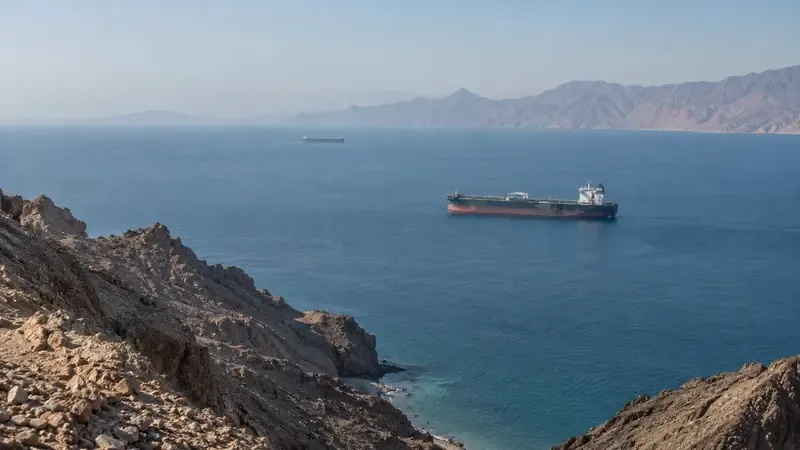
AI-generated contextual illustration of commercial shipping near a strategic strait; it is not a photograph of any incident described in this report.
What happened overnight into September 9
Iran's Islamic Revolutionary Guard Corps said on September 9 that it had fired ballistic missiles at a base used by U.S. forces near Al Azraq, Jordan, and attacked ten ships in or near a restricted area of the Strait of Hormuz. Jordan said its defenses intercepted 18 of 20 missiles, that the other two fell in unpopulated areas, and that there were no casualties. A U.S. official said American personnel were accounted for. At the cutoff time, those statements described the newest reported actions, but the full damage picture and independent confirmation for every claimed maritime strike were not yet available.
The immediate trigger cited by Tehran followed U.S. attacks one day earlier. In a release dated September 8, U.S. Central Command said its forces destroyed five Iranian crude-oil carriers after the IRGC twice targeted a U.S. Navy warship with ballistic missiles over the preceding two days. CENTCOM said the warship evaded the attacks, no Americans were harmed, and crews were directed to leave the tankers before they were struck. The command named M/T Kaviz, M/T Charminar, M/T Horizon 1 and M/T Riesco in the Gulf of Oman, plus M/T Derya near Kharg Island. Readers can check the wording and date in the September 8 CENTCOM release.
CENTCOM characterized the five ships as part of a network financing the IRGC and regional partners. That is the U.S. government's stated justification, not a finding independently adjudicated in public. The command also tied the action to a September 5 episode in which it said three other Iranian tankers were disabled or destroyed after attempted missile attacks on a U.S. aircraft carrier and a guided-missile destroyer. The CENTCOM public-release index showed the September 8 tanker statement as its newest dated release when this article was checked.
The “U.S. submarine” was an unmanned underwater vehicle
On September 8, the IRGC said it had captured what Iranian messaging called a modern American “unmanned submarine” at the entrance to the Strait of Hormuz. Iranian state media identified the vehicle as a Dive-LD. The Pentagon's response was materially different: it said an underwater drone had malfunctioned more than a day earlier while surveying regional waters, and described it as an older model without sensitive data or classified sonar or radar equipment. Anduril confirmed the loss of one of its vehicles and said the platform is designed for hazardous missions where loss is an expected risk.
The most accurate neutral description is therefore autonomous underwater vehicle, or AUV; “uncrewed underwater vehicle” and UUV are also widely used. A vehicle of this kind has no sailors aboard and is not equivalent to a nuclear-powered attack submarine. Anduril's official Dive-LD product page describes a modular large-diameter autonomous undersea vehicle with endurance of up to ten days and a rated operating depth of up to 6,000 meters. Those published capabilities explain why such systems can support survey, inspection and military missions, but they do not by themselves establish the exact task, route or sensor loadout of the lost vehicle.
What is confirmed, claimed and still unclear
Status
Assessment at 8:35 a.m. UTC
Confirmed by named parties
Iran announced possession of an unmanned American submersible; the Pentagon acknowledged a malfunctioning U.S. underwater drone; Anduril acknowledged losing a vehicle.
Official U.S. account
CENTCOM says five Iranian crude carriers were struck on September 8 after attempted ballistic-missile attacks on a Navy warship, with no U.S. casualties and advance directions for tanker crews to leave.
Not yet independently resolved
Whether Iranian forces actively captured an operational vehicle or recovered it after a malfunction; the precise location and timing of recovery; the vehicle's mission package; and the full effects of Iran's September 9 claims against ships.
Unsupported inference
The underwater-drone incident does not prove that a crewed U.S. submarine was captured, disabled or newly deployed in the Strait of Hormuz.
Why reports about U.S. submarines are easy to misread
Crews, propulsion, mission profiles and strategic consequences differ radically between AUVs and commissioned submarines. The distinction matters especially because a real U.S. submarine did participate earlier in the war. In prepared remarks published on March 10, 2026, the Chief of Naval Operations said a U.S. submarine had sunk an Iranian warship during Operation Epic Fury—the first such U.S. submarine sinking of an enemy vessel since World War II. The official Navy transcript did not identify the submarine in the quoted passage. That March combat event is historical context; it is not the September Dive-LD episode.
CENTCOM's Operation Epic Fury page says the operation began at the president's direction and describes strikes against Iranian targets judged to pose an imminent threat. Public descriptions of submarine activity are typically sparse because location, route and timing can be operationally sensitive. Accordingly, the absence of a public submarine deployment detail is not evidence that a boat is or is not in a particular place. Responsible reporting should stop at what officials have released.
Timeline with dates and time zones
September 5, 2026: CENTCOM dated its release on strikes against three Iranian tankers following claimed attacks on two U.S. Navy warships. The page supplies a date but no publication time or time-zone label.
September 8, 2026: CENTCOM dated its release on five additional tanker strikes. Separately, the report carrying the Iranian, Pentagon and Anduril accounts of the Dive-LD incident was published at 10:31 p.m. UTC.
September 9, 2026, 4:07 a.m. UTC: the first widely distributed report examined for this update carried Iran's new claims about Jordan and shipping near Hormuz, along with the Jordanian and U.S. responses.
September 9, 2026, 8:35 a.m. UTC: live-search cutoff for this article. The Department of War daily postings page listed no September 9 release, transcript, speech or headline at that moment. That means there was no newer item on that particular official page; it does not rule out later statements elsewhere.
What to watch next
Three developments would materially change the picture. First, CENTCOM or the Pentagon could release a detailed statement about the Dive-LD's mission, recovery circumstances or data security. Second, independent maritime reporting could establish which of the ships Iran said it attacked on September 9 were actually hit and how badly. Third, Jordan or the United States could publish a fuller damage assessment for the Al Azraq-area missile attack.
Until then, the defensible headline is escalation at sea plus the loss of an American underwater drone—not the capture of a crewed U.S. submarine. Claims about damage, intelligence value or secret submarine movements remain unverified unless a responsible authority provides evidence. This report preserves that boundary because the first hours of a fast-moving conflict routinely produce overlapping claims, incomplete imagery and terminology that can exaggerate what occurred.