Home
» Today
»
Why U.S. Flights Were Grounded: FAA Communications Outage Explained — Nov. 13, 2026
Why U.S. Flights Were Grounded: FAA Communications Outage Explained — Nov. 13, 2026
Information checked: November 14, 2026, 01:16 UTC (November 13, 2026, 8:16 p.m. Eastern Standard Time, UTC−05:00, Washington, D.C.; November 14, 2026, 12:16 p.m. Australian Eastern Daylight Time, UTC+11:00, Sydney). This is the time of the source review, not the start of the FAA order. The situation is developing; check official operational notices for subsequent changes.
Why are U.S. flights grounded? The Federal Aviation Administration ordered an unusual nationwide ground stop on Friday, November 13, 2026, after a telecommunications problem disrupted communication infrastructure serving air traffic control centers. U.S. Transportation Secretary Sean Duffy said the problem affected all 22 Air Route Traffic Control Centers and FAA technicians were investigating. The agency treated the disruption as a safety issue: departures were halted while aircraft already airborne could continue under air traffic control and land. The precise underlying equipment or network failure, and a reliable nationwide restoration time, had not been established in the sources reviewed.
The order affects far more than travelers waiting at U.S. departure gates. International services, connecting itineraries, aircraft positioning, and crews can all be disrupted when a large part of the aviation network cannot launch flights as scheduled. For Australian travelers, the practical question is whether a flight to the United States, or a connection through a U.S. airport, can operate as ticketed—not whether an airport in Australia has itself been shut down.
Destaques
Immediate trigger: A telecommunications outage affecting U.S. en-route air traffic control centers prompted the FAA's nationwide departure halt on November 13.
Safety measure: The ground stop prevents covered departures; it does not mean every aircraft already airborne was forced to land immediately.
Cause still under investigation: Officials had not established a detailed root cause. There was no publicly identified evidence of a malicious attack at the time of the checked reporting.
International impact: U.S.-bound flights and connections can be delayed or changed. Airline-specific information is essential.
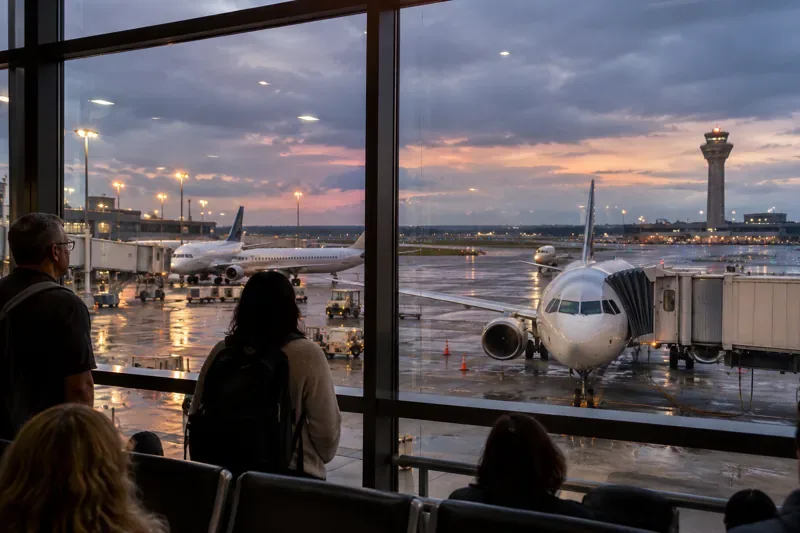
AI-generated illustrative airport scene; not a photograph of a specific airport during the November 13 FAA ground stop.
What happened when the FAA ordered the November 13 nationwide ground stop?
The FAA's air traffic control system coordinates departures, arrivals, and aircraft moving between airports. On November 13, a communications issue affecting the regional centers responsible for high-altitude and en-route traffic led to an extraordinary nationwide hold on departures. The official message cited safety reasons and specified that international inbound traffic would be assessed case by case. Reporting by the Associated Press describes the disruption as a telecommunications outage affecting 22 regional control centers, with aircraft already in the sky allowed to land.
Accounts published during the afternoon of November 13 described the hold as beginning before 4:00 p.m. in Washington, D.C., Eastern Standard Time (UTC−05:00), equivalent to before 21:00 UTC. That timing should not be confused with the advisory's anticipated end time, the publication of a news report, or a confirmation that departures resumed. The precise time at which every affected restriction will end requires a subsequent official notice; an estimated expiry in a ground-stop message is not proof of system recovery.
The FAA publishes its operational advisories through the Air Traffic Control System Command Center. Its daily air traffic report provides general conditions and directs readers to current operational information. Neither a routine morning weather outlook nor an airport-only delay dashboard should be treated as a complete substitute for a later nationwide order.
What caused the FAA ground stop: weather, a cyberattack, or a technical outage?
The confirmed immediate problem was telecommunications, not a nationwide weather shutdown. Weather can cause ordinary airport-specific delays; the November 13 order was broader because communications serving the air traffic control network were affected. Duffy attributed the precautionary stop to issues across air traffic control centers. Homeland Security Secretary Markwayne Mullin said officials had no indication at that point of a deliberate attack, while technical teams continued investigating.
It would go beyond the evidence to declare a particular fiber cable, vendor, software deployment, cyberattack, or separate Microsoft disruption the root cause. Those explanations require technical findings or official confirmation. Similarly, the FAA's ongoing modernization efforts are background context, not proof that a newly deployed system caused this outage. Investigators still need to determine which network elements failed, how redundancy responded, and how communications can be restored safely.
What exactly is an FAA ground stop, and how is it different from a ground delay program?
The FAA's Air Traffic Control System Command Center guidance explains that a ground stop holds qualifying flights at their departure points. Normally it may target flights headed to one airport or entering a specific area. A nationwide ground stop is far more sweeping because the affected area includes U.S. departure operations across the country.
A ground delay program is different: rather than stopping eligible departures altogether, controllers assign controlled departure times to meter arrivals at a constrained airport. Such programs often respond to poor visibility, wind, or congestion. A flight may be delayed under either measure, but the operational restrictions and recovery process are not identical. When a ground stop is lifted, airlines still need available aircraft, crews, gates, departure slots, and usable connections.
Were planes already in the air grounded, and were international flights exempt?
Reports on the November 13 incident said aircraft already airborne were permitted to continue and land safely; the core nationwide restriction applied to departures. The FAA said inbound international flights would be managed individually. Some exceptions were reported for particular operations, but travelers should not assume their flight qualifies simply because it is international or originates outside the contiguous United States.
Air traffic control communication is a basic safety function: it helps controllers separate aircraft and coordinate movement between sectors. If technicians cannot establish dependable systemwide communications, preventing additional departures can reduce the number of aircraft entering a constrained network. That is a precautionary operational choice, not an announcement that every plane in U.S. airspace has lost communication or is unsafe.
How could the U.S. flight disruption affect Australian travelers?
The disruption can reach Australian itineraries through flights bound for Los Angeles, San Francisco, Dallas–Fort Worth, or other U.S. gateways, as well as through onward domestic connections. Even if an Australia-origin service has not been canceled, an aircraft or crew that must arrive from the United States may be unavailable. A U.S. domestic leg may also fail to operate on schedule, changing the usefulness of an otherwise on-time international arrival.
Check the operating airline's flight-status page using the actual flight number, then inspect each segment of a connecting itinerary. A departure notice is more useful than a general headline. If the airline changes a flight, request a new confirmed itinerary before relying on a tight connection. Keep travel documents accessible, monitor messages from the carrier, and check official FAA advisories for broad operational conditions. A specific passenger's entitlements depend on the airline, route, ticket terms, and applicable law; this explanation does not establish compensation eligibility.
When will U.S. flights resume, and what happens after the ground stop ends?
A verified systemwide resumption time was not available in the official and primary reporting reviewed for this article. Authorities must restore and validate communications before lifting restrictions; airlines can then begin rebuilding schedules. The earliest flights to depart may depend on airspace capacity, the duration of the halt, aircraft and crew locations, and how many delayed flights are competing for space.
That makes a rapid nationwide return to normal an uncertain forecast rather than a confirmed outcome. Cancellations or missed connections can continue after the original restriction is relaxed. For current conditions, use the FAA Command Center and the relevant airline's own operating updates rather than assuming a headline announcing technical progress means a particular ticket is usable.
FAQ: U.S. flights grounded by the FAA
Did the FAA ground every plane already flying?
No. The nationwide order halted covered departures, while aircraft already airborne were allowed to continue and land under applicable air traffic control procedures.
Was the November 13, 2026 ground stop caused by a cyberattack?
No cyberattack had been established in the reviewed reporting. Officials identified a telecommunications outage and said the deeper cause was under investigation.
Does a nationwide ground stop mean my U.S.-bound flight from Australia is canceled?
Not automatically. A ground stop can disrupt departure and connection arrangements, but only your airline can confirm the current status and alternatives for your particular flight.