Leftover Halloween Candy and Pumpkins: What to Do Next

Sort leftover Halloween candy safely, share or repurpose sealed treats, and choose food use or compost for pumpkins based on their condition.
Xiaomi is now planning to develop its own mobile processors, as part of a plan to reduce its dependence on chipmakers like Qualcomm and MediaTek for its mobile processor needs. If successful, Xiaomi will join Apple and Samsung as the only two companies that use in-house silicon chips for their own smartphones.
Specifically, Xiaomi is working on a custom 3nm chip that will launch in early 2025 with performance comparable to Qualcomm's flagship Snapdragon 8 Gen 1 processor. With its own chips, Xiaomi can customize them specifically to meet the needs of its devices, which can help improve performance and efficiency.
Xiaomi’s journey to develop its first custom chipset has been quite bumpy, starting with the Surge S1, which Xiaomi launched in the Mi 5c about seven years ago but didn’t achieve much success. Then, the Surge S2 never materialized, remaining on paper due to financial and technological hurdles that Xiaomi couldn’t overcome.
Fortunately, the Chinese tech giant’s determination has never wavered. However, there could still be many obstacles that stand in Xiaomi’s way. Making your own chips is no easy task. Developing mobile chips is a complex and expensive business. Take Samsung, for example. The Korean manufacturer has struggled with its Exynos line for over a decade now, only to get it right. However, there have been complaints about performance issues with Exynos variants when compared to Snapdragon variants of the same smartphone.
Despite the risks, Xiaomi has partnered with ARM to help design its custom chips. The design phase for the company’s first 3nm processor was recently completed, with mass production expected in 2025. Xiaomi plans to partner with renowned semiconductor manufacturer TSMC to manufacture these 3nm chips, taking advantage of the Taiwanese company’s advanced fabrication process.
It should be noted that Xiaomi still faces external pressure from the United States as restrictions remain on Chinese companies' access to advanced chip technology. The Biden administration has restricted China's ability to purchase next-generation semiconductor technology. With the Trump administration set to begin soon, new rules have been proposed that will further restrict Chinese companies' ability to purchase chips, which is also why China has started to stockpile so many of these high-end chips.
Xiaomi is likely to launch a 3nm chipset sometime next year, but there’s no update on whether the chip will be based on TSMC’s N3E process or the more advanced N3P node. There’s also no word on the CPU cluster, GPU, or whether the chipset will use an ARM design or a custom design. It remains to be seen whether the company will be able to successfully develop and launch a new smartphone SoC, and how it will perform.
Sort leftover Halloween candy safely, share or repurpose sealed treats, and choose food use or compost for pumpkins based on their condition.
Compare workplace Halloween costume choices by respect, dress code, mobility, and safety—and learn when a subtle accessory or a policy check is the better option.
Find a couples costume that fits your style, budget, and comfort level, from Addams Family classics to original inside-joke duos.
Need a last-minute high school Halloween costume? Compare 10 easy closet-based ideas by prep time, comfort, school-day practicality, and simple safety checks.
Use a simple 2026 Halloween decorating timeline for indoor décor, outdoor displays, and fresh pumpkins, with practical adjustments for weather and events.
Mix five vivid, approachable Halloween cocktails with measured recipes, simple prep tips, and an alcohol-free option for your party guests.
Find 15 office-friendly Halloween costume ideas for 2026, with practical checks for dress codes, respectful themes, comfort, and workplace safety.
Plan a fun elementary school Halloween party with easy crafts, games, inclusive treats, costume tips, and a sample 75-minute classroom schedule.
Compare realistic side hustles for 2026 by startup cost, fees, flexibility, and income control, with current tax and scam guidance from official sources.
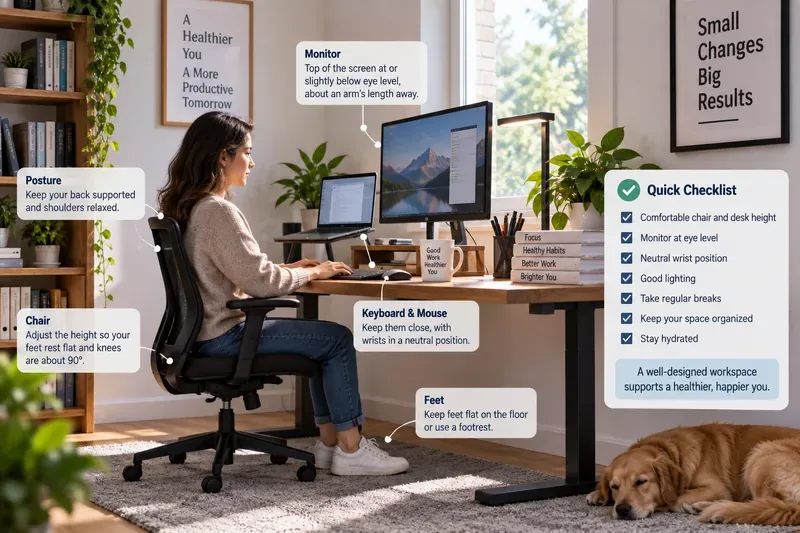
Upgrade your home office ergonomics with current OSHA and NIOSH guidance on chair fit, monitor height, laptop setup, lighting, and movement.