Home
» Today
»
Allure of the Seas Overboard Search: What Happens Next? — Updated November 25, 2026
Allure of the Seas Overboard Search: What Happens Next? — Updated November 25, 2026
Verified and updated November 25, 2026, at 12:06 p.m. UTC. A passenger was reported overboard from Royal Caribbean’s Allure of the Seas off San Salvador Island in the Bahamas on Monday night, November 23. The U.S. Coast Guard said the ship alerted it and the Royal Bahamas Defence Force at about 11:30 p.m. EST (UTC−05:00); Bahamian forces were leading the search with Coast Guard support, according to CBS News.
As of this update, I could not verify a later official announcement confirming the passenger’s recovery or the search’s conclusion. The incident has disrupted the ship’s itinerary, but the immediate priority in any overboard emergency is to locate and assist the person—not to maintain the planned schedule.
Destaques
The ship reported the emergency to Bahamian and U.S. authorities; the Royal Bahamas Defence Force was leading the search, with Coast Guard support.
Typical first actions include raising the alarm, marking the person’s last known position, manoeuvring the ship and preparing recovery and medical equipment.
Nearby vessels and aircraft may help, while the ship coordinates with the responsible search-and-rescue authority.
Passengers should follow crew instructions, keep sightlines clear and avoid sharing unverified claims about the person or cause.
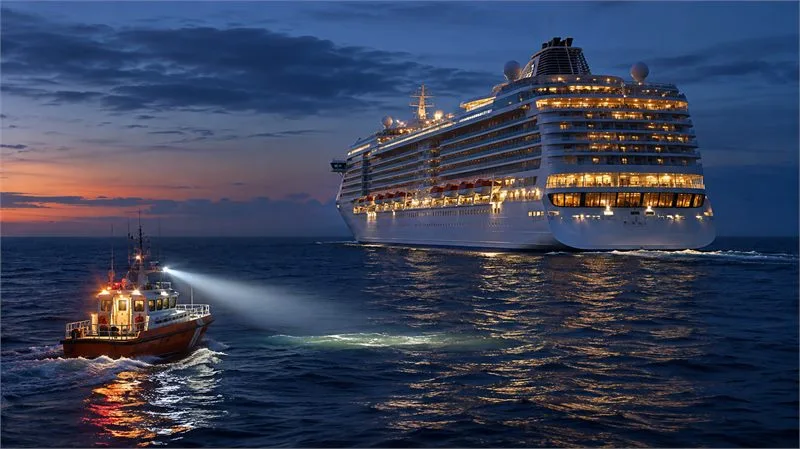
Illustrative image: a rescue boat searches near a cruise ship at dusk. This is not a photograph of the Allure of the Seas incident.
What happens immediately after someone goes overboard?
When a crew member or passenger sees someone fall, the first useful actions are to shout an alert, throw a flotation device if it can be done safely, keep pointing toward the person and notify the bridge. Every second can matter: the ship needs the person’s last known position and the side of the vessel where they entered the water.
The bridge team can mark that position on its navigation systems, manoeuvre to avoid striking the person and turn back or circle as conditions permit. Crew prepare searchlights, rescue equipment and first-aid supplies; the captain also alerts the relevant authorities and requests help from vessels or aircraft nearby. A U.S. Coast Guard emergency response plan describes these actions as a practical sequence, including keeping the person in sight, marking the location, calling for assistance and preparing medical care. It is an operational example, not a universal checklist for every cruise ship or jurisdiction. See the Coast Guard response plan.
Who leads the search at sea?
Responsibility depends on where the emergency occurs and which authority has jurisdiction. The ship’s crew begins the response and communicates with maritime rescue authorities. Those authorities can coordinate additional ships, aircraft, search patterns and information from nearby vessels. In this case, the Coast Guard said the Royal Bahamas Defence Force was leading the search off San Salvador Island, with U.S. Coast Guard assistance.
International rules also matter. The International Maritime Organization’s SOLAS convention includes requirements for life-saving appliances and arrangements, while its guidance on rescue at sea explains duties to assist people in distress when a vessel can do so. The exact operation depends on the person’s last known position, how much time has passed, visibility, sea state, currents, available assets and the safety of rescuers. Read the IMO’s SOLAS overview and guidelines on the treatment of persons rescued at sea.
Why can a search take hours or cover a wide area?
A person in the water can be difficult to see from a ship, particularly at night or in rough seas. Wind and currents can move someone away from the reported position, and the location itself may be uncertain if nobody witnessed the fall. Search teams therefore use the best available information to plan where to look and may widen or adjust the search as conditions and new information warrant.
There is no single public timeline that applies to every case. Search-and-rescue authorities assess the circumstances and available evidence. A ship may resume its voyage when authorities direct or permit it to do so, while the investigation and family support continue. A missed port or changed sailing schedule does not, by itself, reveal what happened or how long a search should last.
What should passengers do during an overboard search?
Passengers should follow announcements and directions from the crew. If asked, move away from exterior areas being used for observation or recovery, and do not obstruct access routes. Anyone who witnessed the event should promptly tell crew what they saw, including the approximate time, location, side of the ship and any identifying details that could help search coordinators.
Stick to confirmed updates from the cruise line or responsible authorities. Passenger posts can provide context, but they may contain incomplete or conflicting information. Do not approach a recovery operation or enter the water; an unplanned rescue attempt can put additional people in danger.
Frequently asked questions
Does the ship always stop when someone goes overboard?
The crew will respond and manoeuvre as circumstances allow, but the captain and rescue coordinators determine the safest course. The ship may turn back, circle or coordinate with other responders.
How long does a cruise ship search last?
There is no fixed duration for every incident. The responsible search-and-rescue authority considers the evidence, conditions, search area and available resources.
Was the passenger from Allure of the Seas found?
At the time of this update, I could not verify an official announcement confirming recovery or the search’s conclusion. The Coast Guard’s reported information placed Bahamian forces in the lead, with U.S. support.