Make Realistic Fake Blood Without a Cleanup Surprise

Mix a glossy prop-only fake blood batch, choose safer products for skin and costumes, and test cleanup before Halloween night.
How do you make sense of the flow of information you encounter on a daily basis as a knowledge worker or lifelong learner? The answer lies in personal knowledge management (PKM)—a system that helps you capture, organize, and use what you learn effectively.

What is personal knowledge management? Why is it important?
Personal knowledge management (PKM) is a structured and intentional approach to collecting, organizing, and using information from a variety of sources, including personal experience, books, articles, podcasts, social media, etc.
A personal knowledge management system helps you make this knowledge accessible and actionable, allowing you to draw meaningful connections and use what you know to create, solve problems, or make better decisions.

PKM addresses one of the brain’s major limitations: memory retention. While our brains are great at generating ideas, forming connections, and solving problems, they are not optimized for storing and retrieving information, especially over the long term—something that often becomes more apparent as we age.
This is where the PKM system comes in handy, increasing your productivity by building a second brain to complement your cognitive abilities.
Most people already have some form of knowledge management system in place, however, sometimes they are ineffective or fragmented.
For example, before I learned about PKM , I created a private WhatsApp group —with no members—where I stored random thoughts, quotes from books, and ideas I didn’t want to forget. While it worked temporarily, it wasn’t scalable or organized, and finding specific notes later became a challenge.
A great starting point to optimizing your personal management system is to understand its core components or principles.
Collect and store knowledge
Knowledge acquisition & storage involves gathering information from various sources and storing it in a trusted external system. Our brains are better at generating ideas than storing them, so the goal is to transfer them to an external system.
Some effective methods for gathering and storing knowledge include:
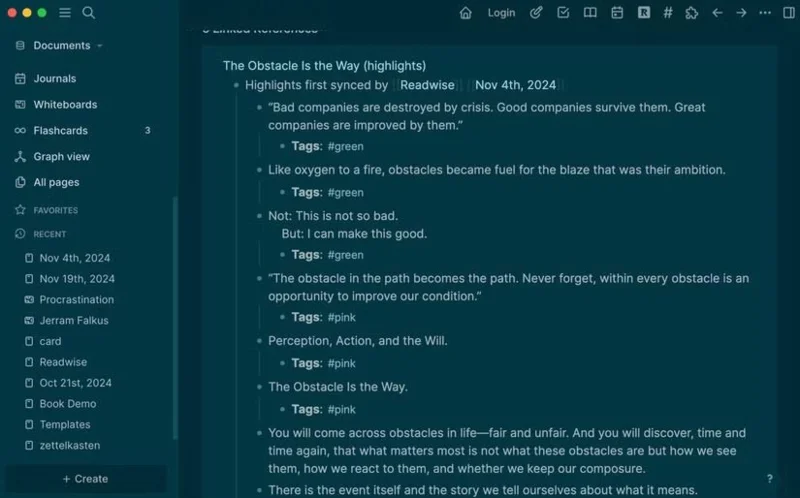
Whichever way you choose, the key is to record everything in one central place—or at least make sure it gets there eventually. A distributed system, where notes are scattered across multiple notebooks, apps, or sheets of paper, makes retrieval difficult and “defeats” the purpose of PKM.
Your recording tool should be easily accessible, like a pocket notebook or an app that syncs across multiple devices, as ideas often come when you least expect them, so it’s important to have a system that you can quickly switch to. At this stage, you may not need to worry about perfectly storing your notes or ideas, as you’ll have time to do that in the next stage.
Organizing and retrieving knowledge
This step ensures that your collected knowledge is organized in a way that makes it easy to retrieve when needed, make meaningful connections, and use effectively. To organize or process information effectively, think about how your future self will access and understand it. A well-organized PKM system will do two main things:
So you want to create a logical and cohesive structure when organizing information. This system should be tailored to your individual needs and workflow. Here are some approaches to consider:
When you organize your knowledge systematically, you create a logical structure that allows you to find, retrieve, and use information quickly. As you gather more knowledge and your needs evolve, your PKM structure will adapt to accommodate new workflows, priorities, and tools.
Distributing and applying knowledge
Personal knowledge management truly comes alive when information is shared and applied. One of the most effective ways to reinforce what you have learned and mastered is to share it with others. This can be through teaching, collaborating with colleagues, or casual discussion.
Beyond sharing, the value of a personal knowledge management system lies in its ability to inform your decisions and guide your actions. You can turn the insights stored in your PKM system into to-do lists or goals. For example, emails and meeting notes can be turned into actionable tasks, while notes from a leadership notebook can be used to improve team dynamics.
Ultimately, your personal knowledge management system can become a powerful tool for creative problem solving by discovering connections between seemingly unrelated ideas. This allows you to discover creative solutions that are not obvious.
In short, a well-designed personal knowledge management system is a framework for capturing, organizing, and applying knowledge to enhance learning, decision-making, and creativity. By integrating these principles into your routine, you can turn disparate ideas into meaningful insights and actionable results.
Mix a glossy prop-only fake blood batch, choose safer products for skin and costumes, and test cleanup before Halloween night.
Create a gentle Halloween look with pastel colors, friendly ghosts, easy no-carve accents, and practical safety tips for your home.
Create a spooky office cubicle with Halloween desk decor ideas that keep your workspace usable, tidy, and mindful of workplace safety.
Plan a recognizable Halloween 2026 look with pop culture costumes inspired by Spider-Man, Supergirl, Toy Story 5, Moana, Mario, and Wednesday.
Sort leftover Halloween candy safely, share or repurpose sealed treats, and choose food use or compost for pumpkins based on their condition.
Compare workplace Halloween costume choices by respect, dress code, mobility, and safety—and learn when a subtle accessory or a policy check is the better option.
Find a couples costume that fits your style, budget, and comfort level, from Addams Family classics to original inside-joke duos.
Need a last-minute high school Halloween costume? Compare 10 easy closet-based ideas by prep time, comfort, school-day practicality, and simple safety checks.
Use a simple 2026 Halloween decorating timeline for indoor décor, outdoor displays, and fresh pumpkins, with practical adjustments for weather and events.
Mix five vivid, approachable Halloween cocktails with measured recipes, simple prep tips, and an alcohol-free option for your party guests.