Home
» Today
»
Beaver Moon in Australia: When the November 2026 Supermoon Is Visible Tonight
Beaver Moon in Australia: When the November 2026 Supermoon Is Visible Tonight
Checked: November 24, 2026, 14:35 UTC (November 25, 2026, 1:35 a.m. AEDT in Sydney; November 24, 2026, 10:35 p.m. AWST in Perth).
Australians looking up tonight are in the right window for the November Beaver Moon. The Moon reaches its exact full phase at approximately 14:53–14:54 UTC on Tuesday, November 24, 2026, equivalent to about 1:53–1:54 a.m. on Wednesday, November 25 in Sydney and Melbourne (AEDT, UTC+11:00), 12:53–12:54 a.m. in Brisbane (AEST, UTC+10:00), and 10:53–10:54 p.m. on Tuesday, November 24 in Perth (AWST, UTC+08:00). It should appear nearly full on the evenings surrounding that instant, provided clouds and local visibility cooperate.
The key distinction is that an astronomical full moon happens at one worldwide moment, while the calendar date differs across Australia's time zones. A forecast cannot guarantee that it will be visible from an individual street or suburb.
Highlights
When: The November full moon peaks around 14:53–14:54 UTC on November 24; the exact event falls on November 25 in eastern Australia.
Where to look: Find an unobstructed eastern to northeastern horizon after local moonrise, then follow the Moon higher across the sky.
What to check: Compare your city's moonrise time, cloud cover, and the direction of the Moon before heading outside.
Why the name: “Beaver Moon” comes from Northern Hemisphere seasonal naming traditions; it is not an Australian wildlife event.
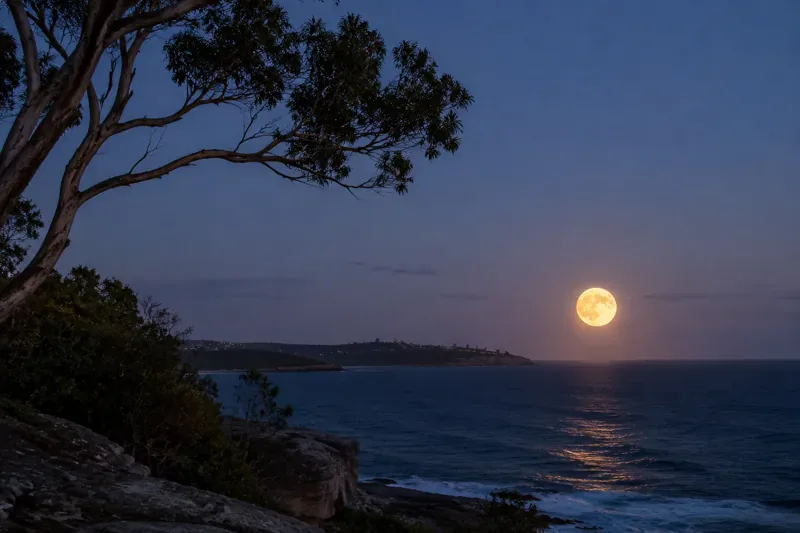
Illustrative AI-generated view of a full moon over a coastal landscape; not a photograph of the November 2026 Beaver Moon or a verified observing location.
Is the Beaver Moon visible in Australia tonight?
Potentially, yes. The bright near-full Moon can be observed from cities and regional areas across Australia if it is above the horizon and the sky is sufficiently clear. Whether “tonight” means Tuesday, November 24 or Wednesday, November 25 depends on the viewer's location and the time they read this article. The Moon does not suddenly appear or disappear at the minute of maximum fullness.
For Tuesday evening, November 24, the published moonrise tables give Sydney a moonrise of about 7:34 p.m. AEDT (UTC+11:00), Melbourne about 8:13 p.m. AEDT (UTC+11:00), Brisbane about 6:09 p.m. AEST (UTC+10:00), and Perth about 6:57 p.m. AWST (UTC+08:00). These are city-based astronomical predictions, not on-the-ground visibility guarantees. Landforms, tall buildings, haze, and weather can delay or block the first view.
For Wednesday evening, November 25, the Moon remains conspicuously round, although it has passed the mathematical instant of fullness. In Sydney, the listed moonrise is about 8:48 p.m. AEDT (UTC+11:00); in Brisbane about 7:21 p.m. AEST (UTC+10:00); and in Perth about 8:10 p.m. AWST (UTC+08:00). Check your exact location before planning a viewing or photo session.
When is the November 2026 full moon in each Australian time zone?
Timeanddate's lunar phase tables place the November full moon at 14:53 UTC on November 24; NASA's supermoon page rounds the event to 14:54 UTC. That one-minute difference reflects published ephemeris presentation and does not affect practical viewing.
Location
Approximate local full-moon time
Perth, Western Australia
Tuesday, November 24, 10:53–10:54 p.m. AWST (UTC+08:00)
Darwin, Northern Territory
Wednesday, November 25, 12:23–12:24 a.m. ACST (UTC+09:30)
Brisbane, Queensland
Wednesday, November 25, 12:53–12:54 a.m. AEST (UTC+10:00)
Adelaide, South Australia
Wednesday, November 25, 1:23–1:24 a.m. ACDT (UTC+10:30)
Sydney, Melbourne, Canberra and Hobart
Wednesday, November 25, 1:53–1:54 a.m. AEDT (UTC+11:00)
These conversions reflect daylight saving time where it applies in late November. Queensland, Western Australia, and the Northern Territory do not use daylight saving time.
How can I check whether the Moon will be visible from my suburb?
Find your moonrise time. Open a moonrise and moonset calendar for your own city and select November 24 or 25, 2026. The Sydney moonrise calendar shows the required date, direction and timing; change the city for your location.
Check cloud and rain forecasts shortly before going out. Use the Australian Bureau of Meteorology for your nearest forecast area and radar. Low cloud or a rain band may obscure the Moon even when it is well above the horizon.
Choose an open view. Start with an eastern or northeastern view close to moonrise. Coastal lookouts, open parks and elevated areas may offer a clearer line of sight, but prioritize safe, public access.
Allow for the horizon. A predicted moonrise occurs at the astronomical horizon; nearby ridges, trees and city buildings may block it. Give the Moon time to climb.
Check again if cloudy. A break in the cloud later in the night can provide a view. The Moon also remains close to full the following night.
Why is November's full moon called the Beaver Moon?
“Beaver Moon” is a traditional English-language name associated with November in North America, where beavers prepare for winter and older seasonal calendars linked moon names to natural activity and harvests. The name is widely used in international skywatching coverage, but it does not describe an Australian seasonal phenomenon. November is late spring in Australia, not the onset of Northern Hemisphere winter.
The same moon phase is seen globally. What changes is its orientation in the sky, its rise and set times, and the weather at the observer's location. The lunar name is a convention, not a separate astronomical category.
Is the 2026 Beaver Moon a supermoon?
Yes. NASA lists November 24, 2026 as a supermoon. The term is commonly used for a full Moon near the closest part of its elliptical orbit around Earth, called perigee. NASA notes that “supermoon” is not a formally defined astronomical term, and that the apparent difference from a typical full moon can be modest without a side-by-side comparison.
A large-looking Moon just above a rooftop or ocean horizon is not necessarily proof that the Moon has physically grown. Perspective and the familiar “Moon illusion” can make a low Moon seem particularly striking. A normal phone camera will often record it as a small bright circle unless the photographer uses appropriate zoom or framing.
What should skywatchers expect after tonight?
After the peak, the Moon enters its waning gibbous phase. It remains very bright and nearly round initially, but rises later on successive evenings. That makes November 25 a worthwhile second chance if November 24 is cloudy. Exact observations remain conditional on local cloud cover and sight lines; no citywide clear-sky claim has been verified for this article.
For the most accurate plan, use the published astronomical schedule for moonrise alongside a current weather forecast, rather than treating a national headline as a promise of visibility. Australia's distance across multiple time zones is precisely why a single undated “tonight” answer can mislead.
FAQ: Beaver Moon in Australia
Is the Moon full tonight in Sydney?
On the night of November 24–25, 2026, yes: Sydney's exact full phase is around 1:53–1:54 a.m. AEDT (UTC+11:00) on Wednesday, November 25. The Moon will already look nearly full on Tuesday evening.
Do I need a telescope to see the Beaver Moon?
No. The full Moon is easy to see with the naked eye when it is above the horizon and clouds do not block it. Binoculars can reveal additional surface detail, but they are optional.
What if clouds hide the Beaver Moon tonight?
Try again on the following evening, when the Moon should still look almost full, or wait for a cloud break. Recheck your suburb's forecast and moonrise time before leaving home.
Sources and verification
The event time was cross-checked against NASA's supermoon schedule and Sydney lunar phase calculations. City moonrise examples were checked against Melbourne, Brisbane, and Perth moonrise tables. Weather conditions should be checked live with the Bureau of Meteorology; this article does not claim to have verified clear skies at every viewing location.