Home
» Today
»
CUSMA Talks: U.S. Says Canada Trade Deal Is Closer, Flags China Concerns — November 24, 2026
CUSMA Talks: U.S. Says Canada Trade Deal Is Closer, Flags China Concerns — November 24, 2026
Verified and updated November 24, 2026, at 3:13 PM UTC. This is a November 24 update to the existing November 23 report; the negotiating positions described below are not a signed agreement.
Canada and the United States have not announced a new tariff agreement, but the U.S. has offered a more optimistic public assessment of the talks. On Sunday, November 22, U.S. Trade Representative Jamieson Greer said the two countries had made progress and were “fairly close on finding a landing zone.” He also raised a new public concern about Canada's expanding trade ties with China, including Chinese electric vehicles and steel and aluminum measures. His remarks are evidence of Washington's stated negotiating posture, not proof that tariff relief has been agreed.
Ottawa's November 19 official readout remains narrower: Minister Dominic LeBlanc and Chief Trade Negotiator Janice Charette briefed a federal advisory committee on continuing discussions with U.S. counterparts, without publishing negotiated terms. Canada is pursuing potential interim tariff relief alongside the longer Canada–United States–Mexico Agreement (CUSMA, called USMCA in the United States) review. The pact itself remains in force even though Washington declined to renew it in its current form at the July 1, 2026 joint review.
Destaques
On November 22, Greer described bilateral trade discussions as constructive and said negotiators were close to a potential landing zone; no signed deal or tariff schedule followed in the sources checked.
Greer specifically questioned Canada's China-related trade decisions, bringing those policies into the public discussion of the U.S. negotiating position.
Canadian officials continue to seek tariff relief, with autos, steel and aluminum among the most consequential sectors; reports of interim proposals are not final agreement terms.
USTR has opened a public-comment process for the 2027 CUSMA review, with submissions due January 12, 2027, at 11:59 p.m. Eastern Standard Time (UTC−05:00).
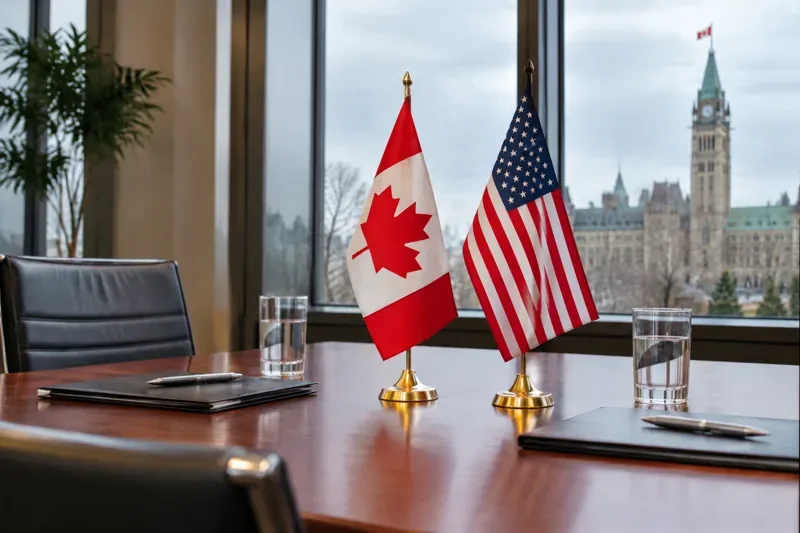
Illustrative image of a Canada–U.S. meeting room; not a photograph of the November 2026 negotiations.
What changed in Canada–U.S. trade talks on November 22 and 23?
Greer's Sunday comments are the clearest new public development after Ottawa's November 19 advisory-committee briefing. In a televised interview, he said the countries were having constructive discussions and were relatively close to a common landing zone. The Canadian Press reported those comments on November 22. Greer also stressed that most goods continue to cross the border duty-free, an important qualification: tariff exposure differs sharply by product and applicable legal measure.
The U.S. trade representative identified a disagreement over trade strategy. He characterized Canada as more inclined toward freer international trade while the United States is emphasizing protection of North American industrial supply chains. He singled out Canada's recent China policies concerning Chinese electric vehicles and relief for certain Chinese steel and aluminum products. His criticism is a statement of U.S. concern, not confirmation that Canada has agreed to reverse those decisions or that a China-related condition is written into a proposed agreement. See The Canadian Press, November 22 report of Greer interview.
For Canadian exporters, the practical distinction is between a favorable negotiating signal and a binding change at the border. Neither the November 19 Canadian government announcement nor the subsequent remarks supplied a joint legal text, effective date, product-by-product tariff table or signed agreement. Importers should continue following current customs measures until authorities formally change them.
What are Canada and the United States negotiating?
Near-term tariff relief and sector-specific costs
The near-term track concerns relief from tariffs and other bilateral trade irritants. Automotive supply chains are particularly exposed because vehicles and components move repeatedly between Canadian and U.S. factories. Steel, aluminum and lumber are also prominent in the discussion. Public reporting of ministerial interviews has described an interim arrangement that might lower some Section 232 tariffs while leaving certain duties in place, and seek removal of separate Section 338 measures. Those remain negotiating aims or public assessments, not agreed rates. See CBC interview reporting, November 19.
Canada's November 19 advisory committee, led by LeBlanc with Charette and Ambassador Mark Wiseman participating, discussed U.S. trade measures and federal support for affected workers and businesses. Its official readout reaffirmed a commitment to an agreement that supports Canadian economic interests and sovereignty, but did not specify concessions or a deadline. See Global Affairs Canada, November 19 readout.
China-related trade policy as a U.S. concern
Greer's latest remarks also matter because they explicitly connect Washington's North American manufacturing strategy with Canada's external trade relationships. That does not mean CUSMA prohibits Canada from maintaining trade ties with China, or that the U.S. has published a specific draft restriction. It means Canadian decisions involving Chinese EV access and steel and aluminum tariff relief are now a stated point of contention. The precise concessions, if any, Washington seeks were not established in a public negotiating text reviewed for this update.
How does the 2026 CUSMA review affect the negotiations?
CUSMA entered into force on July 1, 2020. Under Article 34.7, the three parties conducted their sixth-anniversary joint review on July 1, 2026. The U.S. government explicitly said it would not renew the pact in its current form, while also stating that the agreement remains in force. A failure to renew in 2026 did not terminate CUSMA in 2026. If there is no unanimous agreement to extend, the treaty's review mechanism provides for annual reviews; the agreement's initial 16-year term runs to 2036 unless extended or otherwise ended under its provisions.
These reviews are separate from any possible interim bilateral tariff arrangement. Amendments to CUSMA require the parties to complete their applicable procedures. Article 34.6 separately provides a withdrawal mechanism involving six months' written notice, which should not be confused with a decision against a 16-year extension. The original legal language is available in CUSMA Chapter 34; the U.S. description of the July review is in USTR July 1 joint-review statement.
When is the next official USMCA review deadline?
The Office of the U.S. Trade Representative announced on October 2 that it was seeking public comments ahead of the 2027 joint review. It specified a deadline of January 12, 2027, at 11:59 p.m. EST (UTC−05:00) for comments and for requests to appear with testimony summaries. That is a U.S. public-consultation deadline, not a deadline for Ottawa and Washington to sign a tariff deal. USTR indicated that details of the public hearing would be released separately. See USTR consultation announcement.
Although officials and reporting have discussed trying to reach interim relief around the end of 2026, that is an aspiration rather than a guaranteed completion date. The 2027 consultation is one concrete procedural step that businesses and trade associations can act on regardless of whether interim talks produce a breakthrough.
What would an interim trade deal mean for Canadian businesses and consumers?
If the governments agree on lower duties for specified goods, affected importers and producers could see reduced border costs and greater predictability. The actual effects would depend on tariff coverage, product classification, eligibility for CUSMA treatment, contract terms, exchange rates and the timing of implementation. For integrated auto manufacturers, even a partial change in duties could matter across multiple production stages. For smaller exporters, clarity on a specific tariff line may be more valuable than a broad political announcement.
There is no verified basis to promise lower grocery bills, vehicle prices or employment gains from an unsigned deal. Businesses should examine the official tariff schedule applicable to their goods rather than assuming all Canada–U.S. shipments incur the same rate. Any forecast of price cuts or increased investment remains conditional until governments specify enforceable terms and implementation dates.
What happens next in the Canada–U.S. negotiations?
Three concrete signals would indicate a substantive breakthrough: a joint government announcement identifying agreed measures; publication of legally operative tariff changes, including covered products and effective dates; or formal CUSMA review outcomes documented by the three parties. Statements that negotiations are close are useful context, but do not on their own alter customs duties.
As of this verification, the newly confirmed development is Greer's November 22 assessment and his explicit concern over Canada–China trade policy. The Canadian government had previously confirmed ongoing discussions but not an agreement. The current CUSMA rules remain in force, while the separately announced U.S. consultation establishes a firm January 2027 public-submission milestone.
Frequently asked questions
Have Canada and the United States reached a trade deal?
No signed deal or detailed new tariff schedule was verified in the official sources checked. Greer said on November 22 that the talks were relatively close, but that statement is not an agreement.
Is CUSMA still valid after the July 2026 review?
Yes. The United States declined to extend it in its current form, but CUSMA remains in force under its review provisions.
Why is China part of the Canada–U.S. trade discussion?
Greer publicly questioned Canadian measures affecting Chinese EVs and some steel and aluminum imports. No publicly verified settlement of that concern was identified.