Home
» Today
»
Did the Clocks Go Back Today? UK Time Change Explained
Did the Clocks Go Back Today? UK Time Change Explained
If you’re asking on Monday, October 26, 2026, no—the UK clocks did not go back today. They went back yesterday, Sunday, October 25. If you saw this question on Sunday, the answer was yes: at 2:00 a.m. British Summer Time (BST, UTC+01:00), clocks moved back to 1:00 a.m. Greenwich Mean Time (GMT, UTC+00:00). The switch happened at 01:00 UTC, and the UK now uses GMT.
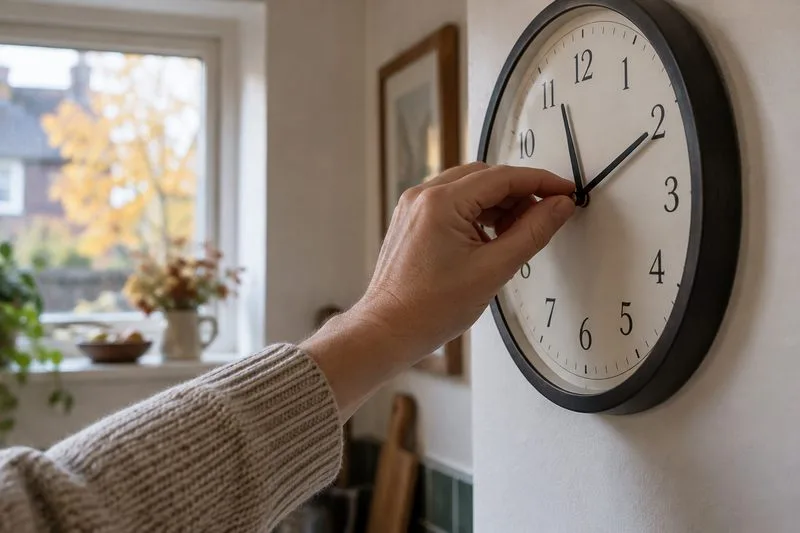
A hand adjusts an analog wall clock, the kind of clock that usually needs to be set manually after the seasonal time change.
What happened when the UK clocks changed?
The official clock change took place at the end of British Summer Time on Sunday, October 25, 2026. The time on the clock reached 2:00 a.m. BST, then moved back to 1:00 a.m. GMT. Since BST is one hour ahead of UTC and GMT is the same as UTC, the change occurred at 01:00 UTC. The GOV.UK clock-change calendar lists October 25 as the 2026 autumn date, and the National Physical Laboratory’s explanation describes the BST-to-GMT transition.
Moment
UK clock reading
UTC relationship
Immediately before the change
1:59 a.m. BST
00:59 UTC
At the change
2:00 a.m. BST becomes 1:00 a.m. GMT
01:00 UTC
After the change
The 1:00 a.m. hour repeats, now on GMT
GMT is UTC+00:00
That repeated 1:00 a.m. hour is why the UK’s autumn clock-change night is one hour longer by the clock. It does not mean every person automatically gets an extra hour of sleep: work shifts, alarms, travel and personal routines still matter. If you work overnight, check whether your rota records the repeated hour in local time or UTC so you know how your actual shift is counted.
Why does the date move each year?
The UK does not change clocks on a fixed date such as October 31. The rule is the last Sunday in October. In 2026, that fell on October 25; in 2027, GOV.UK lists October 31. The spring change follows a separate rule: clocks go forward one hour at 1:00 a.m. on the last Sunday in March. For 2027, the listed spring date is Sunday, March 28.
So if a search result, old calendar or printed reminder gives October 31 as the 2026 date, it is out of date: October 31 is the 2027 date. Check the government’s current clock-change calendar before updating a future reminder. The change applies across the UK; it is not limited to London or to one part of Great Britain.
Do phones, computers and home clocks change by themselves?
Many internet-connected phones and computers adjust when automatic time and time-zone settings are enabled, but the setting and network connection matter. If a device still shows BST or the wrong hour, first compare it with a trusted UK time source, then check its automatic settings.
iPhone: Open Settings, then General and Date & Time. Check that Set Automatically is enabled. Apple notes that time-zone setting can depend on Location Services and service availability; see Apple’s iPhone date and time guidance.
Android: Open Settings and find System or Date & time. Turn on automatic date and time and, if available, automatic time zone. Menu wording varies by manufacturer; Google’s Android instructions explain the options.
Windows: Go to Settings, Time & language, then Date & time. Check Set time automatically and, where available, Set time zone automatically or the daylight-saving adjustment. See Microsoft’s Windows time settings.
Manual clocks: Wall clocks, many ovens, car dashboards and some watches may need a manual adjustment. Set them to GMT, then check any alarms or timed routines that rely on those displays.
A clock that changed automatically is not proof that every device in your home did. Check the devices you rely on for waking up, heating, appointments or travel instead of assuming they all share one time source.
Common clock-change questions
Did the clocks go back an hour or two?
They went back one hour. The display moved from 2:00 a.m. BST to 1:00 a.m. GMT. If you are setting a manual clock, subtract one hour from its previous reading; do not change the date.
Is the UK on GMT now?
Yes. After the October change, UK standard time is GMT, which is UTC+00:00. During British Summer Time, the UK is one hour ahead of UTC. For an international call or online appointment, check both locations’ time zones because other countries may change clocks on different dates or may not use daylight saving time at all.
When do the clocks go forward again?
The next UK change is Sunday, March 28, 2027. At 1:00 a.m. GMT (UTC+00:00), clocks are scheduled to move forward to 2:00 a.m. BST (UTC+01:00). Confirm the date on GOV.UK if you are making travel or work plans far ahead.
One useful seasonal check
The clock change can serve as a reminder to review household routines, but it is not a substitute for regular safety checks. GOV.UK says smoke alarms should be tested at least monthly. If yours are due, press each test button until the alarm sounds, then keep the monthly reminder in place. See the official fire-safety guidance for more detail.
In short: the UK clocks went back on Sunday, October 25, 2026. On Monday, October 26, the change was already in effect: the UK had moved from BST to GMT, and the repeated 1:00 a.m. hour had passed.