Home
» Today
»
Golden Knights’ 5-3 Win Cuts Oilers’ Pacific Lead to Three Points | Nov. 24, 2026
Golden Knights’ 5-3 Win Cuts Oilers’ Pacific Lead to Three Points | Nov. 24, 2026
Information checked: November 25, 2026, 4:47 a.m. UTC (November 24, 2026, 9:47 p.m. MST, Edmonton).
Vegas beat Edmonton 5-3 at Rogers Place on Tuesday, November 24, taking two points from the Pacific Division leader and cutting the Oilers’ advantage from five points to three. Edmonton remains in first place with 38 points; Vegas is second with 35. The result makes the division race tighter, but it does not change the order at the top.
The game started at 7:09 p.m. MST (UTC−07:00) in Edmonton. This was a regular-season game, not a playoff elimination contest: its immediate standings effect is two points for Vegas and none for Edmonton. The clubs are scheduled to meet three more times this season, so the head-to-head race remains open.
Destaques
Vegas won 5-3 and improved to 15-6-5 (35 points); Edmonton fell to 17-6-4 (38 points).
The Oilers still lead the Pacific by three points, with one more game played than Vegas.
Edmonton’s losing streak reached four games (0-3-1); Vegas has won two straight after a four-game skid.
The teams have three more scheduled meetings, including one in Edmonton.
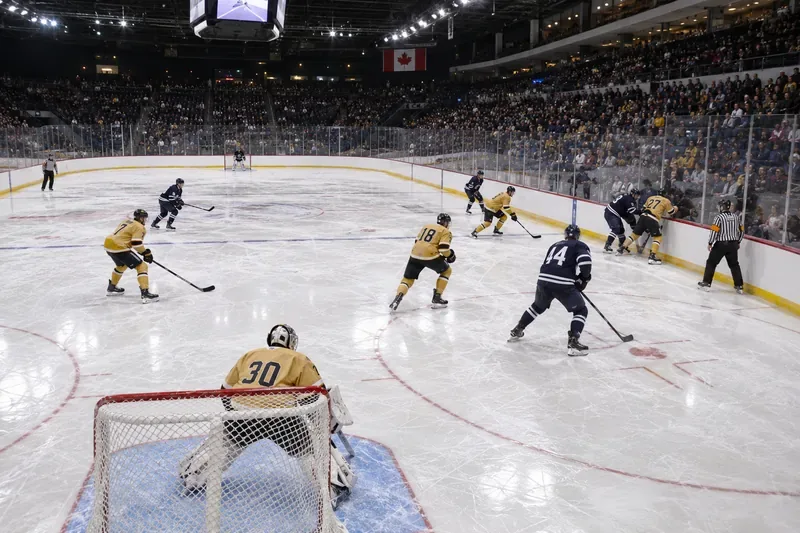
Illustrative arena scene showing a divisional hockey matchup; it does not depict the Nov. 24 game. Image generated for this article.
How did the Golden Knights vs. Oilers result change the Pacific standings?
Before puck drop, Edmonton was 17-5-4 with 38 points and Vegas was 14-6-5 with 33. The 5-3 result changed those records to 17-6-4 and 15-6-5, respectively. Under NHL scoring, a regulation win awards two standings points and a regulation loss awards none. Vegas therefore added two points while Edmonton’s total stayed at 38.
That closes the gap by two, from five points to three. It does not put Vegas ahead, and the standings should be compared with games played in view: Edmonton has played 27 games to Vegas’ 26. Vegas has a game in hand, but a game in hand is only an opportunity to earn points; it is not a guaranteed point or win. The rest of the Pacific table can also shift as other clubs play, so this result alone does not settle playoff positions.
What decided the game, and why does it matter to the race?
Vegas built a 2-0 first-period lead through a Jack Eichel power-play goal and a Trevor Connelly goal. Edmonton responded in the second: Colton Dach made it 2-1, and Connor McDavid tied the game at 2-2 with 19 seconds left in the period. Vegas then regained control early in the third. Nic Dowd scored, Eichel added his second, and Connelly sealed the 5-3 win with an empty-net goal. Vasily Podkolzin’s reply came 16 seconds after Eichel’s second tally.
Connelly finished with two goals and an assist; Eichel also scored twice, while Mitch Marner recorded two assists. Edmonton’s scorers were McDavid, Dach and Podkolzin. The NHL’s official recap records Carter Hart making 20 saves for Vegas and Devon Levi making 22 for Edmonton. Those are game facts; the standings impact comes from the final score, not from individual point totals.
For Edmonton, the practical concern is the trend: this was a fourth consecutive loss, including one overtime loss, for a 0-3-1 stretch. That is a four-game sequence, not proof of a season-long decline. The Oilers retain the division lead and can stop the slide in their next games. For Vegas, the win is a useful two-point gain and a second straight victory, but the club still needs to make up three points while accounting for Edmonton’s extra game played.
What should fans watch next?
Watch the standings after each team’s next game rather than treating the current three-point difference as fixed. A Vegas win while Edmonton loses would narrow the gap further; an Edmonton win would restore breathing room. If either game goes beyond regulation, the losing team can still collect one point, which changes the arithmetic. These are conditional scenarios, not predictions.
The teams have four regular-season meetings in 2026-27, according to Edmonton’s pregame schedule report. The November game was the first; three remain. The next listed meetings are January 20 in Las Vegas, February 3 in Edmonton, and April 2 in Las Vegas. Those direct matchups are especially relevant because one team’s win both adds points to its own total and denies the other a regulation win. The April date is late in the season, but its eventual playoff significance will depend on standings and results still to come.
For readers tracking the race, the useful checklist is simple: current points, games played, each club’s next result, and the remaining head-to-head dates. Edmonton is still first today; Vegas has cut the margin, and its game in hand gives it a chance to gain ground. Neither fact guarantees how the Pacific Division will finish. A short streak can move the margin quickly at this stage, but the table remains a snapshot of completed games rather than a forecast. Check the NHL standings after upcoming divisional games for the next confirmed change.