Home
» Today
»
How NASA Engineers Troubleshoot Voyager 1 Glitches Across a 48-Hour Signal Delay
How NASA Engineers Troubleshoot Voyager 1 Glitches Across a 48-Hour Signal Delay
Checked: November 24, 2026, 9:22 p.m. Pacific Standard Time (UTC−08:00; November 25, 05:22 UTC).
NASA’s Voyager 1 troubleshooting illustrates what a “48-hour delay” means when a spacecraft is about one light-day from Earth: a command takes roughly 24 hours to arrive, and a reply takes roughly another 24 hours to return. Engineers cannot make a rapid back-and-forth adjustment. They have to diagnose from limited signals, plan a carefully checked command, transmit it, then wait for the spacecraft’s response.
The latest confirmed anomaly is more specific than the October communications pause. NASA said Voyager 1’s science and engineering data stopped reaching Earth on November 14, even though a Canberra Deep Space Network antenna received the spacecraft’s carrier signal. NASA used that carrier and trajectory calculations to confirm the probe reached one light-day from Earth on November 18. In the latest public update reviewed for this article, the cause of the data problem and its relationship, if any, to October’s roughly 48-hour loss of contact remained under investigation. NASA’s November 18 mission update and JPL’s November 19 milestone report provide the latest confirmed details.
Destaques
At one light-day, the radio link imposes about a day in each direction; a full command-and-response cycle takes close to 48 hours.
Voyager 1’s carrier signal was detected after science and engineering data stopped arriving, suggesting the antenna and Earth-pointing functions were still working.
The October loss of contact resolved on its own after about 48 hours; the November data outage is a separate reported condition, and NASA had not confirmed a connection.
Engineers must infer, test, and verify in small steps because the spacecraft cannot be serviced and a mistaken command may take days to assess.
What happened to Voyager 1’s signal?
NASA’s Jet Propulsion Laboratory reported that the Deep Space Network (DSN) briefly could not detect Voyager 1 during scheduled communication attempts on October 18 and 19, 2026. The signal reappeared October 20, after about 48 hours. NASA said engineers found that one group of thrusters had gone offline and backup thrusters had switched on automatically through the spacecraft’s fault-protection response. The team had not yet identified what triggered the switch.
On November 14, a different symptom appeared: the DSN antenna in Canberra locked onto Voyager 1’s carrier signal, but the expected science and engineering data were absent. A carrier is the basic radio signal; it is not the same as usable telemetry. NASA said its presence indicated that Voyager 1’s attitude and articulation control computer was keeping the antenna pointed toward Earth and that the antenna and broadcast equipment were operating. The missing data pointed toward a possible problem in the onboard process that gathers spacecraft readings and formats them for transmission. That is a working inference, not a confirmed diagnosis.
NASA confirmed the one-light-day distance on November 18 using the carrier and trajectory calculations even though the data stream had not returned. This distinction matters: a weak or missing telemetry stream does not automatically mean the spacecraft is silent, lost, or unable to receive commands.
How do engineers troubleshoot with a 48-hour round trip?
First, the team separates what the evidence shows from what it cannot yet show. A detectable carrier helps establish that the spacecraft is transmitting and roughly pointed toward Earth. Detailed engineering data would reveal temperatures, voltages, instrument states, and fault indicators. Without that stream, the team has less direct evidence and must reason from the carrier, prior telemetry, and the spacecraft’s known behavior.
Next, teams use the DSN’s geographically separated antenna complexes—Goldstone in California, Madrid in Spain, and Canberra in Australia—to track distant spacecraft as Earth rotates. The network helps maintain opportunities to listen and transmit, but it cannot shorten the signal’s travel time. NASA describes the DSN’s role and sites in its Deep Space Network overview.
Before sending a command, engineers can model its effect against the probe’s original design documents, software constraints, available power, and known hardware condition. Commands are prepared and checked on Earth; they are not joystick inputs. After transmission, the team must wait for the command to reach the spacecraft and then for a signal or data response to cross the same distance back. A command that produces no immediate visible change cannot be judged instantly: the team must allow for the full round trip and scheduled antenna coverage before deciding what to try next.
Voyager’s 2023 data problem provides a precedent, not proof of the present cause. In that earlier episode, NASA ultimately traced garbled telemetry to the flight data subsystem and worked around failed memory by relocating software code. The repair unfolded over months. The current November 2026 issue may involve a different fault; NASA has not said it is the same failure or that the earlier fix can simply be reused. See JPL’s account of the 2023–24 recovery.
Why is each troubleshooting step consequential?
Voyager 1 launched in 1977 and operates with aging systems and limited electrical power from a radioisotope thermoelectric generator. JPL says the probes lose about 4 watts of power each year as their plutonium supply decays. NASA has been shutting down or replacing lower-priority devices to protect the remaining science mission. A command or configuration change therefore has to account for both reliability and power; the team cannot assume spare capacity or replacement hardware.
The October episode also shows the value of onboard fault protection. When the spacecraft detected an issue with an active thruster group, it switched to backups and entered a safer operating state. This autonomy can protect the craft while Earth is still waiting for the first clue. It does not guarantee that every problem will be corrected automatically, nor does it reveal the underlying cause by itself.
What should readers expect next?
Confirmed: NASA reported the missing science and engineering data beginning November 14, the continuing carrier signal, the October communications gap and self-restoration, and the November 18 light-day milestone. Not yet confirmed in the reviewed NASA reports: the root cause of the November data issue, whether it is linked to October’s thruster event, when full telemetry will return, and which command or workaround might be used.
Because a diagnosis may take weeks or longer, a quiet period in public updates is not evidence that engineers have stopped working. The operational impact is that science observations cannot be interpreted normally while their data are unavailable, and each corrective action takes time to evaluate. Readers following the mission should distinguish three signals of progress: carrier detection, return of engineering telemetry, and return of science data. Those are different milestones; one does not guarantee the next.
Frequently asked questions
Does “48-hour delay” mean NASA waits two days before sending a command?
No. The command can be sent when an antenna pass is available, but it takes about 24 hours to reach Voyager 1, and a response takes about 24 hours to return.
Was the October 48-hour signal loss the same as the November data outage?
NASA was investigating a possible connection, but its November 18 update did not establish that the two events had the same cause. In October the signal disappeared and returned; in November the carrier was detected without science and engineering data.
Is Voyager 1 confirmed to be fixed?
No. NASA’s latest public update reviewed here said the team was still analyzing the missing data issue. The carrier and distance milestone were confirmed, but those do not mean normal telemetry had resumed.
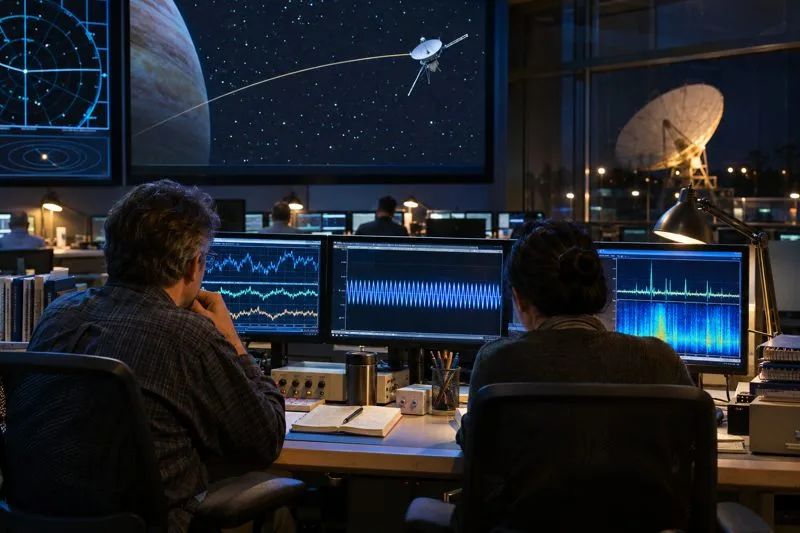
An illustrative mission operations scene; this is not a photograph of the Voyager 1 team or an actual NASA control room.