Desk Decorating Ideas for a Spooky Office Cubicle

Create a spooky office cubicle with Halloween desk decor ideas that keep your workspace usable, tidy, and mindful of workplace safety.
Is your laptop running too loud and too hot? Before you take it apart, here’s an easier solution: Adjust your laptop’s Fan Curves. Adjusting your Fan Curves can make a huge difference in your laptop’s performance and cooling; best of all, it’s incredibly simple.
How to Adjust Fan Curves for Optimal Performance
It's no surprise that high-performance PC internals like your CPU , GPU , and even your RAM or storage run hot under load. At a certain temperature, this heat reduces the performance of the device - a phenomenon known as Thermal Throttling .
There are many ways to reduce and prevent Thermal Throttling and maintain system performance; setting custom Fan Curves for the CPU or GPU is one of the best options.
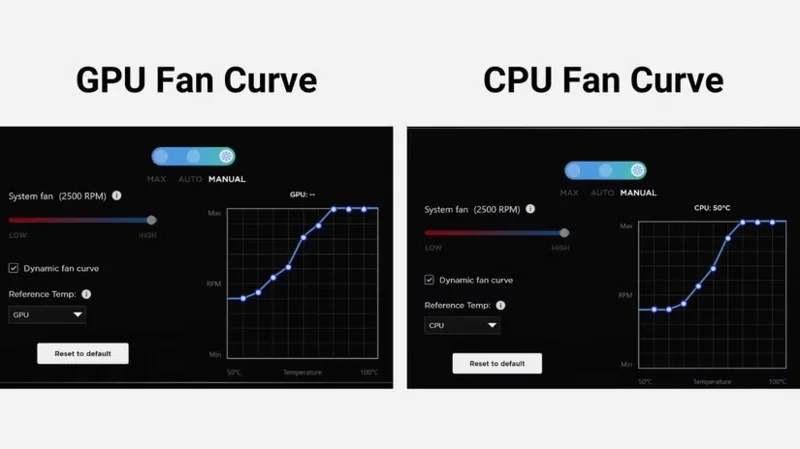
How to change the Fan Curves of each laptop varies from manufacturer to manufacturer, as the utilities they use have different interfaces. On an HP Omen laptop, you'll find these settings in the Performance Control tab of the Omen Gaming Hub.
There are third-party tools like MSI Afterburner r and Fan Control to control GPU and CPU Fan Curves, but they are not guaranteed to work with every laptop.
However, the basic principle of setting up Fan Curves remains the same on most laptops. All you need to do is match the fan RPM to the temperature of the CPU or GPU. So the hotter the CPU or GPU, the faster the fan spins, and vice versa.
For example, on the HP Omen Transcend 14, the CPU fan starts at 40% speed at 122°F, gradually increasing with CPU temperature until it reaches its maximum speed at 176°F. The GPU Fan Curves are a bit more linear, so the fan spins up faster as the GPU heats up quickly when running demanding games.
If you run into Thermal Throttling issues, let the fans spin faster as the temperature rises. However, if you can control the temperature without cranking the fans to maximum speed, you'll have a quieter laptop even when you're working hard.
Adjust Fan Curves to reduce noise
If manual fan settings make your laptop sound like a jet engine when it’s not doing anything, you’re probably using too high a fan speed for the given load. If you’re in a classroom, library, or anywhere where your laptop can’t run too loud when performing basic tasks, try reducing the fan speed when your CPU or GPU temperature rises.
You have to be careful not to let your device get too hot, but the only way to keep the fans from running and damaging your system is to avoid running resource-intensive tasks. If you want to keep your laptop quiet even under heavy load, you’ll have to deal with excess heat that your cooling system can’t handle due to slow fan speeds, leading to Thermal Throttling.
To keep your laptop as quiet as possible, regardless of whether it’s under heavy load or not, your best bet is to try to find the lowest fan speed you can achieve without throttling the CPU, GPU, or both as temperatures rise. Don’t worry if your laptop feels a little warm to the touch. As long as you’re not experiencing extreme temperatures (over 194°F) and you’re not experiencing any performance drops, you should be fine (although obviously a cooler machine would be better).
Adjusting your laptop's Fan Curves may take some trial and error, but the end result ensures that the fans are properly used to give your laptop the highest possible performance while also making it quieter than the manufacturer's default fan profile.
Semiconductors work best within a specific temperature range. If you keep your fans running at maximum speed, you risk damaging them faster. And if you keep them too low, your laptop will lose performance before it reaches its full potential. Adjusting your Fan Curves properly will ensure that your CPU and GPU are running at their ideal levels.
Create a spooky office cubicle with Halloween desk decor ideas that keep your workspace usable, tidy, and mindful of workplace safety.
Plan a recognizable Halloween 2026 look with pop culture costumes inspired by Spider-Man, Supergirl, Toy Story 5, Moana, Mario, and Wednesday.
Sort leftover Halloween candy safely, share or repurpose sealed treats, and choose food use or compost for pumpkins based on their condition.
Compare workplace Halloween costume choices by respect, dress code, mobility, and safety—and learn when a subtle accessory or a policy check is the better option.
Find a couples costume that fits your style, budget, and comfort level, from Addams Family classics to original inside-joke duos.
Need a last-minute high school Halloween costume? Compare 10 easy closet-based ideas by prep time, comfort, school-day practicality, and simple safety checks.
Use a simple 2026 Halloween decorating timeline for indoor décor, outdoor displays, and fresh pumpkins, with practical adjustments for weather and events.
Mix five vivid, approachable Halloween cocktails with measured recipes, simple prep tips, and an alcohol-free option for your party guests.
Find 15 office-friendly Halloween costume ideas for 2026, with practical checks for dress codes, respectful themes, comfort, and workplace safety.
Plan a fun elementary school Halloween party with easy crafts, games, inclusive treats, costume tips, and a sample 75-minute classroom schedule.