India vs New Zealand: India Wins Fifth ODI, Yash Thakur Debuts | Nov. 15, 2026
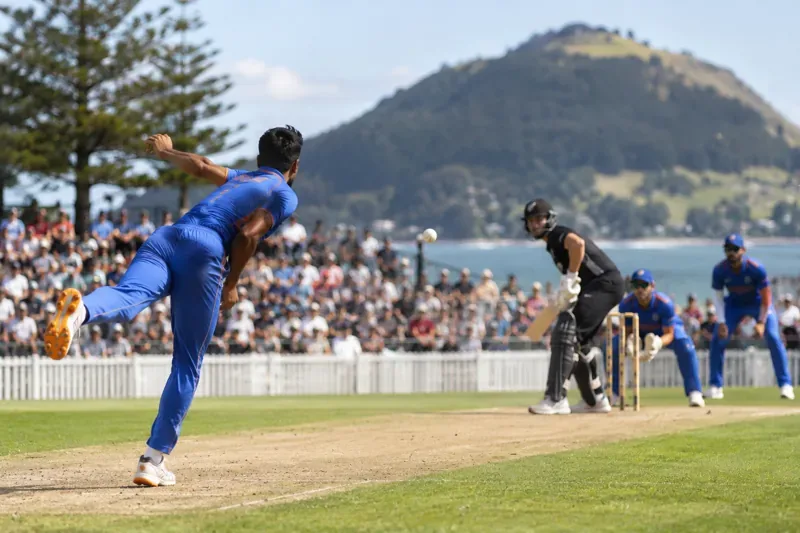
India beat New Zealand by 22 runs to win the ODI series 3–1. Full match highlights, Arshdeep Singh’s 3/30 and Yash Thakur’s debut figures.
Information checked: November 15, 2026, approximately 12:06 p.m. UTC (November 16, 2026, 1:06 a.m. in Mount Maunganui, New Zealand Daylight Time, NZDT, UTC+13:00). The official ICC match scorecard and contemporary reporting were reviewed after the result.
India beat New Zealand by 22 runs in the fifth and final one-day international at Bay Oval in Mount Maunganui on November 15, clinching the five-match ODI series 3–1. India were bowled out for 209 in 42.1 overs, but dismissed the hosts for 187 in 48.1 overs. Arshdeep Singh's 3 for 30 earned him Player of the Match honors, while debutant Yash Thakur delivered an important spell of 1 for 38 from 10 overs.
The final score tells only part of the story. After India's top order struggled, Axar Patel and Ishan Kishan each made 46 to provide a defendable target. New Zealand then found themselves in contention before India's seam attack broke up the middle order. Thakur's first ODI wicket, Dean Foxcroft, helped prevent a recovery, and Axar completed the win with a stumping in the 49th over.
India won by 22 runs, defending 209 to finish the ODI series 3–1. The contest was staged at Bay Oval, Mount Maunganui, on Sunday, November 15. Its scheduled start was 3:00 p.m. New Zealand Daylight Time (NZDT, UTC+13:00), corresponding to 2:00 a.m. UTC and 7:30 a.m. India Standard Time (IST, UTC+05:30). New Zealand won the toss and chose to field.
| Match detail | Confirmed result |
|---|---|
| Fixture | New Zealand vs India, fifth ODI |
| Venue | Bay Oval, Mount Maunganui, New Zealand |
| India innings | 209 all out in 42.1 overs |
| New Zealand innings | 187 all out in 48.1 overs |
| Winning margin | India by 22 runs |
| Series outcome | India won 3–1 |
| Player of the Match | Arshdeep Singh, 3/30 in 10 overs and 14 off four balls |
India's innings began poorly. Matthew Fisher removed Rohit Sharma for seven and Virat Kohli for five, while Jacob Duffy dismissed Ruturaj Gaikwad for 18. Captain Shreyas Iyer made 22 but could not turn his start into a substantial score. Against that backdrop, Axar's 46 from 55 deliveries and Kishan's 46 from 58 were vital rather than merely useful. Naman Dhir contributed 22, and late runs from Mohammed Siraj and Arshdeep lifted the total beyond 200.
New Zealand captain Mitchell Santner finished with 3/47 and Duffy took 3/60. The home side's bowling performance offered a genuine opening: India's top-order failures and 42.1-over innings meant New Zealand did not need an exceptionally high scoring rate. That makes the subsequent bowling comeback especially significant.
New Zealand did not lose because the required rate was impossible. The chase remained within reach for much of the first half, but wickets repeatedly interrupted partnerships. Mohammed Siraj had Tim Seifert caught by Thakur, while Arshdeep accounted for Will Young and Nick Kelly. Siraj then dismissed Finn Allen cheaply. Later, Thakur bowled Foxcroft, the home side's top scorer with 31 from 42 balls.
Mitchell Santner struck 24 in an attempt to keep the chase alive, but Naman Dhir dismissed him. Arshdeep removed Kristian Clarke for his third wicket; Axar took two late wickets, including the final dismissal of Blair Tickner, stumped by Kishan. The combination of wickets at regular intervals and relatively controlled bowling prevented New Zealand from turning a modest chase into victory.
Thakur's verified figures were 10 overs, 38 runs conceded and one wicket. His maiden ODI dismissal was Dean Foxcroft, bowled for 31. He also held the catch that dismissed Seifert off Siraj, showing an impact beyond his bowling column. In India's innings he made zero from four balls and was caught behind off Santner.
For a first appearance, a full allocation of 10 overs with an economy rate of 3.80 runs per over stands out in a low-scoring match. It suggests that the captain trusted Thakur to handle multiple phases of the chase. His dismissal of Foxcroft also came at a meaningful point, with New Zealand seeking a stabilizing partnership. These are observations supported by the scorecard; one match cannot establish whether he will become a regular selection.
The ball-by-ball account also records no-balls when Thakur clipped the non-striker's stumps in his delivery stride. That is an execution issue for him to review, despite the strong overall economy. It would be misleading either to omit the errors or to let them overshadow an otherwise effective bowling performance. His work in the field, accuracy and adaptability should be assessed over a larger sample.
Arshdeep's 3/30 from 10 overs was India's leading bowling return and featured two maidens. His wickets included Young, Kelly and Clarke, giving him influence in different stages of the innings. He also hit 14 from four balls, including two sixes, at the end of India's innings. The award reflects a combination of incisive bowling and a brief but valuable lower-order contribution.
Siraj's two wickets, Axar's 2/28 and Thakur's disciplined spell demonstrate that the win was not produced by one bowler alone. Nonetheless, Arshdeep supplied the breakthroughs that changed the balance after New Zealand had made a manageable start. That distinction explains the award better than the wicket tally in isolation.
The verified immediate consequence is a 3–1 ODI series victory for India. One of the five scheduled games was abandoned because of rain, so the series score should not be read as five completed results. The win gives India's selectors another performance to evaluate from their pace options, particularly Thakur's debut and the established bowling leadership of Arshdeep and Siraj.
New Zealand will be disappointed to have squandered a chase of 210, but the result does not by itself establish a long-term batting weakness. A fuller assessment requires looking at conditions, availability and performances across multiple matches. The teams are scheduled to move to a two-Test series beginning November 19; ODI form is relevant background, not a reliable prediction of Test results.
For readers tracking players rather than only the series, the clearest next questions are whether Thakur retains selection, whether India maintains a four-seamer balance, and how New Zealand responds to middle-order pressure. Those are prospective questions, not confirmed team announcements.
India made 209 in 42.1 overs and dismissed New Zealand for 187 in 48.1 overs, winning the fifth ODI by 22 runs.
Thakur took one wicket for 38 runs in 10 overs on ODI debut, dismissing Dean Foxcroft. He also caught Tim Seifert.
Arshdeep Singh received the award for 3/30 from 10 overs and 14 runs from four balls.
Sources: International Cricket Council: official fifth ODI scorecard; Reuters: November 15 match report; Mumbai Indians: post-match account.
India beat New Zealand by 22 runs to win the ODI series 3–1. Full match highlights, Arshdeep Singh’s 3/30 and Yash Thakur’s debut figures.
India won the ODI series 3–1 and T20Is 3–2. Here’s what the results mean for the upcoming Tests and World Test Championship standings.
Michael Amadio had a goal and an assist as Ottawa beat Pittsburgh 4–1 on Nov. 14, extending its point streak to five games. See the scoring recap and key stats.
Ottawa beat Pittsburgh 4–1 on Nov. 14 to reach 28 points and extend its point streak to five games. Here’s what the result means for the Eastern race.
Canada winter travel update for November 15, 2026: Ontario snow hazards, B.C. rain warnings, how to check flight cancellations and highway closures, and safety tips.
Canadian travelers: what U.S. border officers can check, which documents to carry, how device searches work, and when 30-day registration rules apply.
Environment Canada’s live alert page showed no active alerts at 12:03 UTC on Nov. 15. See the latest verified snowfall update and where to check local road conditions.
Prepare for a Canadian winter storm with practical steps for your home, a 72-hour household kit, vehicle supplies and carbon monoxide safety.
New winter hours affect 26 Canadian border crossings. See what changed November 1, how U.S. Border Patrol differs from port inspections, and where to check delays.
Canadian commuters should allow for possible extra U.S. screening and check live crossing conditions. Here’s what current border data shows and how to prepare.