MuseScore is a free professional music composer software on PC. Using MuseScore you can manually compose the desired music in just a glance.
MuseScore uses virtual instruments to play back audio. That virtual instrument can be one of two types:
- SoundFont (file extension sf2 / sf3): The file contains one or more virtual instruments.
- SFZ (file extension sfz): A collection of audio files and definition files that contain one or more virtual instruments.
SF2 SoundFonts
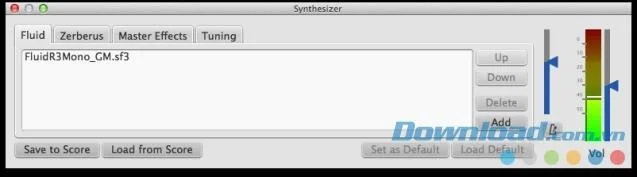
SoundFont is a special type of file containing sound samples of one or more different types of musical instruments. MuseScore 2 integrates with soundfont " FluidR3Mono_GM.sf3 ". This is a basic sample library of MIDI (GM) including 128 instruments and drum kits for many styles from classical, jazz to pop ...
When you have completed setting up the correct score sheet via FluidR3, you can activate the same instrument from any GM audio source. Thus, sharing works with non-MuseScore users by exporting them to MusicXML, MIDI files is also extremely easy.
The vast Internet world has many different soundfonts available, both free and paid. Larger SounFont usually have better sound, but they may be too heavy to run on the computer. If you find MuseScore running slowly after installing a large SoundFont or the computer is choppy during playback, look for a smaller SoundFont.
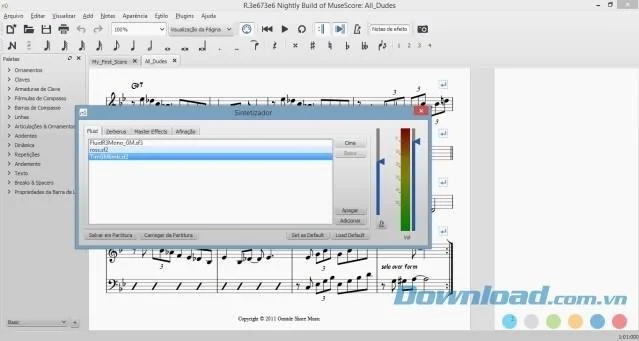
After installing SoundFont, you can use it to "playback" in MuseScore (and control other aspects of audio output) with Synthesizer. To display Synthesizer , go to View → Synthesizer.
Install SoundFont
After searching and extracting SoundFont, double click the corresponding file to open it. In most cases, the SoundFont file type is associated with MuseScore. The software runs and a dialog box will appear asking if you want to install that SoundFont. Occasionally, other than MuseScore, another application will associate with this type of SoundFont file. If that is the case, you need to right-click or click on the control on the file to display the menu from where you chose to open the file in MuseScore. In other cases, when asked if you want to install SoundFont, click " Yes " to place a copy of the SoundFont file in MuseScore's SoundFont list. This category can be viewed or changed in MuseScore's Preferences , but its default location is:
- Windows :% HOMEPATH% \ Documents \ MuseScore2 \ Soundfonts
- macOS and Linux : ~ / Documents / MuseScore2 / Soundfonts
In contrast to the SoundFont users add, SoundFont installed by default with MuseScore was originally in the system catalog, only for its main purpose and should not be modified. The default location of the SoundFont file in this case is:
- Windows (32-bit) :% ProgramFiles% \ MuseScore 2 \ sound \ FluidR3Mono_GM.sf3 Windows (64-bit):% ProgramFiles (x86)% \ MuseScore 2 \ sound \ FluidR3Mono_GM.sf3
- macOS : / Applications / MuseScore 2.app/Contents/Resources/sound/FluidR3Mono_GM.sf3
- Linux (Ubuntu) : /usr/share/mscore-xxx/sounds/FluidR3Mono_GM.sf3 (xxx is the version of MuseScore)
Uninstall
To uninstall SoundFont, open the folder containing the installation file and delete it.
SFZ
SFZ contains many files and directories, including SFZ files and a series of actual audio files in WAV or FLAC format. The SFZ text file, basically, describes the position and is used for instruments of the same high and low level.
Note: To receive comprehensive support for SFZ, you need to install MuseScore 2.1 or higher, the older version has limited support, specifically for the Salamander grand piano line only.
Install SFZ
After finding SFZ, you need to manually extract all files that belong to SZF to the list listed above.
Uninstall
To remove SFZ, open the folder in the installation file and delete them.
Synthesizer
Synthesizer is the central control panel of Synthesizer for audio output. SoundFont when installed, needs to be uploaded to Synthesizer. MuseScore will use it for "playback". To create a different default SoundFont, download it in Synthesizer and click Set as Default .
To display Synthesizer, go to View → Synthesizer.

List of some audio files that can be downloaded
GM SoundFonts
- GeneralUser GS (29.8 MB)
Courtesy of S. Christian Collins
- MuseScore 1 came with TimGM6mb (5.7 MB)
License: GNU GPL, version 2
Courtesy of Tim Brechbill
- MuseScore 2 comes with
FluidR3Mono_GM.sf3(12.6 MB).
License: released under the MIT license
Soundfile Orchestral
- Sonatina Symphonic Orchestra (503 MB uncompressed)
Downloads: SoundFont
License: Creative Commons Sampling Plus 1.0
Troubleshoot
If the toolbar is grayed out or not displayed, follow these instructions:
- Right-click on the menu bar and make sure there is a check mark next to the Transport Tools menu . You can add or remove this accent by clicking the corresponding menu item. If this step does not solve the problem, try the way below.
- If the music control panel disappears after changing SoundFont, go to Edit → Preferences ... → I / O , click OK without having to make any changes. After restarting MuseScore, the "Play" control panel will reappear.
If the playback is jerky, continuous looping, it means your computer cannot handle SoundFont. There are two solutions:
- Reduce the amount of RAM MuseScore used by replacing a smaller SoundFont.
- Increase RAM for MuseScore by exiting all other running applications. If you're still having issues and really need a great SondFont, consider raising your PC's RAM.
Updated in the new version MuseScore 2.1
- Top new features
- Many new note input modes
- Rhythm Input: First enter the rhythm, then the pitch. Swap back and forth between the computer and the MIDI . keyboard
- Part-Time MIDI Input: A limited form of real-time input (play each track on a MIDI keyboard, notation automatically generated). In semi-real-time, you cannot enter 3 Triple notes or notes shorter than the selected duration. However, it is more reliable than full entry at real time
- Real-time (automatic): Play with metronome
- Real-time (manual): Play while touching the key/background to set tempo
- Better support for the SFZ sample library in the Synthesizer Zerberus
- New "Swap" command added to "Copy, Cut, Paste"
- New "Regroup Rhythms" command under the Layout menu to separate and join musical notes, silences according to the rhythm rule
- Changing the midrange instrument now also changes the vocal translation
- More analog note selections in Select
- Edit instrument name with double click
- Changing instruments and fingers is available in the Add/Text main menu, supports keyboard shortcuts
- Shortcut to switch "Hide Empty Staves" and for the bow and arrow icons
- Add Next and Previous buttons to the Staff Properties dialog box
- Added Pause to interrupt the voice in Inspector
- Loading SFZs at a time in Zerberus
- Option to add a page break when creating an album
- Album Manager is set to “Untitled” at first use
- Multiple MP3 bitrate settings
- New musical instruments: percussion, guitar, tenor…
- Nhiều template mới: brass band, small concert band, marching bands, bluegrass band
- Upload your performance to musecore.com with scores
- New Shift-Q and Shift-W commands to decrease or increase the amount of time to the nearest dot or non-dot
Download MuseScore Download MuseScore for Android