BBC Licence Fee Projections: How Streaming and TV Rules Could Change

The UK’s BBC Charter Review is weighing licence fee reform as viewing shifts online. Here is what is confirmed, what could change, and what remains undecided.
Verified: November 23, 2026, 11:02 PM EST (UTC−05:00); November 24, 2026, 04:02 UTC.
If you are looking at the sky in the United States on Monday night, November 23, 2026, the Moon will look almost full, but the exact full Beaver Moon occurs on Tuesday morning, November 24. The U.S. Army Corps of Engineers' astronomical tables put the event at 9:53 a.m. Eastern Standard Time, while NASA's supermoon calendar lists 9:54 a.m. EST. Both sources agree on the date, and the one-minute difference is immaterial for viewing.
You do not need to be outside at that precise moment. Monday evening and Tuesday evening both offer opportunities to see a nearly circular lunar disk, provided clouds and local obstructions do not block your view. NASA also identifies this November full Moon as a supermoon, meaning it occurs near the closer portion of the Moon's orbit around Earth.
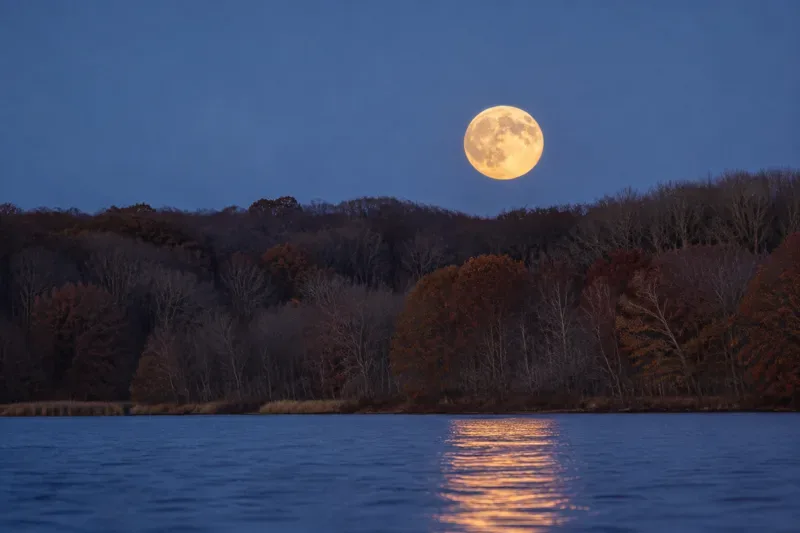
The full phase is a single astronomical moment shared by observers worldwide. It does not happen separately at moonrise in each state. The following times are converted from the official tables and use standard time, which applies in November in the listed U.S. time zones.
| Time zone | November 24 full phase |
|---|---|
| Eastern (EST, UTC−05:00) | 9:53–9:54 a.m. |
| Central (CST, UTC−06:00) | 8:53–8:54 a.m. |
| Mountain (MST, UTC−07:00) | 7:53–7:54 a.m. |
| Pacific (PST, UTC−08:00) | 6:53–6:54 a.m. |
| Alaska (AKST, UTC−09:00) | 5:53–5:54 a.m. |
| Hawaii (HST, UTC−10:00) | 4:53–4:54 a.m. |
These are phase times, not moonrise predictions. Some locations may have the Moon below the horizon at the listed moment. The NASA supermoon calendar and the 2026 Cape Cod Canal astronomical tables provide the underlying dates and times.
The Moon does not produce its own visible light. Sunlight illuminates roughly half of its surface, and the amount of that illuminated half that we can see changes as the Moon travels around Earth. At full phase, the Moon is opposite the Sun in the sky in terms of ecliptic longitude. That alignment produces the familiar round appearance.
The change is gradual, rather than a switch that flips at a particular minute. On November 23 the Moon is technically waxing gibbous, meaning its visible illuminated portion is increasing. After the full phase on November 24, it becomes waning gibbous. Near either side of the transition, the small dark portion can be difficult to distinguish without magnification.
Earth is not normally blocking the sunlight at full Moon because the lunar orbit is tilted relative to Earth's orbital plane. A full Moon is therefore not automatically a lunar eclipse. NASA's explanation of lunar phases illustrates how the geometry changes throughout the month.
The name connects the lunar calendar with seasonal activities in North America. One historical explanation relates it to the preparations beavers make before winter, including maintaining their shelters and accumulating food. Another connects it to the historical trapping season, when people sought beaver pelts before waterways froze.
Neither explanation means that all Indigenous peoples used an identical name or calendar. Different communities developed their own seasonal traditions, and November's Moon has also been associated with frost and early snow. NASA discusses these alternative interpretations in its background on the Beaver Moon name.
The Moon travels along an elliptical orbit, so its distance from Earth varies. Its closest orbital point is called perigee. A supermoon is an informal name for a full Moon occurring sufficiently close to perigee; there is no single universally adopted distance threshold.
NASA notes that the closest full Moon can look roughly 14 percent wider and 30 percent brighter than the most distant full Moon. Those figures compare opposite extremes, not this November Moon with an ordinary full Moon. Do not expect the lunar disk to suddenly double in size. The apparent enlargement people often notice near the horizon is largely a perceptual effect known as the Moon illusion, separate from the orbital distance change.
Tuesday evening remains an excellent opportunity. Start by checking your town's moonrise using the U.S. Naval Observatory's daily Sun and Moon data. Look generally east around sunset, allowing extra time for hills, trees or buildings. If that horizon is blocked, wait until the Moon climbs higher. Check the cloud forecast at the National Weather Service for your location rather than assuming nationwide clear skies. Even Wednesday evening can provide a bright, nearly round Moon if Tuesday is cloudy.
The next full Moon is listed by NASA for December 24 at 01:28 UTC, corresponding to December 23 at 8:28 p.m. EST (UTC−05:00). It is also listed as a supermoon.
No. It is a waxing gibbous Moon that looks almost full. The exact full phase takes place Tuesday morning in the United States.
No. The Moon is visible without equipment when it is above the horizon and skies are sufficiently clear.
No. Orange or reddish colors near the horizon can result from sunlight reflected by the Moon passing through more of Earth's atmosphere. The seasonal nickname does not specify a color.
The UK’s BBC Charter Review is weighing licence fee reform as viewing shifts online. Here is what is confirmed, what could change, and what remains undecided.
NVIDIA shares jumped 31.48% after Jensen Huang returned as CEO. Here’s what the move, latest earnings and risks mean for tech investors.
Jensen Huang’s return as Nvidia CEO drove a 31.5% one-day stock jump. Here’s what’s confirmed, why searches surged, and what investors should watch next.
The UK licence fee is £180 for 2026/27, with another CPI-linked rise scheduled for April 2027. See what Parliament’s long-range projections say—and what remains undecided.
GTA VI is set in Leonida, but Rockstar has not announced a GTA Online character or asset transfer. Here is what current migration rules mean for players.
GTA VI launched with Leonida and an official map, but Rockstar has not confirmed a GTA Online move, multiplayer release date, or character transfer.
Explore how Leonida could transform GTA Online racing, cooperative missions and shared-world exploration, and what Rockstar has actually confirmed.
The DWTS Season 35 finale airs live coast-to-coast Nov. 24. See ABC and Disney+ viewing times, voting limits, eligibility, replay details and how to make your votes count.
The DWTS Season 35 finale airs live Tuesday, Nov. 24, at 8 p.m. ET on ABC and Disney+. See U.S. time-zone start times, the West Coast encore, and Hulu streaming date.
Find out when November’s Beaver Moon reaches its full phase, why it is a supermoon, and how to see it across the United States on November 23–24.