Home
» Today
»
John Langford Leaves Microsoft: What His AI Research Exit Means — November 15, 2026
John Langford Leaves Microsoft: What His AI Research Exit Means — November 15, 2026
Information verified: November 15, 2026, at 5:14 a.m. Greenwich Mean Time in London (GMT, UTC+00:00; 05:14 UTC). This is the verification time, not the time of Langford’s departure.
Veteran machine-learning researcher John Langford has left Microsoft and says AI Frontiers, the research organization he helped establish, is over. In a first-person account published November 6, 2026, and dated again November 7 following an update, Langford described a disagreement over how fundamental AI research should fit within Microsoft’s push to develop and deploy larger models. The departure matters because Langford is associated with influential work on efficient and interactive machine learning—not simply because Microsoft lost another senior employee.
There is an important distinction between the two public accounts. Microsoft's official AI Frontiers page said on September 14 that the group had joined Microsoft AI and would continue pursuing frontier research. Langford subsequently characterized the transition as a breakdown in the path from research to product use. The statement that AI Frontiers is “over” is Langford’s assessment, not a separately verified announcement that Microsoft has ended every related project or laid off the organization’s full staff. Read the Langford’s November 6 firsthand account and the Microsoft Research’s AI Frontiers page for the original positions.
Destaques
Langford publicly confirmed his exit in a November 6, 2026 blog post; he did not name a new employer in that account.
Microsoft confirmed on September 14 that AI Frontiers had become part of Microsoft AI; Langford said the reorganization took place in early September.
His central criticism concerns whether exploratory research can influence the systems Microsoft develops and deploys.
Microsoft’s published AI Frontiers page still describes agent and model research; the future of individual teams and open-source projects is not established by the departure post.
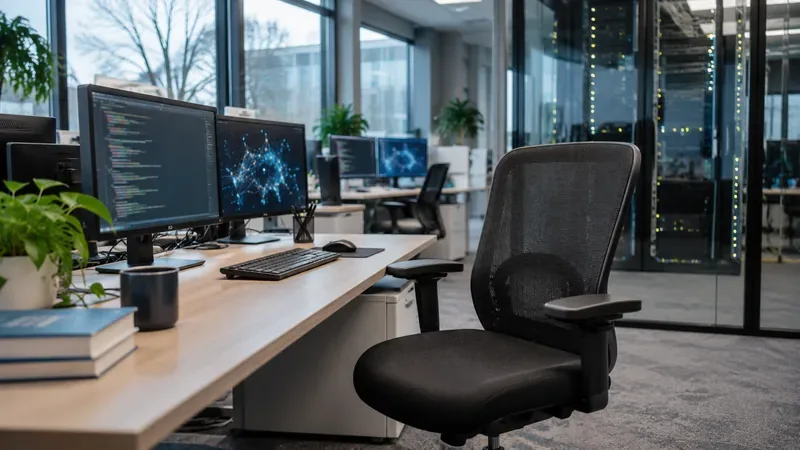
Illustrative image of an AI research workspace. This is not a photograph of John Langford or a documented Microsoft office.
Who is John Langford, the researcher who left Microsoft?
Langford is a computer scientist known for both the mathematical foundations of machine learning and systems that make learning algorithms practical. According to his Microsoft Research biography, he earned degrees in physics and computer science at the California Institute of Technology in 1997 and completed a computer science Ph.D. at Carnegie Mellon University in 2002. His earlier affiliations include Yahoo! Research, IBM’s Watson Research Center, and Toyota Technological Institute. He was also among the early members of Microsoft Research’s New York lab.
His work spans online learning, contextual bandits, learning reductions, Cover Trees, and techniques for handling large-scale data. He is particularly associated with Vowpal Wabbit, an open-source machine-learning project designed for fast and flexible learning. Microsoft’s Microsoft’s reinforcement-learning research history identifies the first public Vowpal Wabbit release in 2007 and documents the role of Langford and colleagues in the company’s reinforcement-learning research. This background explains why his criticism carries weight in discussions about the balance between scaling existing AI systems and inventing new algorithms.
What happened to Microsoft’s AI Frontiers group?
In Langford’s account, AI Frontiers took shape in 2023 after the arrival of ChatGPT demonstrated how much computing, teamwork, and organizational coordination cutting-edge AI research required. He estimated that the group involved about 50 people. Its efforts included agent systems such as the AutoGen orchestration framework and Fara computer-use agent, alongside model architectures and training techniques.
Langford said the organization was moved into Microsoft AI in early September 2026. Microsoft's official page, updated September 14, independently confirms the organizational shift and presents it as a way to continue model and agent research within Microsoft AI. That announcement names projects including AutoGen, Fara, Magentic-One, and other agent-related work. It does not say that the projects were canceled.
Langford’s later post painted a different picture of the transition. He said he found positions for colleagues as best he could before leaving, and wrote that he believed other founding leadership members had reached similar conclusions. Those claims have not been independently established for every individual, and the post does not give a comprehensive roster of personnel changes. His statement that there would be no internships with his former group the following year is likewise a statement about that group, not about all Microsoft internships.
Why did John Langford say he left Microsoft AI?
Langford’s stated reason was a fundamental disagreement about research priorities. In his telling, the leadership approach he encountered within Microsoft AI emphasized scaling models and refining the data used to train them over experimental algorithms. He acknowledged that increasing model scale can produce improvements and offers a business with relatively predictable returns. His objection was that a singular focus on scaling can overlook breakthroughs that might make systems more capable or dramatically more efficient.
As one example, Langford cited experiments from ByteDance relating to a variant of the Full Bandwidth Transformer, arguing that research ideas may deliver substantial efficiency gains. This is his interpretation of research findings, not a confirmed statement that Microsoft could halve all AI expenses, and not a verified production result for Microsoft's models.
Langford also said he chose not to return to Microsoft Research because he doubted whether his ideas would find a practical adoption path inside the company. Microsoft’s public September statement, by contrast, says the merged organization aimed to advance research in efficient models and agentic systems. Neither public document alone establishes the full internal decision-making process, and a disagreement described by one participant should not be presented as an independently proven company-wide prohibition on research.
What does his departure mean for Microsoft’s AI strategy?
The immediate verified consequence is the loss of a researcher with a long record of contributions to machine learning, and an unusually candid public disagreement about how AI discoveries reach deployed products. Three areas are especially relevant for understanding the potential impact.
Could Microsoft lose expertise in efficient AI models?
Langford’s career has focused in part on achieving better learning with less data, computational effort, or experimentation. Such approaches are economically important when training and serving modern models demand substantial computing resources. His exit removes his direct leadership from Microsoft, but does not demonstrate that all his ideas, collaborators, or existing software have left the company. The cost and capability effects will depend on which approaches Microsoft subsequently evaluates and adopts.
What happens to AutoGen, Fara, and agent research?
AI Frontiers is associated with work on AI agents that can coordinate tasks and interact with software. Open-source developers and enterprise teams may understandably ask who will maintain those projects and whether their roadmaps will change. Yet Langford’s post does not announce a discontinuation of AutoGen or Fara, and Microsoft’s official lab description still names both among its contributions. Developers should look for release notes, repository maintainers’ statements, and project documentation before assuming support has ended.
Does this signal a wider talent problem at Microsoft?
The departure illustrates a possible risk for any organization combining academic-style research with product-oriented model development: researchers need freedom to investigate uncertain ideas, while product teams need schedules, measurable goals, and scalable infrastructure. If talented researchers conclude their work cannot affect real products, retention may become more difficult. That is a conditional organizational risk, not proof of a company-wide exodus. The documents checked do not provide a verified number of departures from Microsoft AI attributable to this reorganization.
What should observers watch next?
The strongest signals will be specific, observable actions rather than speculation about executive motives. Microsoft may clarify the structure of its research teams, publish new model-efficiency findings, or provide updates to the agent tools associated with AI Frontiers. Public hiring information and project release histories may also indicate whether research activity continues in new organizational homes. Until such developments are documented, it would be premature to declare that Microsoft's AI program has abandoned fundamental research or that its products will suffer a particular performance decline.
For business customers, Langford’s departure does not by itself change a license, support obligation, or service-level agreement. For researchers and engineers, the more meaningful issue is whether innovation and deployment remain connected. That is the broader question behind this otherwise personal career decision—and the answer will depend on what Microsoft builds and publishes after the reorganization.
Frequently asked questions
Did John Langford leave Microsoft?
Yes. Langford said in his November 6, 2026 blog post that he had left the company after the AI Frontiers reorganization.
Why is John Langford well known in AI?
He is known for work on contextual bandits, online learning, learning reductions, and the Vowpal Wabbit machine-learning system.
Has Microsoft officially shut down AutoGen or Fara?
No shutdown of either project was established by the verified sources. Langford said AI Frontiers was over, while Microsoft's official page describes its move into Microsoft AI and lists both projects among its work.