Verified and updated: Nov. 15, 2026, 5:14 a.m. UTC (4:14 p.m. AEDT).
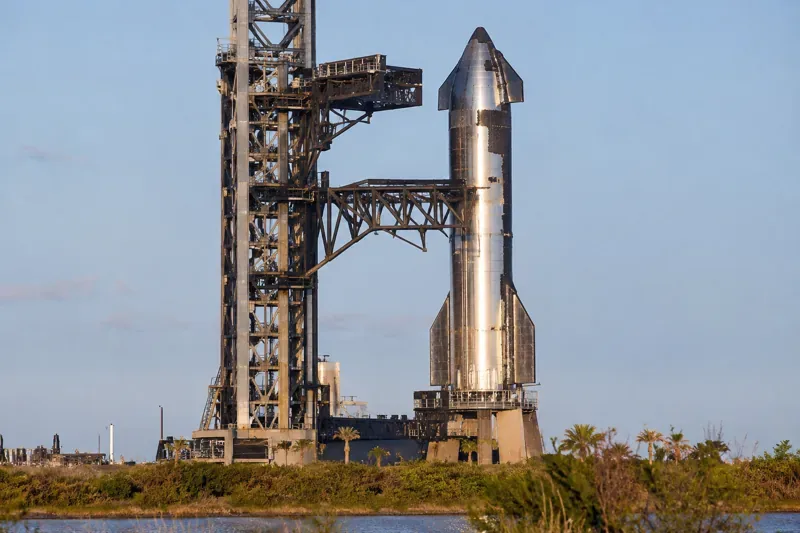
SpaceX’s Starship Flight 15 is complete. The spacecraft launched from Starbase, Texas, on Friday, Nov. 13, released 26 Starlink satellites and returned to a first-of-its-kind catch by the launch tower’s mechanical arms on Saturday, Nov. 14. The Super Heavy booster’s planned catch did not happen: its recovery was aborted, and it was lost in the Gulf of Mexico.
For viewers in Australia, the launch window opened at 9:45 a.m. AEDT on Saturday, Nov. 14. The mission has concluded, so the useful viewing option now is the recording of SpaceX’s webcast. Check the official Flight 15 page and SpaceX’s X account for the stream and any follow-up coverage.
Destaques
- Flight 15 lifted off at about 4:47 p.m. CST on Nov. 13 (10:47 p.m. UTC; 9:47 a.m. AEDT on Nov. 14).
- Starship deployed 26 Starlink satellites and completed roughly 14 Earth orbits.
- The spacecraft was caught at Starbase after a flight of about 22 hours.
- The booster catch was aborted; the planned double catch was not achieved.
When did Starship Flight 15 launch?
SpaceX’s official mission page said the 75-minute launch window would open at 4:45 p.m. Central Time on Friday, Nov. 13, pending regulatory approval. That is CST (UTC−06:00), equivalent to 10:45 p.m. UTC and 9:45 a.m. AEDT on Saturday, Nov. 14. Reports put liftoff at about 4:47 p.m. CST—two minutes after the window opened.
Australia spans several time zones. The AEDT conversion applies to daylight-saving areas including Sydney, Melbourne and Canberra; local times differ elsewhere. The scheduled start should not be confused with liftoff itself, which occurred a couple of minutes later.
Where can you watch the Starship Flight 15 live stream replay?
SpaceX said its webcast would begin about 30 minutes before liftoff and continue through the planned spacecraft catch, with the possibility of extended in-orbit views relayed through Starlink. Since the event is over, viewers should use the official SpaceX Flight 15 page or SpaceX on X to find the replay and any official post-flight updates. Replay availability and video length can change, so the mission page is the best starting point.
What happened during Flight 15?
The flight delivered a mixed but significant result. SpaceX had planned to bring both stages back to Starbase for catches by the launch tower. The Super Heavy booster did not reach that recovery goal. During its return, a problem led to the catch being waved off; the booster went into the Gulf of Mexico and exploded. SpaceX said its team was investigating the cause.
The upper stage continued the mission. It reached orbit, deployed 26 Starlink satellites and spent more than 20 hours circling Earth. The spacecraft then returned to Starbase and was caught by the tower arms—its first such return from orbit. The Associated Press report describes the spacecraft’s catch and the booster’s failure; SpaceX’s mission page provides the planned timeline and webcast information.
Why does the catch matter for future flights?
Recovering the spacecraft at the launch tower is a step toward SpaceX’s goal of reusing both Starship stages. A successful catch can make inspection and turnaround at the launch site possible, supporting a higher launch cadence if the approach proves reliable. Flight 15 demonstrated that the spacecraft could complete an orbital mission and return to the tower, while the booster outcome shows that recovery still depends on guidance, engine performance and safety checks working together.
Those are test results, not a guarantee of a particular launch date or schedule for Flight 16. SpaceX has not established a next-flight date in the cited mission update. The practical next step is to watch for official announcements as engineers review the booster’s aborted recovery and the spacecraft’s successful return.
Frequently asked questions
Has Starship Flight 15 launched?
Yes. It launched on Nov. 13, 2026, from Starbase, Texas, and the mission concluded the following day.
Did both Starship stages get caught?
No. The upper-stage spacecraft was caught at the tower. The Super Heavy booster’s catch was aborted and it was lost offshore.
What time was the launch in Australia?
The window opened at 9:45 a.m. AEDT on Nov. 14. Liftoff followed at about 9:47 a.m. AEDT.