Verified and updated: November 15, 2026, 5:15 a.m. UTC.
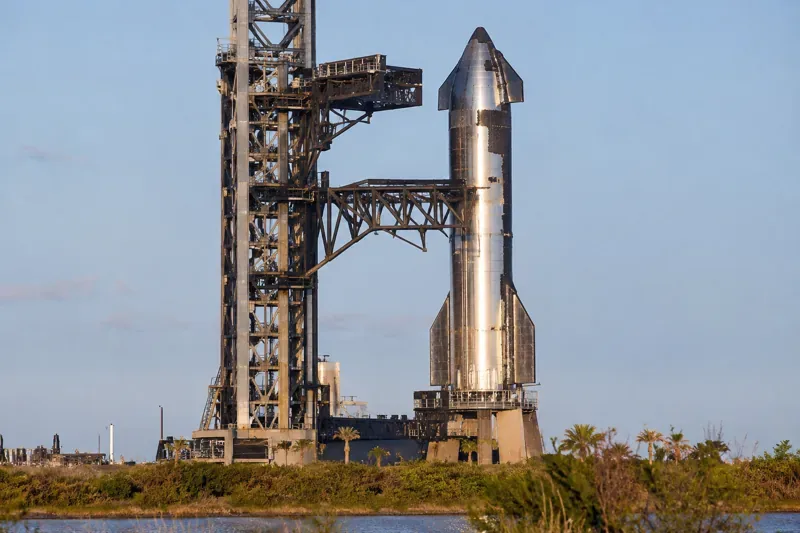
SpaceX’s Starship Flight 15 has demonstrated a major step toward recovering and reusing both parts of its giant launch system: on Saturday, November 14, the Starship upper stage returned from orbit and was caught by the launch tower at Starbase, Texas. The booster’s planned catch did not happen. Its guidance system aborted the attempt after the booster ended its return burn early, with SpaceX citing an early low-fuel alarm as the initial indication. The split result matters: Starship proved it can complete an orbital mission and return to its launch site, while the booster recovery still needs work.
The ship also completed 14 revolutions of Earth during a roughly 22.5-hour flight and deployed 26 Starlink V3 satellites. For space exploration, the catch is a meaningful reusability demonstration, not proof that Starship is ready for routine crewed lunar flights or rapid turnaround. Those goals still depend on repeatable recoveries, inspections, refuelling and further testing.
Destaques
- Starship returned from orbit and was caught at the Starbase launch tower on November 14.
- The Super Heavy booster’s catch was aborted; SpaceX reported an early low-fuel alarm as the initial indication.
- The ship completed 14 Earth orbits and deployed 26 Starlink V3 satellites.
- The flight advances reusability, but does not establish an operational launch cadence or crew readiness.
What happened during Starship Flight 15?
Flight 15 launched from Starbase on Friday, November 13, and separated its upper stage from the Super Heavy booster during ascent. SpaceX planned for both vehicles to return to the launch site, where the tower’s mechanical arms—often called “chopsticks”—would catch them. The booster’s return did not go to plan: it diverted toward the Gulf of Mexico and was lost before splashdown. SpaceX said its autonomous system had aborted the catch approach to protect the launch site.
The upper stage continued on its own. It completed 14 Earth orbits, released 26 Starlink V3 satellites and returned to Starbase on Saturday, November 14, where the tower caught it. The successful ship recovery was the first such catch after an orbital flight. SpaceX also reported that the vehicle’s heat shield appeared to perform well during re-entry. These are company statements and mission results reported by Aerospace America, published by the American Institute of Aeronautics and Astronautics, and The Associated Press.
Why does catching Starship matter for space exploration?
A launch vehicle that can return to its launch site may be easier to inspect, refurbish and fly again than one that is discarded after each mission. If SpaceX can make both stages reusable in practice, more frequent launches could eventually support larger satellite deployments and the repeated cargo flights needed for exploration beyond Earth orbit. Recovery itself is only one part of that equation: launch operations, inspections, repairs and safe relaunches must also become dependable.
Flight 15 provides evidence of progress on the upper-stage return and recovery, but its booster failure is a reminder that the system remains in development. The mission did not prove rapid reuse, a lower cost per flight or a commercial schedule. Those outcomes will require additional flights and transparent performance over time.
How could Flight 15 affect NASA’s lunar plans?
NASA has selected a Starship-derived lander for future Artemis lunar missions. That makes the vehicle’s development relevant to a programme that requires a spacecraft capable of carrying people and supplies between lunar orbit and the Moon’s surface. A successful return from orbit is useful engineering evidence, but it does not demonstrate the lander’s full mission capability. The lunar system must still meet demanding requirements for propulsion, life support, crew safety, docking and in-space propellant transfer.
Flight 15 should therefore be read as one test result in a longer chain. NASA’s mission plans depend on Starship meeting its contractual and safety milestones; the catch alone does not settle schedule or readiness questions. Flight 15 also offers no new proof that the booster can be recovered after an orbital mission, because its catch was aborted.
What should readers watch for next?
The practical question after Flight 15 is whether SpaceX can identify the cause of the booster’s early return-burn cutoff and demonstrate a successful booster recovery on a later flight. Further indicators include repeat ship catches, the condition of recovered heat-shield tiles, how much inspection or repair each stage needs, and whether a recovered vehicle flies again. Those details will help show whether tower catches can become part of a routine operating cycle.
For readers following space exploration, the verified milestone is clear: Starship’s upper stage completed an orbital mission and was caught back at its launch site. The broader forecast—that this will make lunar missions or Mars travel affordable and frequent—remains conditional on future tests. SpaceX’s mission page described the flight’s planned return and catch goals before launch; the completed outcome is summarised by the AIAA’s Aerospace America report.
FAQ
Did Starship Flight 15 catch both rocket stages?
No. Starship’s upper stage was caught at Starbase on November 14. The Super Heavy booster’s catch attempt was aborted, and the booster was lost over the Gulf of Mexico.
What did Starship Flight 15 accomplish in orbit?
The upper stage completed 14 Earth orbits, deployed 26 Starlink V3 satellites and returned to Starbase for a tower catch.
Does the flight mean Starship is ready for crewed Moon missions?
No. It is a significant recovery test, but crewed lunar readiness depends on many further demonstrations, including reliability, refuelling, life support and crew safety.