Home
» Today
»
Lost BBC Show Whirligig: Rare 1954 Audio Recovered — November 22, 2026
Lost BBC Show Whirligig: Rare 1954 Audio Recovered — November 22, 2026
Information checked: November 22, 2026, 1:22 a.m. GMT (UTC+00:00), London, United Kingdom. This is the source-check time, not the date the recording was made or the time of its discovery.
A three-minute audio fragment of Whirligig, the pioneering BBC children’s television program once believed to have no surviving recordings, has been identified on an old cassette acquired at auction. BBC reporting published November 21 says Stuart Woodhead, a collector from Grimsby who runs the Joy Laurey Archive, found the material appended to a recording of an interview with puppeteer Joy Laurey. A comparison with surviving BBC scripts identified the broadcast as the June 26, 1954 edition.
The discovery restores actual sound to the historical record of a show that ran from 1950 to 1956. But its limits are just as important: the find is audio, not recovered moving-picture footage, and it represents only a short extract rather than a complete episode. There is no verified announcement of a full episode restoration or a public television rebroadcast.
Destaques
What was recovered: Approximately three minutes of audio from the June 26, 1954 Whirligig broadcast.
Who found it: Stuart Woodhead of Grimsby, curator of the Joy Laurey Archive, while examining an auction-acquired cassette.
How it was identified: The sound was matched to scripts held by the BBC Written Archives Centre in Caversham.
Why it matters: The fragment is described as the only known surviving recording of a live early BBC children’s series previously thought lost.
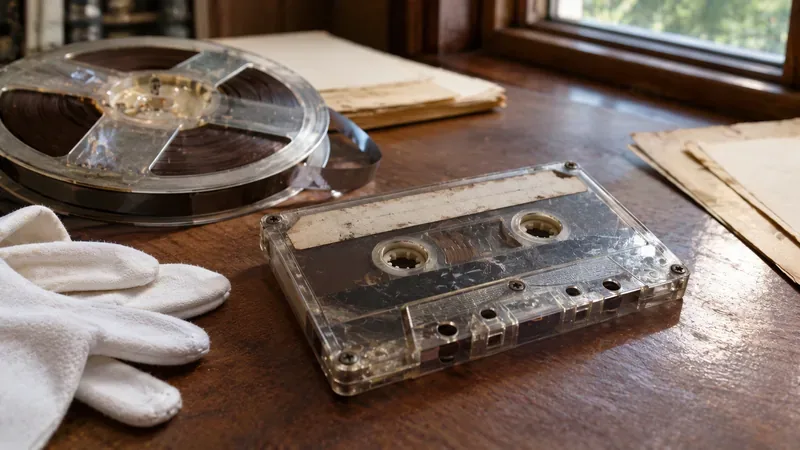
Illustrative image of archival audio media, not the recovered Whirligig cassette or an original BBC archive photograph.
What exactly was recovered from the BBC’s Whirligig?
The short audio recording features regular performers discussing the idea of moving out because the series was ending. The tape reportedly bore a note identifying it as part of the final episode. Yet the historical chronology is more complicated than that label suggests. The June 26, 1954 show had been planned as a concluding edition, but Whirligig returned for another series in 1955 and remained on air until 1956.
Woodhead discovered the segment at the end of a cassette whose principal content was an interview with Joy Laurey. The BBC report says the sound probably originated on reel-to-reel tape before being copied onto a cassette at a later point. That copying history is a plausible explanation for how a 1950s broadcast survived on a later format, but the identity of the original person who made the recording has not been established in the reporting.
The crucial verification was documentary rather than visual. Scripts in the BBC Written Archives Centre in Caversham, Berkshire, provided a way to match the recorded dialogue with the June 26, 1954 program. That means researchers have more than an unidentified voice or an unverified handwritten label: they have a connection between surviving audio and a dated broadcast script.
Who found the lost Whirligig recording?
Stuart Woodhead, based in Grimsby, maintains the Joy Laurey Archive, devoted to the artist and puppeteer behind the character Mr Turnip. His work collecting objects associated with Laurey brought the tape into his possession. The find shows how personal collections and specialist archives can preserve evidence that did not survive in a broadcaster’s own recording holdings.
Laurey designed, made and operated Mr Turnip, a vegetable-headed marionette closely associated with Whirligig. Actor Peter Hawkins provided the character’s voice. The archive’s own catalog documents production-related artifacts, photographs, artwork and merchandise that help reconstruct the show’s wider cultural presence even without surviving video. A puppet, a script, a press photograph and a sound recording each preserve different information; none should be confused with a complete visual record.
Why did so little of Whirligig survive?
Whirligig was the BBC’s first regular Saturday children’s television program. It aired in five series of roughly fortnightly, hour-long editions between November 1950 and the summer of 1956, with more than 90 broadcasts in total. It was transmitted live from Lime Grove Studios in west London, usually at 5 p.m. local time. As a historical schedule reference, London observed Greenwich Mean Time (UTC+00:00) on the recovered episode’s June 26, 1954 date only if corroborated by period time rules; this article does not infer a precise UTC transmission timestamp from the customary slot.
Programs of that period were frequently transmitted without being systematically recorded for later viewing. Preserving a live broadcast required resources, equipment and an expectation that it might be valuable in the future. Even sound-only home recordings were unusual. Paul Marshall, chairman of the Broadcast Engineering Conservation Group, told the BBC that recording technology then demanded money as well as technical enthusiasm and skill.
The show combined short features rather than following a single dramatic plot. Its elements included drama, music, magic and a comedic cowboy segment, with presenter Humphrey Lestocq and Mr Turnip among the familiar faces and voices. The new audio cannot recreate those visual performances or the complete variety format, but it does preserve genuine speech from an early live television production.
What makes the 1954 audio an archive milestone?
The recovery changes the evidentiary status of the series. Before the find, researchers could study written scripts, photographs, publicity material and surviving artifacts, but there was no known recorded excerpt from the actual broadcasts. Now there is a small piece of the original program’s sound. For historians of broadcasting, performance and childhood culture, that is a meaningful shift from secondhand documentation to a surviving primary recording.
The significance does not depend on the clip being lengthy. A few minutes can preserve voices, delivery, transitions and the texture of a live studio presentation in ways that a transcript cannot. Equally, the recording should not be treated as evidence for every episode or as a full representation of the series. Any assessment of what it reveals must stay within the contents and provenance of the surviving fragment.
Can viewers watch or listen to the recovered Whirligig clip?
The BBC discussed the discovery in reporting and in an installment of Secret Lincolnshire on BBC Sounds. That coverage is the appropriate starting point for audiences interested in the find. However, a report about a recording does not itself establish that the full three-minute source file has been publicly released, made downloadable or scheduled for television. No such distribution plan was confirmed in the sources checked for this article.
Further work may involve documenting the tape’s provenance, assessing its sound quality and ensuring that a preservation copy is retained. Those are reasonable archival next steps, not announced actions or completed restoration milestones. Similarly, future discoveries remain possible, but this report makes no claim that additional Whirligig recordings are known to exist.