Home
» Today
»
What Jamieson Greer’s Latest Trade Comments Mean for Canada–U.S. Relations
What Jamieson Greer’s Latest Trade Comments Mean for Canada–U.S. Relations
Updated November 23, 2026, at 7:02 a.m. EST (UTC−05:00). U.S. Trade Representative Jamieson Greer said November 22 that Canada and the United States are “fairly close” to finding a landing zone for a trade deal. That signals renewed momentum after talks broke down in August, but it is not confirmation that the countries have agreed on terms. Canadian reporting says several issues remain outstanding, with the U.S. tariff on Canadian automobiles a major sticking point.
For Canadians, the practical message is cautious: a deal could ease uncertainty for businesses and workers, but Greer’s optimism does not itself change tariffs, guarantee a timetable or settle the broader dispute over how the two countries manage trade.
Destaques
Greer described the talks as “fairly close,” while no agreement has been announced.
The U.S. auto tariff remains a central unresolved issue, according to sources cited by Global News.
Greer also raised concerns about Canada’s trade rapprochement with China.
USMCA remains in force, but the United States did not agree to renew it in its current form during the July joint review.
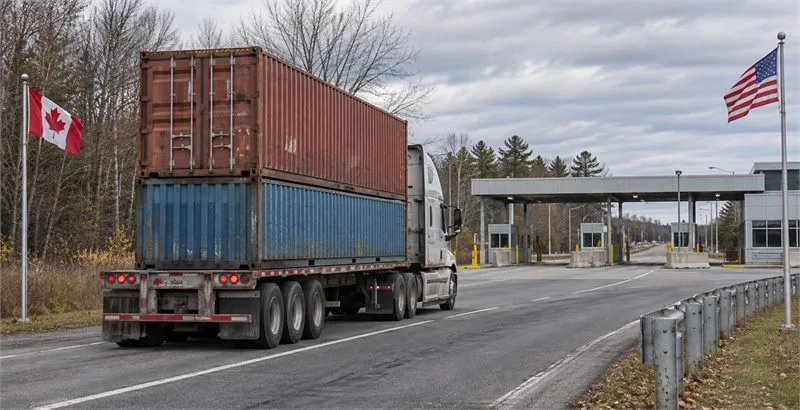
Illustrative image: cross-border freight depends on predictable Canada–U.S. trade rules.
What did Jamieson Greer say about a Canada–U.S. trade deal?
In a November 22 Fox News interview, Greer said negotiators had made “a lot of progress” and were “fairly close on finding a landing zone.” He described the overall trade relationship as more positive than many people realize and said the goal was to protect the North American economy while reaching a deal beneficial to both countries. Those are Greer’s characterizations of the talks, not a joint announcement from Ottawa and Washington.
His remarks came after Prime Minister Mark Carney and U.S. President Donald Trump discussed trade in Shenzhen. Carney’s office said the leaders agreed to continue work on a mutually beneficial agreement that would support jobs and affordability while respecting Canada’s languages, culture and sovereignty. Separately, Canada’s November 19 update to an economic advisory committee said discussions with U.S. counterparts were ongoing and that Canada was seeking an agreement that supports workers and businesses while protecting Canadian sovereignty.
Why is Greer’s “fairly close” assessment not the same as a deal?
Negotiations can be near a broad compromise while still lacking agreement on important details. Global News reported that Canada’s chief trade negotiator, Janice Charette, told a federal advisory committee that multiple trade issues were still outstanding. Sources briefed on the meeting identified the 25 per cent U.S. tariff on Canadian automobiles as the biggest unresolved issue. That detail matters because auto manufacturing depends on parts and vehicles crossing the border repeatedly; uncertainty can affect investment and production decisions even before a company sees a final tariff bill.
Greer has also criticized Canada’s closer trade relationship with China, including plans involving Chinese vehicles and tariff treatment for some steel and aluminum products. This adds a strategic dimension to the negotiations: Washington is discussing not only market access but also the shape of North American supply chains. Canada, meanwhile, has said it wants the ability to pursue its own economic relationships. The two governments’ public positions show areas of tension, but they do not establish that China-related policy is a formal condition of any eventual agreement.
What does this mean for tariffs and CUSMA?
For now, Greer’s comments do not change the rules companies face. Canada’s Trade Commissioner Service says that goods meeting CUSMA rules can qualify for preferential tariff treatment, but compliance does not exempt every product from every U.S. tariff. Sector-specific measures can still apply. Exporters therefore need to check the rules for their product and shipment rather than assume that a possible deal or CUSMA status removes all duties.
The agreement—called USMCA in the United States and CUSMA in Canada—also remains in force. At the July 1, 2026, joint review, the U.S. did not agree to renew it in its current form; USTR said the agreement would remain in effect while the parties addressed issues or until termination. That means the immediate question is not whether trade rules disappear tomorrow, but whether negotiators can reach terms that reduce tariff exposure and make the longer-term framework more predictable.
What happens next for Canadian businesses and workers?
The most useful signal to watch is a concrete announcement: published terms, a defined tariff change, or a formal negotiating milestone from both governments. Until then, businesses exposed to autos, metals, agriculture or cross-border components should treat Greer’s comments as an encouraging negotiating signal, not a basis for assuming costs will fall. Consumers could eventually benefit if lower trade costs flow through to prices, but the timing and scale would depend on the deal’s coverage and how businesses respond.
For Canada–U.S. relations, the remarks suggest both governments still see value in keeping the continental economy connected. Yet the disagreement over tariffs, sovereignty and China policy shows that “close” can describe the mood of a negotiation without resolving its hardest choices. The next phase will test whether optimism can be converted into terms each country is willing to sign.