Home
» Today
»
Miss Universe Judging Explained: 2026 Rounds, Cuts and What Scores Are Public
Miss Universe Judging Explained: 2026 Rounds, Cuts and What Scores Are Public
Checked November 24, 2026, 8:11 p.m. Pacific Standard Time (PST, UTC−08:00; November 25, 04:11 UTC). The Miss Universe judging process is staged: contestants are assessed in preliminary activities, then the field is narrowed through televised rounds until judges select a winner. But fans should not expect to reproduce the result from a public spreadsheet. The Miss Universe Organization’s verified website does not publish a 2026 table of category weights, individual ballots, or a complete numerical score formula in the materials reviewed for this guide.
The 75th final is taking place Tuesday, November 24, at the Coliseo de Puerto Rico José Miguel Agrelot in San Juan, Puerto Rico. Telemundo’s published schedule set the main broadcast for 8 p.m. Eastern Standard Time on November 24 (Toronto and Montreal, UTC−05:00), equivalent to 9 p.m. Atlantic Standard Time in San Juan (UTC−04:00) and 01:00 UTC on November 25. That is the broadcaster’s scheduled start, not a separately published time for when judges submit each score.
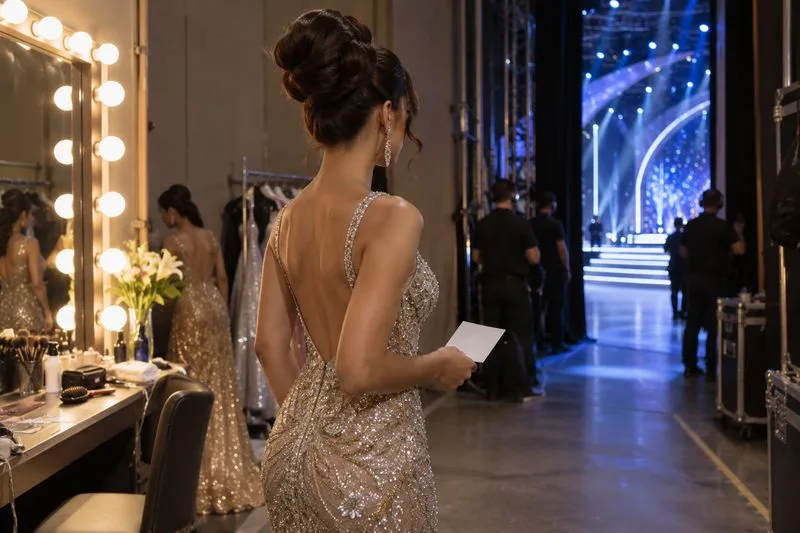
Illustrative backstage scene; this generated image does not depict a specific Miss Universe contestant or the 2026 event.
Highlights
Several stages matter: Official Miss Universe materials describe interviews and stage presentations as parts of the competition; the 2026 broadcast plan specifically identifies swimsuit and evening-gown rounds.
Advancement is a sequence: 2026 coverage describes the field moving through a Top 30, Top 12, and Top 5 before the final question-and-answer stage.
The exact math is private: No official 2026 category percentages or judge-by-judge score sheet were available in the verified public materials reviewed.
Do not confuse awards with points: A costume showcase, fan poll, or social-impact initiative should not be treated as part of the crown score unless the official rules for that edition say it is.
What do Miss Universe judges evaluate?
There is no single universal rubric that can safely be applied to every year. The official Miss Universe competition page for 2024 described selection activities that included personal statements, in-depth interviews, evening gowns, and swimwear. Its 2025 competition page listed a closed-door interview and separate presentation events, reflecting how the schedule and its labels can vary by edition.
Those formats show why the contest is broader than a runway walk: judges may observe communication and personal presentation in an interview as well as composure, confidence, and stage presence during a live presentation. However, those are practical descriptions of what viewers can observe, not a published 2026 scoring rubric. The organization has not publicly assigned a percentage to “confidence,” an interview answer, or any other individual trait in the official materials reviewed here.
For 2026, Telemundo’s advance coverage said delegates would appear in swimsuit and evening-gown rounds during the preliminary competition, helping determine the Top 30. People reported that contestants had completed closed-door interviews before the televised competition. Those reports establish that interviews were part of the 2026 week, but they do not reveal interview questions, scoring sheets, judge instructions, or how interview results were combined with stage presentations.
How does the Top 30 become the winner?
The selection works through cuts. For the 2026 final, live coverage described the Top 30 competing in swimwear, followed by a cut to 12 for evening gowns. Five finalists then advanced to a question-and-answer stage before the title decision. The broadcast reveals who progresses; it does not, by itself, reveal the exact margin between contestants or how the judges reached each cut.
Think of the rounds as successive decision points, not as a public viewer vote on every walk. The judging panel is responsible for selecting who advances and ultimately who wins. A candidate’s earlier performance may influence a cut if that edition’s rules combine preliminary and final scores, but the audience cannot assume that scores carry forward, reset, or receive equal weight unless the official regulations state so.
For readers following from Canada, this distinction helps separate the result from fan predictions. A contestant can be widely praised online yet fail to advance, while another may impress judges in a less visible interview. The order in which contestants are announced is not a score ranking unless the organizers explicitly label it that way.
Are the exact Miss Universe scores published?
Not in the official 2026 materials reviewed for this article. The public can follow round results and placements, but I found no official release of category percentages, judge-by-judge ballots, cumulative totals, tie-break rules, or a downloadable 2026 scorecard. Without those records, claims such as “the gown round counts for 40 percent” should be treated as unverified unless accompanied by current official rules.
Miss Universe did publish clarifications about judging in 2025. It said the Beyond the Crown social-impact program operated separately from the official judging panel and that its committee did not evaluate contestants or add points to that edition’s results. That statement is useful for understanding the 2025 dispute, but it should not be stretched into a complete scoring rule for 2026.
Does the national costume or a fan vote count toward the crown?
Do not infer scoring from airtime, a special award, or social-media popularity. National costume is presented as a distinct cultural showcase in Miss Universe programming, but the official 2026 materials reviewed do not explain whether or how it enters the main title score. The same caution applies to fan voting: unless the current edition’s official rules state that a vote advances a contestant or changes a score, a poll or online ranking is not evidence of judges’ marks.
There is also a difference between the winner of a special segment and the Miss Universe titleholder. A “Best in” award can recognize a particular presentation without proving that it adds points to the overall result. The safest approach is to follow the official announcement for each award and the final placements as separate outcomes.
What can viewers usefully compare?
Fans can assess visible parts of the contest without pretending to know the hidden arithmetic. For each round, note whether a contestant communicates clearly, stays composed under pressure, connects with the audience, and presents herself consistently. Compare those observations with the advancement results, while remembering that a private interview and the judges’ deliberations are not visible on the broadcast.
That is the key limitation: viewers see performances and outcomes, but not enough information to audit the score calculation. If the organization releases a complete scoring policy or scorecard for a future edition, it would allow a more exact explanation. Until then, any precise formula should be attributed to an official document, not reverse-engineered from a final lineup.
Frequently Asked Questions
Is Miss Universe judged only on beauty?
No. Official competition materials include interviews and personal statements along with stage presentations. The exact criteria and their weights can differ by year, and the 2026 numerical weights were not published in the official materials reviewed.
Does the evening-gown round decide the winner?
It is one stage in a sequence. In the reported 2026 format, the evening-gown round followed the Top 12 cut, then five finalists advanced to questions before the winner was selected.
Can fans calculate the winner from broadcast scores?
Not reliably. The broadcast shows advancement and placements, but no official 2026 judge-by-judge score sheet or category-weight table was available in the sources checked.