Home
» Today
»
NASA SLS Rocket and the Ionospheric “Hole”: What Artemis II Shows (Nov. 5, 2026)
NASA SLS Rocket and the Ionospheric “Hole”: What Artemis II Shows (Nov. 5, 2026)
Information checked: November 5, 2026, at 09:06 UTC (4:06 a.m. EST, U.S. Eastern Standard Time).
Yes. A rocket such as NASA’s Space Launch System (SLS) can create a temporary “hole” in the ionosphere—but not a hole through the atmosphere or the ozone layer. The term describes a region where the number of electrically charged particles drops after rocket exhaust interacts with upper-atmospheric plasma. The phenomenon is well documented for earlier launches; new attention has focused on the April 2026 Artemis II flight, whose ionospheric effects are being examined in preliminary research.
Recent accounts of an Artemis II analysis describe pronounced disturbances recorded by ground-based satellite-navigation receivers, including effects associated with the rocket’s initial ascent and subsequent upper-stage engine burns. These observations raise questions about precision GPS performance, but they do not by themselves establish a widespread GPS outage, an accident, or a lasting atmospheric injury. The full text of the newly discussed Artemis II preprint could not be independently retrieved during this check, so its event-specific estimates remain preliminary here.
Highlights
An ionospheric “hole” is an electron-density depletion, not empty space and not an ozone-layer hole.
NASA confirms Artemis II lifted off on April 1, 2026, at 6:35 p.m. EDT (UTC−04:00), or 22:35 UTC.
Peer-reviewed observations of other launches show that exhaust can produce temporary plasma depletions measurable by GPS receivers.
Potential GPS range errors are scientifically plausible, but reports of Artemis II-related positioning effects should not be mistaken for verified public-system failures.
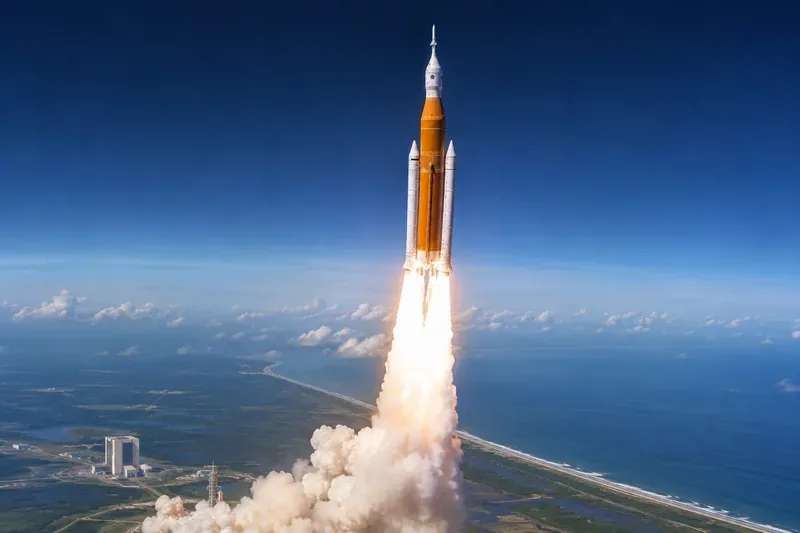
Illustration of an SLS-style rocket launch over a coastal launch complex. This is not a photograph of Artemis II or a direct image of ionospheric changes.
What happened during NASA’s Artemis II SLS launch?
According to NASA’s launch announcement, the SLS rocket carrying the four-person Orion crew launched from Pad 39B at Kennedy Space Center, Florida, on Wednesday, April 1, 2026, at 6:35 p.m. Eastern Daylight Time (EDT, UTC−04:00), equivalent to 22:35 UTC on April 1. Daylight saving time was in effect in Florida on that date. The mission subsequently flew around the Moon and returned to Earth, as recorded in NASA’s Artemis II mission record.
Scientists can investigate launch-related atmospheric changes without observing a visible opening in the sky. Networks of ground receivers track signals from navigation satellites. Changes in the signal paths reveal variations in the amount of free electrons in the ionosphere, often expressed as total electron content (TEC). Recent coverage of a new National Cheng Kung University analysis suggests the Artemis II flight produced an unusually broad set of signatures connected with ascent and later orbital maneuvers. The exact geographic extent, comparative intensity, and practical effect on individual GPS users need to be assessed against the full underlying study and independent observations.
What does a “hole in the upper atmosphere” really mean?
The ionosphere is a region of Earth’s upper atmosphere containing electrons and ions, shaped largely by solar radiation and processes in the atmosphere below. NASA describes it as extending through portions of the mesosphere and thermosphere and as crucial to radio communications and satellite navigation. See NASA’s explanation of the ionosphere.
In this context, a “hole” is shorthand for a localized reduction in plasma electron density. Neutral gas and the rest of the atmosphere remain present. The word does not imply that a rocket has punctured a physical membrane around Earth, removed breathable air near the ground, or opened a gap in the protective stratospheric ozone layer. Those are separate atmospheric concepts with different chemistry and altitudes.
How can rocket exhaust make an ionospheric hole?
Two effects need to be distinguished. First, a fast-moving launch vehicle can generate acoustic and gravity waves that disturb the upper atmosphere. Second, water vapor and other constituents of rocket exhaust released at ionospheric altitudes can participate in chemical reactions that speed the removal of free electrons from the plasma. The affected region can then spread and move as exhaust disperses and upper-atmospheric winds transport material.
Researchers documented this mechanism after a Falcon 9 launch carrying FORMOSAT-5 on August 24, 2017. A peer-reviewed study in Space Weather identified a plasma depletion approximately 900 kilometers (560 miles) across, with recovery over roughly 2.5–3 hours. Those measurements apply to that particular flight, not to Artemis II. The original study is available through the American Geophysical Union research paper.
Could Artemis II have affected GPS and navigation?
Potentially, yes—but a measured ionospheric disturbance is not the same as a confirmed GPS service outage. GPS and other global navigation satellite systems send radio signals through the ionosphere. Changes in electron density change signal propagation, which can introduce errors into distance estimates used to calculate a position. NASA explains this relationship in its September 2026 research article on ionospheric radio effects.
Reports about the new Artemis II analysis have discussed possible positioning deviations of several meters under affected conditions and disturbances spread across large parts of North America. These figures should be understood as reported interpretations of scientific measurements, not verified records that consumer navigation apps failed, autonomous vehicles changed lanes, or aircraft lost guidance. Actual accuracy depends on the receiver, available satellite geometry, correction services, and local conditions.
The recent Artemis II work is associated with an Earth and Space Science Open Archive research record. Its complete preprint was not accessible for independent review during this check. That limitation is important when assessing dramatic descriptions such as “a hole thousands of miles wide” or claims of record-setting intensity.
Is an ionospheric hole dangerous or permanent?
Previous studies show that rocket-induced plasma depletions can be temporary and recover as chemistry, transport, and solar-driven ionization restore electron densities. A wide footprint on a TEC map describes a region in which measurements changed; it does not mean that an equally wide column of air disappeared. There is no verified evidence in the sources checked that Artemis II caused a permanent atmospheric opening or an ozone-layer rupture.
Potential operational risks deserve careful study because even short-lived navigation errors can matter for applications needing precise positioning. However, the seriousness of a particular event cannot be determined from the word “hole” alone. Researchers would need to establish its amplitude, duration, location, receiver exposure, and any independently recorded effect on users.
What should scientists and launch operators investigate next?
Future work can compare ground-based TEC measurements with satellite observations, rocket flight timelines, and atmospheric models. Researchers can also test whether the height and timing of upper-stage burns predict the largest disturbances better than liftoff thrust alone. If more lunar and deep-space missions use engine burns at ionospheric altitudes, these observations could inform monitoring and precision-navigation planning. That is a research priority and a conditional projection—not proof that every SLS launch will reproduce the same event.
For readers following upcoming missions, the most useful distinction is between a confirmed rocket launch, a measured change in ionospheric plasma, and a demonstrated impact on navigation users. These are three different evidentiary steps, and headlines should not collapse them into one.
FAQ
Can NASA’s SLS rocket really punch a hole in the atmosphere?
It can cause a temporary region of reduced electron density in the ionosphere. That is not a physical hole in Earth’s air or ozone layer.
Did Artemis II knock out GPS across the United States?
There is no verified evidence here of a nationwide GPS outage. Preliminary research points to measurable disturbances and possible positioning errors, not established widespread service failures.
How long do rocket-created ionospheric holes last?
Duration varies with exhaust altitude, atmospheric conditions, and launch trajectory. Earlier studied cases lasted on the order of hours, but the exact duration of the reported Artemis II event has not been independently confirmed in this review.