Verified and updated: November 22, 2026, at 05:07 UTC (05:07 GMT, London).
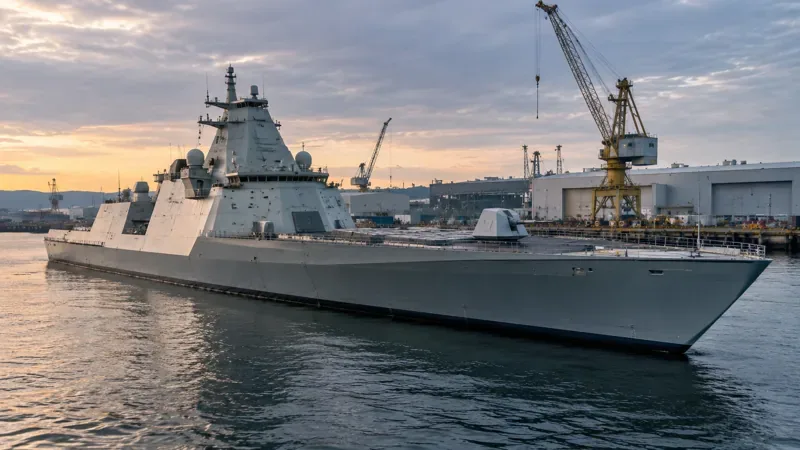
The proposed U.S. Navy BBG(X) battleship is facing sharper congressional scrutiny over its projected price, unfinished design and demands on nuclear shipyards. A House appropriations committee report says the ship’s design and requirements remain unsettled and calls for independent cost estimates and analysis of how the programme could affect submarine and aircraft-carrier construction. The report’s directives would require action following enactment; they are not themselves proof that the requests have become law.
The cost debate has also widened. The Congressional Budget Office (CBO) estimates the lead ship at $23.4 billion in 2026 dollars and the next ships at an average $18 billion. Those are independent estimates under stated assumptions, not a final contract price. The Navy’s earlier $15.1 billion lead-ship estimate covered a conventionally powered version, so it is not a like-for-like comparison with the nuclear-powered ship now proposed.
Destaques
- CBO estimates $23.4 billion for the lead ship and an $18 billion average for subsequent ships, in 2026 dollars.
- The Navy’s May 2026 shipbuilding plan schedules three BBG(X) ships through fiscal 2031, with $43.526 billion in planned funding across that period.
- A House appropriations committee report highlights the unfinished design and orders reporting on costs, capacity and possible effects on other nuclear ship programmes.
- The Navy’s current budget request seeks advance procurement and research funding, with the lead ship award targeted for fiscal 2028.
What has changed in the BBG(X) cost debate?
The latest shift is not a new Navy price announcement. It is the combination of CBO’s independent estimate and the House committee’s concerns about whether the Navy has enough design maturity and cost control to proceed responsibly. The House report says the BBG(X) programme has not completed a formal analysis of alternatives, finalized the ship design or established stable requirements. It cites CBO’s estimate that the lead ship could exceed $20 billion.
The committee directs the Navy to provide a reconciled independent estimate for the lead ship and the class, explain cost differences and identify the projected cost of novel systems. It also seeks a design-maturity assessment and an account of how the Navy would avoid disrupting other nuclear-powered programmes. These requests put affordability and execution capacity alongside the ship’s military rationale.
The House Appropriations Committee report also raises concern about shipbuilding delays and overruns across the broader portfolio. Its position is a warning about programme risk, rather than a finding that the BBG(X) has already exceeded a contracted budget: construction has not begun.
How much could the proposed battleship cost?
CBO’s cost analysis estimates $23.4 billion for the first nuclear-powered ship, assuming it is ordered in 2028, displaces 35,000 tons at full load, and forms part of a 15-ship programme built at the rate set out in the Navy’s 2027 plan. CBO estimates that later ships would average $18 billion. Those estimates include the expected expense of detailed design and related one-time work in the lead ship.
The Navy’s earlier estimate was $15.1 billion for a conventional lead ship, with the second and third ships averaging $10.2 billion, also in 2026 dollars. Nuclear propulsion changes the design and cost basis, so comparing the two sets of figures as if they priced identical ships would mislead readers. CBO’s estimate is not a guaranteed ceiling: changes in size, requirements, design or production conditions could change the eventual bill.
The Navy’s May 2026 shipbuilding plan schedules three BBG(X) ships across fiscal 2027–2031 and lists $43.526 billion in planned funding for that period. That five-year figure is not the same as CBO’s estimated total cost for a 15-ship programme over decades. The Navy’s budget documents describe fiscal 2027 advance procurement and research funding to support a lead-ship award in fiscal 2028.
Why are shipyards and other Navy programmes part of the debate?
A nuclear-powered surface ship would draw on specialised yards, skilled trades, reactor components and suppliers. The House report warns those resources overlap with work on Columbia-class and Virginia-class submarines and Ford-class aircraft carriers. It asks the Navy to spell out capacity, workforce and supplier needs and explain how BBG(X) construction would be sequenced without putting those programmes’ schedules at risk.
This is the central practical question beyond the headline unit price: can the Navy add a complex new ship while delivering its existing high-priority nuclear fleet? The committee’s concern is that adding funding alone does not create shipyard capacity or trained workers. The Navy, by contrast, presents the battleship as a high-volume long-range strike, air-defence and command platform within its Golden Fleet concept. Its budget materials call for faster design development, but the programme still has to mature its requirements and design.
What happens next for the Navy battleship plan?
The next milestones are budget and oversight decisions, followed by clearer cost and design information. The Navy’s schedule points to advance procurement and design work before a planned fiscal 2028 lead-ship award. Congressional scrutiny could shape the conditions attached to funding and require the additional assessments described in the House report. The timing and final form of those requirements depend on the legislative process.
For now, there is no fixed construction price or completed design to settle the dispute. CBO’s estimate provides an independent benchmark, while the Navy’s plan lays out a proposed procurement schedule and the committee’s report demands more evidence on affordability and industrial capacity. Future cost projections remain conditional on ship size, requirements, design choices and the pace at which the shipbuilding base can deliver.
Frequently asked questions
How much does CBO estimate the first BBG(X) will cost?
CBO estimates $23.4 billion in 2026 dollars for the lead ship, based on its stated assumptions. It is an estimate, not a final contract price.
Has the Navy started building the battleship?
No. The Navy’s plan targets a lead-ship award in fiscal 2028 and requests earlier funding for design development and long-lead items.
Why is Congress concerned about the programme?
The House appropriations report cites the unfinished design and requirements, potential cost risk and competition for specialised shipyard capacity with submarine and carrier programmes.