Home
» Today
»
Trump-Class Navy Warships: Specifications, $275 Billion Cost Estimate and Budget Fight | November 22, 2026
Trump-Class Navy Warships: Specifications, $275 Billion Cost Estimate and Budget Fight | November 22, 2026
Information checked: November 22, 2026 at 5:09 AM UTC (UTC+00:00). This is the time of the source review, not a naval event time or a publication timestamp.
The U.S. Navy’s proposed Trump-class guided-missile battleships would be unusually large, heavily armed surface warships—but their design, final price and congressional funding remain unsettled. A Congressional Budget Office (CBO) analysis published in August 2026 estimates that a 15-ship nuclear-powered program could cost approximately $275 billion in 2026 dollars through 2056, including $23.4 billion for the lead ship. The Navy’s original plan used a less expensive, conventionally powered design.
The immediate budget question sharpened in November: the Senate Appropriations Committee released its fiscal year 2027 defense proposal on November 16, and its approach to shipbuilding has put the requested battleship funds under scrutiny. A committee proposal is not an enacted cancellation. For readers assessing the program, the key distinction is between a design ambition, a government cost projection and money Congress has actually approved.
Destaques
The Trump-class concept, led by the proposed USS Defiant, remains in design; it is not an operational warship class.
CBO estimates $23.4 billion for the first nuclear-powered ship and roughly $275 billion for a 15-ship program in 2026 dollars.
Published concept characteristics include about 35,000 long tons of displacement, a length of 840–880 feet, 128 vertical-launch cells and a crew of 650–850; these are not final production specifications.
The FY2027 budget includes a request of approximately $1.84 billion for design and advance procurement, while congressional proposals could change the amount available.
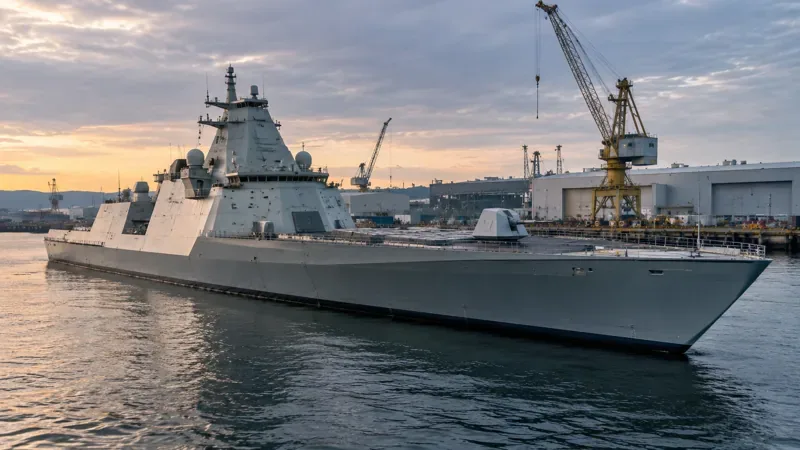
Illustrative image of a modern large surface warship at a shipyard. This is not a photograph or an official design of the proposed Trump-class battleship.
What is the Trump-class battleship, and why is the Navy proposing it?
Announced on December 22, 2025, the concept is part of the administration’s Golden Fleet initiative. The Navy says the new ships would combine long-range offensive strike, fleet air and missile defense, anti-surface warfare and command-and-control functions. The service also stated that the Trump-class proposal would replace its earlier DDG(X) next-generation destroyer concept while incorporating capabilities pursued under that effort. It is therefore misleading to count both concepts as separate confirmed procurement programs.
The lead ship is designated USS Defiant. Initial Navy material described a guided-missile battleship designated BBG(X); the May 2026 plan subsequently envisioned nuclear-powered ships, described by CBO as BBGN. These designations reflect an evolving program rather than two different built ships.
What are the proposed Trump-class warship specifications?
The specifications below come from CBO’s comparison of the Navy’s published concept with existing surface combatants. CBO notes that many figures were released for a conventionally powered version, before the switch to nuclear propulsion. They should be read as design targets rather than a frozen shipbuilding contract.
Characteristic
Published concept / CBO comparison
Full-load displacement
Approximately 35,000 long tons
Length
840–880 feet
Beam
105–115 feet
Draft
24–30 feet
Sustained speed
More than 30 knots
Complement
650–850 personnel
Main missile launchers
128 vertical-launch cells, plus 12 large cells envisaged for Conventional Prompt Strike weapons
Other planned armament
Two five-inch guns, a railgun and two high-powered lasers
Propulsion in FY2027 shipbuilding plan
Nuclear, subject to final design and authorization
Those numbers would make the proposed warship more than three and a half times the full-load displacement of a Flight III Arleigh Burke destroyer in CBO’s comparison. The ship is not intended to revive the 16-inch-gun layout of a World War II-era battleship. Its proposed striking power instead centers on missile magazines, including hypersonic weapons, and high-power electrical systems. Railgun, laser and nuclear cruise missile integration remains a major engineering and policy challenge—not proof that these systems are already deployed on the ship.
How much could the new Navy battleships cost?
Different price tags describe different configurations and accounting assumptions. The Navy’s earlier budget submission estimated a $15.1 billion lead ship and an average $10.2 billion for ships two and three under conventional propulsion. CBO’s nuclear-powered scenario instead estimates $23.4 billion for the lead ship and $18.0 billion on average for subsequent ships, for a total of roughly $275 billion for 15 ships purchased from 2028 through 2056.
CBO also modeled a conventional version at roughly $243 billion for the same number of ships, about 13% below its nuclear-powered scenario. Those figures are estimates in constant 2026 dollars, not signed construction contracts or an annual congressional appropriation. CBO explicitly cautions that uncertainties in the design and industrial assumptions could move the figures upward or downward. Nuclear propulsion could avoid conventional ship fuel purchases, but CBO says available information is insufficient to quantify those potential lifetime operating savings.
What is happening to the FY2027 budget request?
The government’s fiscal 2027 weapons acquisition budget material requests approximately $836.9 million in research, development, testing and evaluation and $1.0 billion in advance procurement for the battleship—approximately $1.84 billion combined. These are requested funds for design work and long-lead items, not the cost of delivering one finished battleship.
On November 16, 2026, the Senate Appropriations Committee released its FY2027 defense bill and supporting materials. The committee’s proposal has been reported as eliminating the requested $1 billion in advance procurement and reducing associated development funding. Those proposed changes must still pass the relevant legislative process before they can be treated as final spending authority. The congressional debate centers on whether a costly ship design should move toward procurement before critical design decisions and industrial capacity are sufficiently mature.
Why would the new ships put pressure on U.S. shipyards?
A large nuclear-powered surface combatant would place unusual demands on shipbuilding infrastructure, nuclear-qualified suppliers, skilled workers and major-component production. CBO projects that the Navy’s 2027 shipbuilding plan would require average annual surface-combatant procurement funding to climb from about $11 billion to $19 billion compared with the older plan. It also estimates that large-surface-combatant construction tonnage would more than double by 2035, a formidable industrial expansion target.
The issue is not simply whether one sophisticated ship can be designed. It is whether shipyards could build it while sustaining destroyers, submarines, aircraft carriers, frigates and essential maintenance work. More advanced weapon integration also creates cost and schedule risks if technology arrives later than the hull. These are forward-looking risks, not documented overruns for a ship that has already been built.
What happens next for USS Defiant and the Golden Fleet?
The May 2026 shipbuilding plan envisioned purchasing a lead battleship in fiscal 2028 and a total of 15 through 2056. The schedule, hull design, propulsion details, weapons integration and eventual fleet size remain conditional on funding, engineering and subsequent Navy decisions. The original 2025 announcement spoke of an ambition for more ships, but that aspiration is not equivalent to the 15-ship planning scenario used by CBO.
Readers should watch three measurable developments: whether Congress ultimately provides procurement and research funding; whether the Navy publishes a stabilized design and acquisition baseline; and whether the industrial-base plan identifies realistic construction and delivery capacity. Until those milestones are confirmed, a projected $275 billion program should be understood as a cost estimate for a proposed future fleet rather than an amount already spent.
Frequently asked questions
Is the Trump-class battleship already being built?
No completed or operational Trump-class warship is established by the official sources reviewed. The program remains in design and acquisition planning, with a proposed lead-ship purchase in fiscal 2028.
How many missiles could the proposed ship carry?
The published concept lists 128 standard vertical-launch cells and 12 large cells for Conventional Prompt Strike missiles. A final missile mix and loadout have not been confirmed.
Has Congress approved $275 billion for the program?
No. That is CBO’s estimated cost of a 15-ship nuclear-powered program through 2056 in 2026 dollars, not a congressional appropriation.