Home
» Today
»
Nvidia Stock Jumps After Jensen Huang’s Return as CEO; AI Demand Remains in Focus — Nov. 23, 2026
Nvidia Stock Jumps After Jensen Huang’s Return as CEO; AI Demand Remains in Focus — Nov. 23, 2026
Last checked: Nov. 23, 2026, 9:14 a.m. Pacific Standard Time (UTC−08:00).
Nvidia shares surged Monday after the company said co-founder Jensen Huang had been reinstated as president and CEO. In a market snapshot at 11:58 a.m. Eastern Standard Time (UTC−05:00), or 8:58 a.m. Pacific, NVDA traded at $165.99, up about 32.2% from the previous close; its intraday high at that point was $171.50. The move followed a sharp selloff the prior week, so the rebound is a dramatic reversal in sentiment, not evidence that the stock has made a fresh record high.
The longer-term demand story rests on Nvidia’s latest reported results and its next-generation Vera Rubin platform. For the fiscal third quarter ended Oct. 25, Nvidia reported $115.8 billion in revenue, up 103% year over year, including $107.6 billion from Data Center. The company said volume shipments of Vera Rubin NVL72 and Vera CPUs began in the quarter. Those figures support the view that customers are still spending heavily on AI computing, but Monday’s immediate catalyst was the leadership announcement—not a new earnings report or a new demand forecast from Huang.
Highlights
Nvidia’s board announced Nov. 23 that Jensen Huang was reinstated as president and CEO; the company said its independent investigation will continue.
NVDA was up about 32.2% at $165.99 in a market snapshot at 11:58 a.m. ET, after an intraday high of $171.50.
Nvidia reported $115.8 billion in Q3 FY2027 revenue, with Data Center contributing $107.6 billion.
The company’s Q4 revenue outlook is $130 billion, plus or minus 3%; that is management guidance, not a guaranteed result.
Why did Nvidia stock surge on Nov. 23?
The direct catalyst was a sudden change in leadership. Nvidia said its board voted unanimously to reinstate Huang, effective immediately. The company’s SEC filing identifies Nov. 22 as the effective date of the board action, while the public announcement was dated Nov. 23. Chief Financial Officer Colette Kress will continue as CFO after serving as interim CEO. Nvidia said the board had received input from senior U.S. government officials and concluded that Huang’s reinstatement posed no national security risk.
Investors had been reacting to uncertainty around the CEO transition and the wider outlook for AI-linked stocks. The reinstatement reduced one immediate leadership concern and helped trigger a powerful rebound. The Associated Press reported Nvidia shares were up 34.4% around 11 a.m. ET, while noting the stock was still below its $186.40 level from before the controversy that preceded the selloff. A sharp one-day move can reflect positioning and changing expectations as well as company fundamentals; it does not, on its own, establish that the longer-term risks have disappeared.
The board’s statement also says its independent investigation into reports that Huang had been targeted by a foreign intelligence effort will continue. Nvidia has formed a National Security and Export Control Committee and says it is searching for a chief compliance officer. These are company disclosures about ongoing oversight steps, not findings that the investigation has concluded.
What do Nvidia’s latest results say about AI demand?
The most recent quarterly numbers provide concrete evidence of strong demand. Nvidia reported $115.8 billion in total revenue for Q3 FY2027, compared with $57.0 billion a year earlier. Data Center revenue reached $107.6 billion, up 110% year over year and 21% from the prior quarter. GAAP gross margin was 74.8%, and GAAP diluted earnings per share were $2.70. Those results show how central AI data-center systems have become to Nvidia’s business.
For Q4 FY2027, Nvidia guided to revenue of $130 billion, with a range of plus or minus 3%. The forecast includes an extra week in the quarter and assumes no Data Center compute revenue from China. The company forecast GAAP gross margin of 71% to 72%, below the 74.8% reported for Q3. Guidance reflects management’s current expectations; actual revenue can differ because customers may change deployment schedules, supply can be constrained, and export rules may affect sales.
The demand narrative is also shifting from training large AI models toward serving those models at scale, including inference and AI-agent workloads. More use can require more computing, networking, memory, power, and data-center capacity. Nvidia’s reported shipment of Vera Rubin NVL72 systems and Vera CPUs is relevant because the company sells an integrated platform, not only individual accelerators. The release names cloud partners where systems are running or planned, but it does not guarantee that every announced deployment will translate into revenue on a particular schedule.
How do Vera Rubin and CUDA support Nvidia’s position?
Vera Rubin is Nvidia’s next-generation data-center platform. Its NVL72 configuration packages compute and networking components into a rack-scale system intended for large AI workloads. Bundling hardware and software can make it easier for cloud providers and enterprises to deploy clusters, while creating a broader sale than a standalone chip. Nvidia’s release says shipments began in the third quarter and lists a number of cloud partners deploying or preparing to deploy systems.
The software ecosystem is another part of the investment case. CUDA includes GPU programming tools, libraries, compilers, and debugging and optimization utilities. Nvidia’s developer documentation describes CUDA as the software layer that lets applications use GPU computing. Teams that have built software and operational expertise around that stack may face time and engineering costs when moving to another architecture. That can strengthen Nvidia’s competitive position, although it does not prevent customers from adopting competing products or designing their own chips.
Huang has previously argued that AI demand is tied to the usefulness of AI applications and the infrastructure needed to run them. For this Monday’s move, however, the newly verified event was his return to the CEO role. The demand evidence in this article comes from Nvidia’s latest reported quarter and product shipments, rather than a newly issued Huang forecast on Nov. 23.
What could change the outlook for NVDA?
The next test is whether reported demand converts into delivered systems, revenue, and profits while the company moves customers onto new architectures. Nvidia’s own risk disclosures identify supply-chain complexity and the need for data-center infrastructure—including land, power, financing, and facilities—as constraints that could delay deployments. Export controls, competition from other accelerators, and customers’ own chip programs are additional factors investors monitor.
Valuation is another source of volatility. When a stock price reflects expectations of rapid growth, even a strong quarter can disappoint investors if it falls short of what they had already priced in. Conversely, sustained orders, successful Vera Rubin shipments, and continued growth in inference workloads could support the bullish case. Those are conditional scenarios, not predictions. The market quote above is an intraday snapshot, not a closing price, and can change throughout the session.
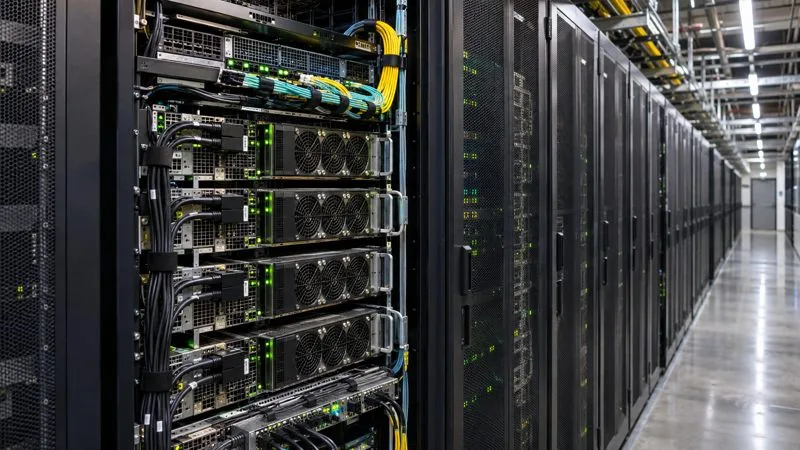
Illustrative photo of server racks used for high-performance computing; it does not depict a confirmed Nvidia facility.
FAQ
Why is Nvidia stock surging today?
The immediate catalyst was the company’s announcement that Jensen Huang had been reinstated as CEO after a period of leadership uncertainty.
Is today’s move a new all-time high?
No. The intraday quote snapshot cited here showed NVDA at $165.99, still below the $186.40 level AP reported before the recent selloff.
What is driving Nvidia’s longer-term AI demand story?
Its latest results show rapid growth in Data Center revenue, while Vera Rubin shipments and the CUDA software ecosystem support the company’s broader AI-computing platform.