Home
» Today
»
Rockets vs. Warriors: Paint Advantage and Roster Fallout — Nov. 12, 2026
Rockets vs. Warriors: Paint Advantage and Roster Fallout — Nov. 12, 2026
Information checked: November 12, 2026, at 06:09 UTC (November 12 at 12:09 a.m. in Houston, Central Standard Time, CST, UTC−06:00). This is the reporting verification time, not the game’s start time or this article’s publication time.
The Houston Rockets beat the Golden State Warriors 115–108 on November 11, 2026, halting Golden State’s eight-game winning streak. The larger story behind the score was a clash of styles: Houston generated interior opportunities through Alperen Sengun and its athletic forwards, while Golden State had to reorganize its offense after Stephen Curry left in the first quarter with right abdominal soreness. Houston outscored Golden State 50–34 in the paint, according to the November 12 game report.
For fans trying to understand why the matchup tilted Houston’s way, the decisive questions are more specific than the final score: How did the Rockets create advantages without two regular centers? What did Curry’s departure change in the Warriors’ spacing and ball handling? And which roster combinations offer each team a sustainable answer in a future meeting?
Destaques
Final result: Houston won 115–108 in the November 11 game at Toyota Center, ending Golden State’s eight-game winning streak.
Interior play: Houston’s 50–34 advantage in points in the paint showed how efficiently its lineup attacked the basket and finished possessions.
Roster disruption: Curry departed early with right abdominal soreness; his availability for later games was not established by the initial game report.
Matchup lesson: Sengun’s passing, Houston’s collective rebounding and Golden State’s secondary creation are the key areas to monitor in another meeting.
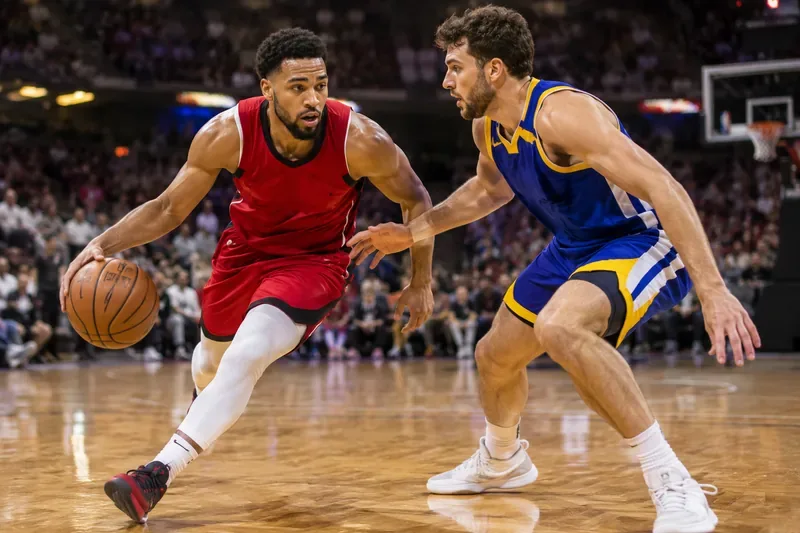
Illustrative basketball action created for this analysis. The scene does not depict the November 11 Rockets–Warriors game or identifiable NBA players.
What happened in Rockets vs. Warriors on November 11?
The game took place at Toyota Center in Houston, Texas, with an official tipoff of Wednesday, November 11 at 8:30 p.m. Houston CST (UTC−06:00). That was Thursday, November 12 at 02:30 UTC, or Thursday at 1:30 p.m. Australian Eastern Daylight Time (AEDT, UTC+11:00) in Sydney and Melbourne. The Rockets game details confirm the venue and Houston start time; the NBA game center is the league’s game reference.
Houston built an early lead, Golden State recovered enough to remain in contention, and the Rockets pulled away late. Sengun recorded 19 points, 13 rebounds and nine assists, with Kevin Durant scoring 20 and Amen Thompson adding 19. For Golden State, rookie Yaxel Lendeborg had 25 points and 10 rebounds, and Brandin Podziemski scored 22. These game figures come from the November 12 game report; some NBA web game-center views were still missing a populated box score during this check, so they should not be treated as independent confirmation of every individual stat.
Curry’s early exit was a major tactical change, but it would be reductive to assign the entire result to one injury. Houston still had to exploit the resulting defensive and offensive matchups, execute late in possessions and protect its lead.
Why did Houston control the paint despite missing centers?
Before tipoff, Houston had already ruled out Steven Adams (calf) and Clint Capela (ankle). Its available frontcourt therefore depended more heavily on Sengun, Durant, Jabari Smith Jr. and active rebounding from perimeter players. In the previous 110–100 win over Denver, the Rockets had claimed 15 offensive rebounds and finished plus-11 on the boards, according to the NBA matchup preview. That performance offered an early indication that Houston could compete physically without relying on a conventional two-center rotation.
Sengun changes the geometry of the offense because he is both an interior scorer and a passing hub. When defenders collapse on him, perimeter teammates can relocate or cut; when they stay attached to shooters, he can work closer to the rim. His nine assists against Golden State help illustrate that dual threat, although an assist total alone does not measure every defensive rotation he created.
Thompson’s size, speed and activity add another layer. Houston can put pressure on the rim without needing every possession to end with a traditional post-up. Durant’s shooting and ability to attack from multiple spots further complicate decisions about where help defenders should come from. The resulting 50–34 paint-scoring gap is a useful description of the outcome, not proof that any single defender or lineup was responsible for it.
How did Stephen Curry’s exit affect the Warriors’ offense?
Curry was ruled out for the remainder of the game after experiencing right abdominal soreness in the first quarter, according to NBA report on Curry’s exit. He entered the matchup averaging 30.6 points per game, the league reported. His threat extends beyond the shots he takes: defenders frequently follow him far from the basket, opening passing lanes, cuts and second-side actions.
Without that movement and long-range gravity, Golden State needs more traditional creation from its other guards and forwards. Podziemski can facilitate and attack gaps, while Lendeborg’s scoring and rebounding give the team another source of production. Their performances helped keep the Warriors competitive. But asking them to replace Curry’s shot volume, defensive attention and late-clock improvisation is a larger structural demand than replacing his raw points alone.
Draymond Green’s passing remains useful when teammates move and shooters pull defenders away. Al Horford can offer another experienced decision-maker. Yet the value of those passing partnerships depends on the floor balance and available finishers. A short-handed team can still move the ball effectively while finding it harder to produce reliable shots against a set defense.
Which other roster absences mattered?
Golden State began the season already working without Jimmy Butler and Moses Moody, while Kristaps Porzingis was also unavailable in the early-season roster picture, as the NBA explained in its November 10 analysis. The Warriors’ 2026–27 opening-night roster establish the broader roster construction, but an opening-night list is not a game-day availability report. That distinction matters when evaluating whether coach Steve Kerr had enough defensive wings, ball handlers and frontcourt combinations to cover against Houston.
For Houston, the absence of Adams and Capela reduced the number of conventional centers available but also pushed a more flexible frontcourt into longer stretches. This creates a trade-off: smaller units may switch and run more freely, but they can also be vulnerable to deep post catches and second-chance rebounds. Houston’s collective effort helped offset that risk in the games immediately preceding and including this matchup.
What tactical adjustments could decide the next Rockets–Warriors meeting?
Can Golden State reduce Houston’s second chances?
Golden State’s first priority would be securing defensive rebounds with all five players, not simply assigning that job to its centers. Against lineups featuring Thompson and other active wings, guards must find bodies before chasing the outlet pass. Reducing extra possessions can also help the Warriors get back to their preferred passing and transition rhythm.
Can Houston defend without overcommitting to Curry?
If Curry is available in a later matchup, Houston must decide when to trap, switch or stay with its original assignment. Aggressive help can remove the initial shot but leave cutters or screeners open. If he is unavailable, Houston may have more freedom to crowd the ball and load up on Golden State’s next-best creators. Those are tactical possibilities, not claims about a confirmed future lineup or injury timetable.
Does lineup size change the rebounding battle?
Potential returns for Adams and Capela could give Houston more options to protect the rim and finish possessions, but also change spacing and switching coverage. For Golden State, matching with a bigger unit could help on the glass while potentially sacrificing quickness. The right response depends on who is healthy, the opponent’s actual five players and whether the teams can keep their best offensive actions available.
What does the result mean going forward?
The win confirmed Houston’s ability to beat a surging conference opponent while shorthanded in the middle. It did not prove that the Rockets will win a postseason series against Golden State, nor does one regular-season game settle which team has the better full-strength roster. The Warriors’ response after Curry exited also showed that their supporting cast could produce, even in a loss.
For a future rematch, the most useful evidence will be updated official injury reports, actual starting lineups, contested-rebound performance, points in the paint and whether Golden State can consistently create quality looks against Houston’s switching and help defense. The historical head-to-head record offers context, but these lineup-specific variables are more informative than a simple prediction based on the November 11 result.
Bottom line: Houston’s 115–108 victory reflected an interior edge, Sengun’s playmaking and strong complementary production, alongside a Golden State offense adjusting abruptly to Curry’s absence. Any claim that the same matchup would repeat with healthy rosters remains a projection rather than a verified fact.
FAQ
Who won Rockets vs. Warriors on November 11, 2026?
Houston defeated Golden State 115–108 at Toyota Center in Houston.
What was the biggest matchup advantage for Houston?
Houston outscored Golden State 50–34 in the paint and benefited from Sengun’s combination of rebounding, scoring and passing.
Is Stephen Curry confirmed out for the Warriors’ next game?
Not on the basis of the initial November 11 game report. Curry was ruled out of that game with right abdominal soreness; subsequent availability requires an updated official team or NBA injury report.