Home
» Today
»
UK Cold-Health Alert: Arctic Air Brings Frost, Not Polar Vortex Collapse — Nov. 12, 2026
UK Cold-Health Alert: Arctic Air Brings Frost, Not Polar Vortex Collapse — Nov. 12, 2026
Information checked: November 12, 2026, 6:05 a.m. London time (GMT, UTC+00:00; 06:05 UTC).
England's first cold-health alert of the 2026–27 winter season takes effect today, November 12, as colder Arctic air brings frosty nights and chilly days to much of the United Kingdom. The UK Health Security Agency (UKHSA), working in partnership with the Met Office, has issued a yellow cold-health alert for North West England and the West Midlands from 9 a.m. GMT (09:00 UTC) on Thursday, November 12, until noon GMT (12:00 UTC) on Saturday, November 14. Other regions of England were not covered by this UKHSA alert when checked.
The crucial scientific clarification is that the present drop in temperature is not being caused by the polar vortex, according to a Met Office explanation published November 11. Changes in high pressure and wind direction are drawing Arctic air toward the UK. Although scientists have observed changes in the polar vortex higher in the atmosphere, they have not established that those changes are responsible for the cold spell now unfolding.
Destaques
The yellow cold-health alert applies to North West England and the West Midlands, not the entire UK.
The alert runs from November 12, 9 a.m., to November 14, noon, both in London GMT (UTC+00:00).
The Met Office forecasts cold days, widespread overnight frost, and some wintry showers on higher ground; these do not mean nationwide snowfall is certain.
The Met Office says this week's cold spell is linked to Arctic air and pressure patterns, not a confirmed polar-vortex-driven event.
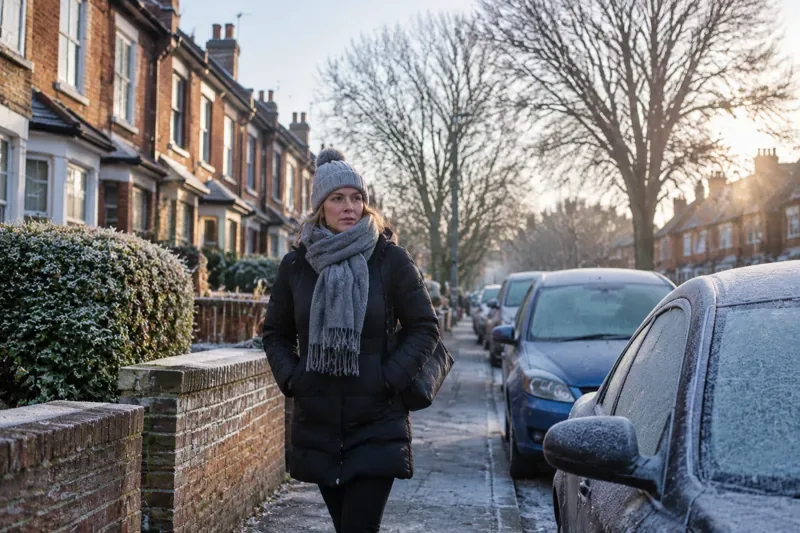
Illustrative image: A frosty residential street reflects the kind of cold conditions households may encounter; this is not a photograph of the November 2026 weather event.
Where is the UK cold-health alert in force, and how long will it last?
UKHSA announced the first yellow cold-health alert of the winter on Tuesday, November 10. Its coverage is limited to the North West and West Midlands regions of England. The alert began at 9 a.m. on November 12 and is scheduled to end at noon on November 14. Throughout those dates, London observes Greenwich Mean Time (GMT, UTC+00:00), so the stated UK times are also the UTC times.
The UKHSA dashboard identifies the North West and West Midlands as yellow; London, the East of England, the East Midlands, Yorkshire and the Humber, the North East, the South East and the South West are not currently under this cold-health alert. The system covers England, so its regional status should not be interpreted as a health-alert map for Scotland, Wales or Northern Ireland. For any subsequent change, readers should use the UKHSA cold-health alert dashboard.
Yellow is a health-risk classification, not a declaration that all residents will experience extreme cold or that schools and transport will close. The alert indicates that adverse weather may cause comparatively limited effects on health and social care services, while increasing risks for people who are particularly vulnerable. UKHSA specifically highlights adults aged 65 and older, people with existing respiratory or cardiovascular conditions, and people sleeping outdoors. See the UK Health Security Agency announcement dated November 10.
What does the Met Office forecast for November 12–16?
In its forecast updated at 04:00 UTC on Thursday, November 12, the Met Office described the overall pattern as cold days and frosty nights for many. Thursday was expected to be generally dry with bright spells, although northern and eastern Scotland faced blustery showers, wintry over high ground. Coastal areas around the North Sea could also see showers. Clearer skies Thursday night could allow widespread frost, with isolated patches of fog in western areas.
Friday, November 13, should bring sunny spells across many parts of England and Wales, with cloudier and showery conditions further north and northwest. The outlook for Saturday through Monday, November 14–16, begins with another cold, frosty morning in many places before conditions turn more unsettled. Rain and hill snow are possible as the pattern changes. These are forecast scenarios and may evolve; they are not confirmation of disruptive snow across the country. The latest regional forecasts are available from the Met Office UK five-day forecast.
Is a polar vortex collapse making the UK colder?
No direct causal link has been established for this episode. In a November 11 analysis, the Met Office said the current colder spell results from developments in the troposphere—the lower atmosphere where day-to-day weather develops. A shift in the position of high pressure is changing prevailing winds and allowing Arctic air to reach Britain.
The polar vortex is a large circulation of winds in the stratosphere, approximately 30 kilometers (about 19 miles) above Earth's surface. The Met Office reported recent stratospheric warming and weakening winds around the vortex, with a brief wind reversal possible. But changes at that height do not necessarily trigger an immediate cold outbreak below; any resulting influence on UK weather can take weeks and is not guaranteed. Forecasts cited by the agency suggested the disruption might be short-lived as December approaches.
This distinction matters for interpreting headlines. An unusually chilly week, frosted vehicles or snow over Scottish hills does not itself establish a polar vortex breakdown. The Met Office analysis published November 11 specifically separates the upper-atmosphere developments from the nearer-term Arctic airflow affecting the UK now.
Is a cold-health alert the same as a Met Office snow or ice warning?
No. The UKHSA/Met Office Weather-Health Alert system assesses potential effects on public health and healthcare services in England. Separately, the Met Office National Severe Weather Warning Service addresses hazards such as snow, ice, rain, wind and fog that could disrupt everyday activities across the UK. A yellow cold-health alert does not automatically mean an official yellow snow warning exists in the same area.
Households should check the Met Office weather warnings for hazards affecting travel and use the UKHSA health dashboard for risk to vulnerable people. This separation is especially important when headlines combine the terms “polar vortex,” “weather warning,” and “health alert,” which are not interchangeable.
Who faces the greatest health risk, and what should households do now?
Low indoor temperatures can worsen existing illnesses and increase strain on the heart and lungs. Older adults, people with long-term health conditions, infants, people with disabilities, and those struggling to afford heating may need additional support. People living alone can also be harder to reach when conditions deteriorate.
The NHS winter health advice advises keeping occupied rooms comfortably warm—at least 18°C (64.4°F) if possible, especially for anyone with a health condition. Wearing several light layers, eating regularly, keeping bedroom windows closed on cold nights, reducing drafts safely, and checking on at-risk neighbors are practical steps. Heating appliances should be used according to safety guidance; indoor combustion equipment should never be improvised as a heating solution.
People who become unwell should seek medical advice promptly from a pharmacist or GP. In England, NHS 111 can help with urgent medical concerns that are not life-threatening; call 999 for an emergency. Those receiving home care or supporting elderly relatives should consider whether regular visits, medication access and heating arrangements will remain adequate during the alert period.
What happens after the alert expires on November 14?
The alert is scheduled to end on Saturday, November 14, at noon GMT, but its expiration is not a guarantee that all cold-weather risks will disappear at that instant. UKHSA can reassess alerts as forecasts and expected health impacts change. The Met Office forecast points toward a shift to wetter, more changeable weather from Sunday into Monday, although some locations may remain cold at times.
The next meaningful developments to watch are any UKHSA extension or change in alert level, updated Met Office regional forecasts, and any separately issued snow or ice warnings. No nationwide cold-health alert or verified immediate polar-vortex-driven freeze was identified in the official information checked for this report.
FAQ: UK cold-weather alert and polar vortex
Has the Met Office issued a nationwide cold-health warning?
No. The yellow cold-health alert announced by UKHSA in partnership with the Met Office covers North West England and the West Midlands, not the whole UK.
When does the current cold-health alert end?
It is scheduled to end on Saturday, November 14, 2026, at 12:00 p.m. London GMT (UTC+00:00; 12:00 UTC), unless the authorities revise it.
Is the polar vortex responsible for the cold spell?
The Met Office says no: the immediate causes are lower-atmosphere pressure and wind changes bringing Arctic air, while the vortex changes higher up are being monitored separately.