Home
» Today
»
Strait of Hormuz Blockade: Tanker Attacks Raise Shipping Risks — November 23, 2026
Strait of Hormuz Blockade: Tanker Attacks Raise Shipping Risks — November 23, 2026
Information checked: November 23, 2026, at 5:26 PM UTC (UTC+00:00). This is a verification timestamp, not the start time of a maritime incident. The Gulf of Oman and Strait of Hormuz use Gulf Standard Time (GST, UTC+04:00) on the Omani side; incident times below are given in UTC where that is how the maritime authority reported them.
The Strait of Hormuz shipping threat remains severe, and a naval blockade targeting Iranian ports is already in force. The Joint Maritime Information Center (JMIC) said in a November 18, 2026 advisory that U.S. forces have enforced a blockade of Iranian ports and coastal areas since July 14. Crucially, the advisory explicitly says the measure does not prohibit neutral transit through the strait to or from non-Iranian destinations. That distinction matters as new attacks on tankers and military encounters bring renewed attention to the critical oil route.
UK Maritime Trade Operations (UKMTO) reported two outbound tankers struck by unidentified projectiles near Khasab, Oman, on November 21 and a separate encounter involving a tanker and military forces in the Gulf of Oman on November 22. These are reported maritime-security incidents, not independently proven evidence that all commercial shipping has stopped. The immediate concern for vessel operators is the combination of an active blockade regime, attacks, possible inspections, and uncertain safe passage.
Destaques
Blockade scope: A U.S. blockade applies to Iranian ports and coastlines; the November 18 JMIC notice distinguishes it from neutral ships transiting to non-Iranian destinations.
Latest incidents: UKMTO reported two tanker strikes on November 21 and another tanker–military encounter on November 22; investigations and damage assessments remain limited.
Threat assessment: JMIC assessed maritime security in the Gulf and Strait of Hormuz as SEVERE on November 18.
Market exposure: The EIA estimated that about 20 million barrels per day of petroleum liquids passed through the strait in 2024; that is historical context, not a verified November 2026 flow measurement.
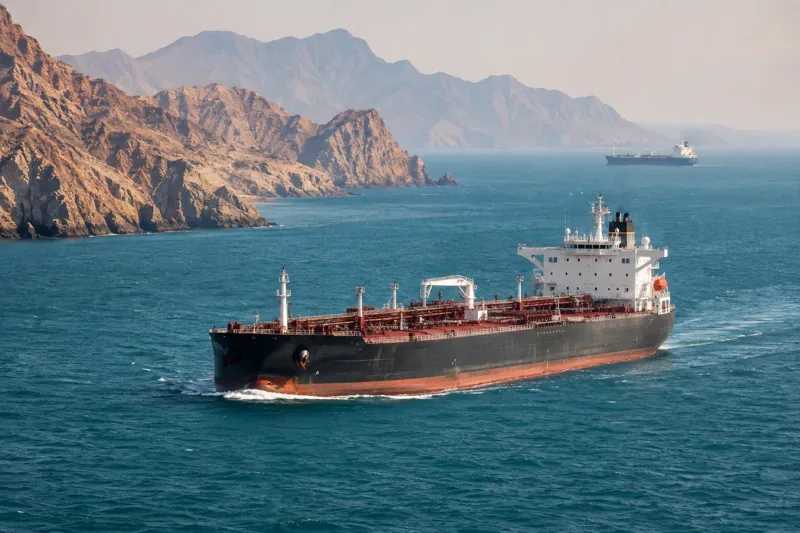
Original illustrative tanker scene representing shipping risks near the Strait of Hormuz. It does not depict a verified November 2026 incident, vessel, or exact location.
What happened in the Strait of Hormuz on November 21–23?
UKMTO warning 215-26 described a tanker hit on its stern by an unknown projectile about 11 nautical miles north of Khasab on November 21 at 05:00 UTC (9:00 a.m. in Khasab, Oman, GST, UTC+04:00). Warning 216-26 described a separate outbound tanker hit in the engine room about 17 nautical miles east of Khasab on November 21 at 05:50 UTC (9:50 a.m. GST). UKMTO said no casualties were reported at the time of either warning, while environmental effects remained unconfirmed. This does not establish the identity of attackers or the full extent of damage.
Advisory 217-26 then reported an incident involving a tanker and military forces in the Gulf of Oman on November 22 at 14:25 UTC (6:25 p.m. GST). UKMTO described an evolving security environment and said relevant investigations continued. As of this check, the incident notices reviewed do not provide enough information to attribute responsibility for these particular events or to calculate total tanker traffic through the strait.
Is the Strait of Hormuz completely blocked?
No universal closure of neutral transit is established by the official U.S. blockade notice. The U.S. Naval Forces Central Command addendum carried in JMIC advisory 017-26 says the blockade covers Iranian ports, coastlines, and oil terminals, regardless of vessel flag, and that vessels suspected of entering or leaving those areas without authorization may be intercepted or diverted. It separately states that neutral passage through the strait to non-Iranian destinations is not impeded by that blockade, although visits and searches may occur. That is the stated policy; it is not a guarantee that any particular voyage will be safe or free from delay.
The November 18 update adds a practical complication: ships receiving cargo through ship-to-ship transfers from vessels covered by the blockade may also be treated as attempting to evade it. For operators, cargo origin and transfer records may matter alongside voyage route. A vessel can face legal or security exposure even without calling at an Iranian port.
How did the blockade begin?
According to the official U.S. maritime addendum distributed by JMIC, enforcement of the current blockade began on July 14, 2026, at 20:00 UTC following an announcement on July 13. The November 18 document is therefore an update to an existing action, not evidence of an entirely new blockade imposed this week. Reports describing all Strait of Hormuz traffic as newly banned on November 23 would misrepresent the distinction in the primary notice.
Why is the shipping risk so important for oil and LNG?
The Strait of Hormuz connects the Persian Gulf with the Gulf of Oman and the Arabian Sea. It is a major route for crude oil, refined products, and liquefied natural gas. In a June 2025 analysis, the U.S. Energy Information Administration estimated that petroleum flows averaged about 20 million barrels per day in 2024, roughly 20% of global petroleum liquids consumption; about one-fifth of global LNG trade also crossed the strait in 2024. These figures describe pre-disruption exposure and must not be mistaken for live 2026 shipping volumes.
The EIA also estimated that 84% of crude oil and condensate and 83% of LNG transiting Hormuz in 2024 went to Asian markets. Even so, U.S. consumers and businesses may feel effects through global benchmark pricing, marine insurance, transportation costs, and supply-chain uncertainty. The direction and size of any retail fuel-price change cannot be calculated from a security alert alone.
Some oil can bypass Hormuz via pipelines in Saudi Arabia and the United Arab Emirates. However, the EIA estimated that spare bypass capacity available in a disruption was about 2.6 million barrels per day at the time of its study. The pipelines are not a like-for-like replacement for all maritime flows, and LNG has different logistical constraints. Those limitations explain why incidents can matter even without a formal shutdown of all vessels.
What changed for shipping companies and crews?
For owners, charterers, insurers, and masters, this is an operational risk rather than simply a question of headlines. The JMIC notice describes a severe threat environment and cautions that mariners may encounter naval activity, hailing by Iranian Revolutionary Guard forces, potential attacks on vessels broadcasting automatic identification system signals, and congestion at anchorages. The advisory calls for close attention to crew safety, communications on VHF Channel 16, and prompt incident reporting.
Ship operators should consult current notices, their flag-state obligations, cargo documentation, war-risk insurance terms, and routing advice. U.S.-flagged vessels can also review the Maritime Administration’s active Persian Gulf, Strait of Hormuz, and Gulf of Oman security advisories. A decision to sail, wait, or reroute depends on a vessel’s itinerary, flag, cargo, and real-time security conditions, which this general article cannot assess.
What could happen next?
Scenario 1: Maritime risks ease
If confirmed attacks subside and authorities establish predictable passage and inspection arrangements, delays and insurance uncertainty could moderate. That would not automatically end the blockade of Iranian ports, and any reopening claim should be checked against a formal change to the relevant notices.
Scenario 2: High-risk but selective passage continues
If neutral voyages continue under tight security while Iranian-related cargoes remain restricted, operators may face higher compliance costs, longer waiting times, and uneven access rather than a single clear closure. This is a conditional scenario, not a confirmed forecast of traffic levels.
Scenario 3: Additional attacks or broader restrictions
Further strikes, seizures, military confrontation, or changed blockade instructions could prompt more carriers to suspend voyages and intensify risk premiums. The scale of any price response would depend on verified losses of supply, inventories, alternative routes, and how long disruption lasts. No specific oil-price target is justified by the currently verified advisories.
What should readers watch for next?
For the next meaningful update, prioritize a revised JMIC blockade advisory, newly numbered UKMTO warnings, a change in the U.S. Maritime Administration’s active advisory list, and shipping or energy-flow data with an explicit observation period. Readers should separate an attack report from an official finding of responsibility, and an anecdotal transit from proof that the route is fully open. The most important unresolved questions are whether the attacks continue, whether inspection rules change, and how merchant shipping actually responds.
Frequently asked questions
Has the entire Strait of Hormuz been closed to shipping?
Not under the wording of the November 18 U.S. blockade update: it targets Iranian ports and coastal areas while allowing neutral passage to non-Iranian destinations, potentially subject to inspection. Actual voyages remain exposed to serious security risk.
Were tankers attacked near Oman in November 2026?
Yes. UKMTO reported two tanker strikes near Khasab on November 21. The reviewed notices did not establish who fired the projectiles.
Could U.S. gasoline prices rise?
They could if disruption materially tightens global fuel supplies or raises transport costs. The maritime reports alone do not quantify a future U.S. gasoline-price increase.