Home
» Today
»
Strait of Hormuz Shipping Disruptions: Oil Prices and Supply Chains, November 23, 2026
Strait of Hormuz Shipping Disruptions: Oil Prices and Supply Chains, November 23, 2026
Information checked: November 23, 2026 at 17:27 UTC (UTC+00:00). Market prices below are intraday snapshots, not closing prices.
The Strait of Hormuz remains a major vulnerability for global energy supplies as the U.S. blockade targeting Iran-related oil exports and shipping security threats continue. On November 23, Iran's foreign ministry said it would confront the U.S. naval blockade. But a restriction on Iranian oil exports is not the same as a complete shutdown of all commercial traffic through the strait, and the economic effects depend on how many barrels can actually move.
There is already measurable disruption. New U.S. Energy Information Administration data released November 16 show oil shipments through Hormuz averaged 9.1 million barrels per day in the third quarter of 2026, versus 21.6 million in the fourth quarter of 2025. Yet oil prices fell during November 23 trading as greater Middle Eastern supplies and a Libyan pipeline restart outweighed immediate security concerns. This is why headlines about a possible blockade do not automatically imply an oil-price spike.
Destaques
Hormuz oil flows averaged 9.1 million barrels a day in July–September 2026, down from 21.6 million in October–December 2025, according to the EIA.
On November 23 at 14:36 UTC, Brent futures were approximately $90.55 per barrel and U.S. WTI about $81.82, both lower on the day; these were not settlement prices.
Pipeline bypasses can move only part of the volumes historically transiting the passage, leaving crude, fuels, and liquefied natural gas exposed.
U.S. drivers and businesses may face higher fuel, freight, and merchandise costs if attacks or restrictions prevent a sustained recovery in shipping.
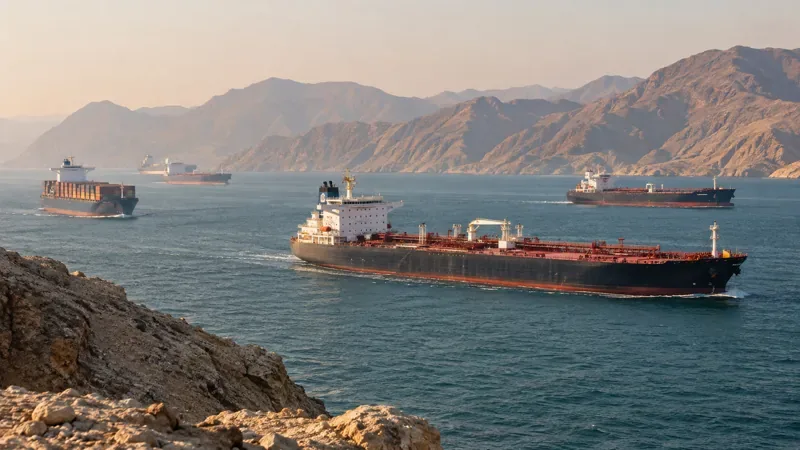
Illustrative, AI-generated maritime scene showing tankers and cargo vessels; not a photograph of an actual November 2026 incident in the Strait of Hormuz.
What changed in the Strait of Hormuz on November 23?
According to Reuters report from November 23, Iran's foreign ministry spokesperson Esmaeil Baghaei said Tehran would use available tools against the U.S. blockade. Reuters reported that the blockade targeting Iran-related exports was introduced April 13, suspended in June, and restored July 14. His comments indicate that the dispute remains unresolved, not that a new universal closure was independently verified on November 23.
Maritime security concerns also extend beyond export restrictions. Ship operators weigh the risk of attacks, inspections, delays, and inability to insure voyages. Lloyd’s List Intelligence transit briefing reported that non-Iranian-linked shipping continued in October despite heightened incidents, illustrating how selective movements and a severely disrupted regional oil market can coexist.
How much oil and LNG normally passes through the Strait of Hormuz?
The strait connects the Persian Gulf to the Gulf of Oman and the Arabian Sea between Iran and Oman. According to the IEA Strait of Hormuz factsheet, roughly 20 million barrels of crude and refined petroleum products crossed it each day in 2025, around one-quarter of seaborne oil trade. Much of that trade served Asian refineries, but oil is priced globally, so supply losses affect buyers elsewhere.
These are quarterly averages, not ship-count estimates for November 23. The steep reductions also reflect a prolonged conflict and cannot be attributed to any single day's announcement.
Would a tighter blockade send Brent and WTI oil prices higher?
A more effective, prolonged interruption would generally put upward pressure on oil prices by cutting available cargoes and forcing refiners to compete for replacement barrels. However, a warning or isolated incident may cause only a temporary risk premium. Prices also respond to demand, inventories, producer output, and the ability of cargoes to reach buyers by alternative routes.
For example, Reuters oil market report from November 23 reported Brent futures at $90.55 and WTI futures at $81.82 at 14:36 UTC on Monday, November 23, even as maritime threats persisted. Increased Middle Eastern oil availability and a restart of Libya's Sharara pipeline helped offset fears. These figures describe a particular trading moment and should not be used as a live quote.
In its November outlook, the EIA November Short-Term Energy Outlook expected Brent spot prices near $100 per barrel in November and December under its then-current assumptions. That is a conditional agency forecast, not a guarantee, and it differs from an intraday futures quote. A new, durable flow disruption could invalidate the assumptions; better export access could reduce the risk premium.
Can pipelines or other shipping routes replace Hormuz?
Only partially. The IEA estimates 3.5 million to 5.5 million barrels per day of potentially available crude export capacity on pipelines through Saudi Arabia to the Red Sea and through the United Arab Emirates to Fujairah, outside the strait. Infrastructure capacity does not mean every producer can use it or that suitable vessels, terminals, and onward routes are immediately available.
Routing ships around Africa is not a straightforward substitute for Hormuz: vessels carrying cargo from ports inside the Persian Gulf still need to exit the gulf first. Alternative suppliers, inventory releases, shipping diversions, and reduced consumption can cushion the disruption, but each has cost, timing, or volume limits. LNG faces additional constraints because gas cargoes require specialized liquefaction, carriers, and regasification terminals.
How could a blockade affect U.S. gasoline, diesel, and supply chains?
The U.S. produces substantial oil domestically, but American fuel prices are not isolated from the world market. A sustained rise in global crude benchmarks can flow into wholesale gasoline, diesel, and jet fuel, although retail changes depend on refinery margins, regional regulations, taxes, inventories, and seasonal demand. Diesel is particularly relevant to trucking, farming, construction, and distribution.
For companies, the first effects may be higher war-risk insurance, tanker charter costs, and uncertain arrival times. Petrochemical feedstocks derived from oil and gas feed into plastics, packaging, textiles, and industrial inputs. LNG disruptions can also increase power and manufacturing costs in importing economies, indirectly affecting the prices of goods shipped to the United States.
Effects are unlikely to be uniform. Some sellers may absorb higher costs temporarily; firms with fixed freight contracts may feel them later. A delay in a specialized component could matter more for a manufacturer than a broad change in a freight index.
What should households and businesses do next?
Households: Watch local gasoline prices and fuel spending trends rather than reacting to a single oil headline. Avoid assuming that a futures price move will translate directly into the same percentage change at the pump.
Importers and manufacturers: Ask carriers about actual sailing status, insurance exclusions, revised lead times, and whether suppliers have inventory outside the Persian Gulf.
Fleet managers: Review diesel budgets, fuel surcharge provisions, and contingency routes; distinguish temporary volatility from a months-long change in costs.
Decision-makers: Track confirmed tanker movements, port throughput, official maritime security notices, the EIA's oil data, and any changes to Saudi or UAE pipeline exports.
What happens next if Hormuz traffic deteriorates?
Three conditional outcomes matter. Partial stabilization would allow additional voyages and reduce freight uncertainty, potentially easing crude-price premiums. Intermittent attacks or inspections could keep costs high even if some tankers pass, creating uneven fuel and delivery impacts. A sustained, broad closure would risk much larger crude, product, and LNG shortages than available bypass routes could replace, likely compelling inventory drawdowns and demand reductions.
None of these scenarios is certain as of this information check. The practical indicator is not the number of alarming statements but whether measured energy exports and commercial sailing activity improve or worsen over successive weeks.
FAQ
Is the Strait of Hormuz completely closed?
No complete closure of every vessel was independently established by the sources checked for this article. Restrictions, attacks, and severe disruption have coexisted with some continuing vessel movements.
Why could gasoline prices rise in the United States?
Oil is priced in a global market. A durable loss of internationally traded crude can raise refinery input costs and eventually fuel prices, even when the U.S. imports relatively little directly through Hormuz.
What is the best indicator to monitor?
Watch sustained changes in verified oil and LNG flows, ship traffic, freight and insurance conditions, and the Brent benchmark together; no single headline or price quotation captures the full supply-chain impact.