Information checked: November 24, 2026, at 9:21 p.m. Pacific Standard Time (UTC−08:00), or November 25 at 5:21 a.m. UTC.
Voyager 1 reached one light-day from Earth on Nov. 18, 2026, at 2:16:07 a.m. Pacific Standard Time (UTC−08:00), or 10:16:07 UTC. The milestone means that a radio signal now takes about 24 hours to travel one way between Earth and the spacecraft. A command sent from Earth cannot get an immediate answer: the spacecraft’s reply also needs about a day to return, so the signal travel alone adds roughly two days to a command-and-response cycle.
That delay changes how engineers plan operations. They cannot steer Voyager 1 with real-time joystick commands or watch a maneuver unfold live. They send carefully checked instructions, wait for the signal to arrive, and then wait again for telemetry to cross the same distance. NASA’s latest mission-specific status report reviewed for this article, published Nov. 19, said the probe was still transmitting a carrier signal but had not returned science or engineering data since Nov. 14. That report did not identify a confirmed cause.
Destaques
- One light-day is a distance: about 16.1 billion miles (25.9 billion kilometers), not the time Voyager took to get there.
- At that distance, a radio message takes about 24 hours each way; a round trip takes about 48 hours of signal travel.
- NASA’s Deep Space Network uses antenna complexes in California, Spain, and Australia to communicate with distant spacecraft as Earth rotates.
- NASA reported a carrier signal but no science or engineering data after Nov. 14; the cause was still under investigation in the latest report reviewed.
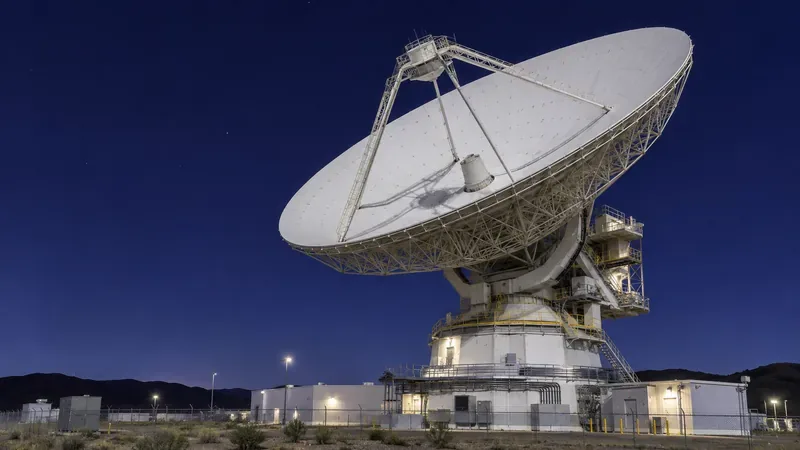
Illustrative photograph of an Earth-based deep-space radio antenna; it is not a picture of Voyager 1 or a specific NASA tracking site.
What does “one light-day away” mean?
A light-day is the distance light travels through a vacuum in 24 hours. NASA gives that distance as about 16.1 billion miles (25.9 billion kilometers). The phrase describes how far away Voyager 1 is, not how long the spacecraft spent traveling. Launched in 1977, the probe took more than 49 years to reach this distance from Earth.
Radio waves are electromagnetic waves and travel at light speed through space. So when NASA says Voyager 1 is one light-day away, the simplest communication consequence is a one-way signal delay of about a day. NASA confirmed the milestone using the spacecraft’s carrier signal and trajectory calculations. The probe crossed the distance threshold on Wednesday, Nov. 18, at 2:16:07 a.m. PST in California (UTC−08:00), which was 10:16:07 UTC that same day. NASA’s Jet Propulsion Laboratory received the signal about 24 hours after the milestone.
The distance is vast, but it is still a small scale compared with interstellar distances measured in light-years. A light-year is the distance light travels in a year. A light-day is one 365th of that distance. Voyager 1 entered interstellar space in 2012 after crossing the heliosphere, the bubble of solar particles and magnetic fields surrounding the Sun.
How does the delay affect commands and replies?
Suppose flight controllers transmit a command to Voyager 1. Even if the radio message travels at light speed, it takes around 24 hours to reach the probe. If Voyager receives it and sends a response immediately, that response takes about another 24 hours to reach Earth. The unavoidable travel time is therefore close to 48 hours before engineers can receive a reply. Scheduling, processing, and the time needed for the spacecraft to carry out the command can add more time.
This is why deep-space operations rely on planning rather than conversational back-and-forth. Teams must anticipate what the spacecraft should do, verify command sequences before sending them, and make sure the craft can safely handle expected conditions while Earth is out of contact. The spacecraft has onboard systems that monitor its condition and can respond to certain faults without waiting for a human operator. Engineers then use delayed telemetry to understand what happened and decide what to do next.
A larger antenna on Earth can help collect a faint signal, and a better communication plan can improve when ground stations listen. Neither can make a radio wave travel faster than light. The delay is caused by distance, not by a slow computer or a crowded phone network.
How does NASA receive Voyager 1’s signal?
NASA’s Deep Space Network, or DSN, is an international system of large radio antennas. Its complexes are near Goldstone, California; Madrid, Spain; and Canberra, Australia. Their positions around the globe let one site take over as Earth rotates and a spacecraft moves out of view from another site. The network tracks many missions, so contact with Voyager depends on scheduled antenna time as well as the physics of signal travel.
Communication includes both an uplink from Earth, carrying commands, and a downlink from the spacecraft, carrying telemetry and science. “Telemetry” is information about the spacecraft’s condition, such as instrument readings or engineering measurements. A carrier signal is a detectable radio transmission, but it is not the same thing as receiving the packaged science and engineering data mission teams want to analyze.
In its Nov. 18 mission update, NASA said a DSN antenna in Canberra had locked onto Voyager 1’s carrier signal, but the probe was no longer sending science and engineering data after Nov. 14. NASA explained that the signal indicated the spacecraft’s pointing control and radio transmission were functioning, while the absence of data suggested a problem in the onboard process that collects and formats information. That was an initial assessment, not a final diagnosis. The team was also investigating whether the issue was related to a brief communications gap in October. No connection had been confirmed in that update.
Does the milestone mean Voyager 1 has stopped working?
No. The one-light-day milestone is a distance marker, not a system failure or a change the spacecraft can feel. NASA reported that the carrier signal was still present when it confirmed the milestone. The reported data interruption is a separate technical issue, and the public update reviewed here did not establish its cause or outcome. It would be inaccurate to say that the milestone itself caused the interruption.
Voyager’s age and limited power do make every technical issue challenging. The probes have operated for nearly five decades, and NASA has been turning off equipment and changing operations to conserve electrical power. The team has also solved difficult computer and communications problems before, but a past fix does not prove that the current issue has the same cause.
What will change as Voyager 1 moves farther away?
The one-way delay will continue to grow as Voyager 1 travels farther from Earth. That means slower troubleshooting, longer waits for confirmation, and a greater need for autonomous spacecraft behavior and carefully designed commands. It does not mean NASA must stop communicating as soon as the probe passes this marker. Continued contact depends on the spacecraft’s remaining power and equipment, the faintness of its signal, and the capabilities and availability of the Deep Space Network. NASA has not given a guaranteed date for the end of Voyager 1 communications.
For space exploration more broadly, the lesson is practical: missions to distant destinations need systems that can operate safely without immediate ground control. At Mars, radio delays vary with planetary positions and can reach tens of minutes one way. Voyager’s roughly day-long delay makes the same constraint more pronounced. Future probes sent farther still will need robust automation, fault protection, and plans that account for long periods without new instructions.
The milestone is therefore both a striking measure of distance and a reminder of how communications shape exploration. Voyager 1 can still be reached by radio, but Earth and the spacecraft no longer share anything like real-time contact. Every exchange is a message sent into the past, followed by a long wait for the answer.
Sources: NASA’s Nov. 19 milestone announcement; NASA Science’s Nov. 18 engineering update and light-day explainer; and NASA’s Deep Space Network overview.
FAQ
How long does a message take to reach Voyager 1?
About 24 hours one way at the one-light-day distance. A reply takes roughly another 24 hours to return.
Does one light-day mean Voyager traveled that distance in one day?
No. A light-day is a distance, not Voyager’s travel time. The spacecraft took more than 49 years to reach it from Earth.
Was Voyager 1 returning science data when NASA confirmed the milestone?
NASA’s Nov. 19 announcement said the spacecraft had not sent science or engineering data since Nov. 14, although its carrier signal was present. The cause was still under investigation in the latest mission update reviewed for this article.