Home
» Today
»
Voyager 1 Reaches One Light-Day From Earth as NASA Details Data Gap | Nov. 24, 2026
Voyager 1 Reaches One Light-Day From Earth as NASA Details Data Gap | Nov. 24, 2026
Information checked: November 24, 2026, at 9:22:51 p.m. Pacific Standard Time (UTC−08:00), corresponding to November 25, 2026, at 5:22:51 a.m. UTC. NASA says Voyager 1 crossed the one-light-day mark on November 18; the check time is not the event time.
NASA has confirmed that Voyager 1 became the first human-made object to reach a distance of one light-day from Earth: about 16.09 billion miles (25.90 billion kilometers). The milestone occurred Wednesday, November 18, 2026, at 2:16:07 a.m. Pacific Standard Time (UTC−08:00), or 10:16:07 a.m. UTC. NASA announced the confirmation the following day, after the probe’s signal had taken roughly 24 hours to reach Earth.
The achievement arrives amid a technical issue. In its November 19 status release, NASA said the spacecraft had not returned science or engineering data since November 14, although it continued transmitting a carrier signal. Mission engineers used that signal with trajectory calculations to confirm the distance milestone. NASA said its team was analyzing the data issue; the latest status statement located for this report does not confirm that normal data transmission has resumed.
Highlights
Voyager 1 reached one light-day from Earth on Nov. 18, 2026, at 10:16:07 UTC, according to NASA.
One light-day is a distance of about 16.09 billion miles (25.90 billion kilometers), not a duration of travel.
NASA’s Nov. 19 update said the probe’s carrier signal was present but science and engineering data had not arrived since Nov. 14.
The milestone sets no new physical boundary in space; it marks the extraordinary scale of the mission and the long signal path between Earth and the spacecraft.
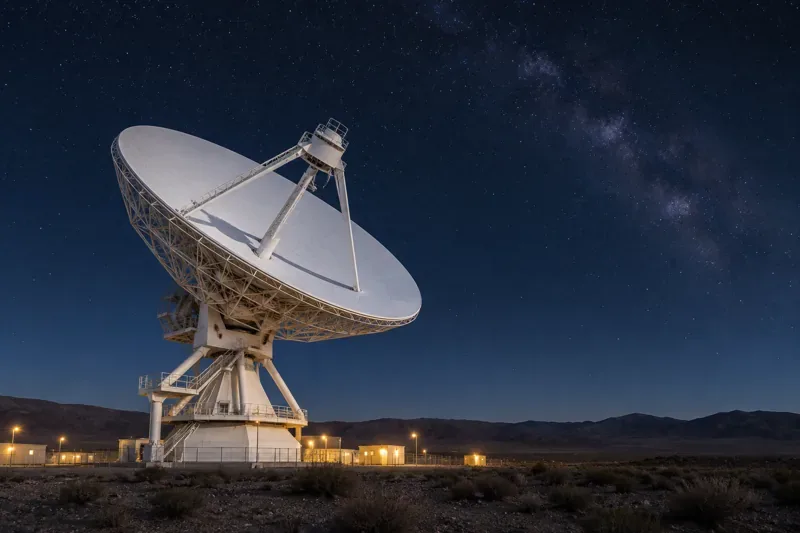
Illustrative photograph of a deep-space communications antenna beneath a night sky; it does not depict Voyager 1 or a specific NASA facility.
When did Voyager 1 reach one light-day from Earth?
NASA’s Voyager mission page gives the milestone time as 5:16:07 a.m. Eastern Standard Time on Wednesday, November 18, 2026. That is 10:16:07 UTC and 2:16:07 a.m. Pacific Standard Time on the same date. The spacecraft is far beyond Earth, so it has no local civil time zone; these are Earth-based timestamps reported by NASA. The agency’s initial news release rounded the time to 2:16 a.m. PST.
NASA defines a light-day as the distance light travels in 24 hours. Its Voyager explainer lists that distance as 16,094,799,096 miles (25,902,068,356 kilometers). Because radio signals travel at the speed of light, the milestone also means that a message sent from Earth takes about one day to reach Voyager 1, and a reply takes about another day to return. The date of the milestone is based on the probe’s position and trajectory, not on when the mission team received the confirmation signal.
What changed in NASA’s latest Voyager 1 update?
The major confirmed development is that the predicted milestone has now been reached and verified. Before the crossing, NASA said the team would use the spacecraft’s carrier signal and trajectory calculations to confirm it. The Nov. 19 announcement reported that the signal reached the Jet Propulsion Laboratory about 24 hours after the spacecraft passed the mark.
NASA also disclosed that Voyager 1 had stopped returning science and engineering data on November 14. A NASA Deep Space Network antenna in Canberra, Australia, had detected the carrier signal, which is the radio transmission used to carry the probe’s data, but the data itself was missing. NASA said that signal indicated the spacecraft’s antenna and broadcast equipment were still operating and its attitude-control computer was keeping it pointed toward Earth. The agency said the missing data suggested a problem with the onboard computer that collects and formats information, but described this as an indication under investigation, not a confirmed cause.
As of the NASA material located for this report, no later official update confirmed a fix or the return of the missing science and engineering data. The distinction matters: Voyager 1’s distance milestone is verified, while the status and cause of the data interruption remain subject to NASA’s investigation. This article does not infer a repair from the fact that the carrier signal was received.
Why is the one-light-day milestone historic?
Voyager 1 has traveled for more than 49 years since its 1977 launch and remains the most distant human-made spacecraft. A light-day is a familiar way to express a vast distance in terms of how long light takes to cross it. The marker is about 25.9 billion kilometers from Earth—roughly 173 times the average distance between Earth and the Sun. It is a record for human-made objects, not a new boundary where one region of space suddenly becomes another.
Voyager 1 crossed the heliopause in 2012 and entered interstellar space, the region beyond the Sun’s heliosphere. Its twin, Voyager 2, followed a different path and crossed into interstellar space in 2018. The probes continue to provide measurements from beyond the Sun’s protective bubble, where scientists can study the magnetic field and particles in the surrounding interstellar environment. NASA notes that Voyager 2 is expected to reach one light-day from Earth in November 2035.
The mission also reflects decades of engineering work on spacecraft designed long before today’s electronics. NASA has been conserving electrical power as the probes’ radioisotope power sources age. Voyager 1 and Voyager 2 carry the Golden Record, a gold-plated copper record containing sounds and images from Earth. These mission facts give the distance marker scientific and historical context, while the present data interruption remains a separate operational concern.
What happens next for Voyager 1?
NASA’s latest public statement says engineers are analyzing why data stopped arriving and what steps to take. Because each radio transmission takes about 24 hours to travel one way, troubleshooting commands and evaluating results operate on a long feedback loop. The Nov. 19 release referred to a similar 2023 episode in which a spacecraft computer problem caused garbled data and was eventually addressed, but it did not confirm that the current issue has the same cause or solution.
NASA continues to describe the Voyager mission as operating far beyond its original expected lifetime. The next meaningful update would be a mission statement confirming either the return of usable science and engineering data or a specific diagnosis and recovery plan. Until then, the accurate summary is that the one-light-day achievement is confirmed, the carrier signal was present in NASA’s report, and the data problem was still under analysis in the latest status statement located.